Claude for Ecommerce: The AI That Finally Knows Your Store
Claude arrives fluent in ecommerce and blind to your own store: your Shopify orders, your ad accounts, your retail and wholesale channels, your definitions. This guide covers what it can already do, what it cannot do alone, and how to bridge that gap fast.
Connect PolarWhat Is Claude for Ecommerce?
Claude is a large language model built by Anthropic. “Claude for ecommerce” is not a separate product. It is what happens when you give that model access to your commerce data and a job to do.
Claude is trained on the public internet, not on your store
A large language model learns from text: books, code, documentation, the open web. Claude has read a great deal about ecommerce. It knows what contribution margin is, how a Klaviyo flow works, why prospecting ROAS and retargeting ROAS are not comparable. What it has never seen is your orders, your spend, your margins or your returns. None of that is public, and none of it is in the model.
It is worth being precise about the vocabulary, because the marketing around it is not. There is no separate “Claude for ecommerce” product to buy. There is one Claude, and there is the question of what you have given it access to. Everything people mean by the phrase is downstream of that.
This is why a generic question gets a generic answer. Ask Claude why your ROAS dropped and it will explain the usual causes, correctly, without knowing which one applies to you. The knowledge is real. The context is missing.
What changes when Claude reads your own commerce data
Connect your data and the same model stops teaching and starts diagnosing. The question does not change. The answer does.
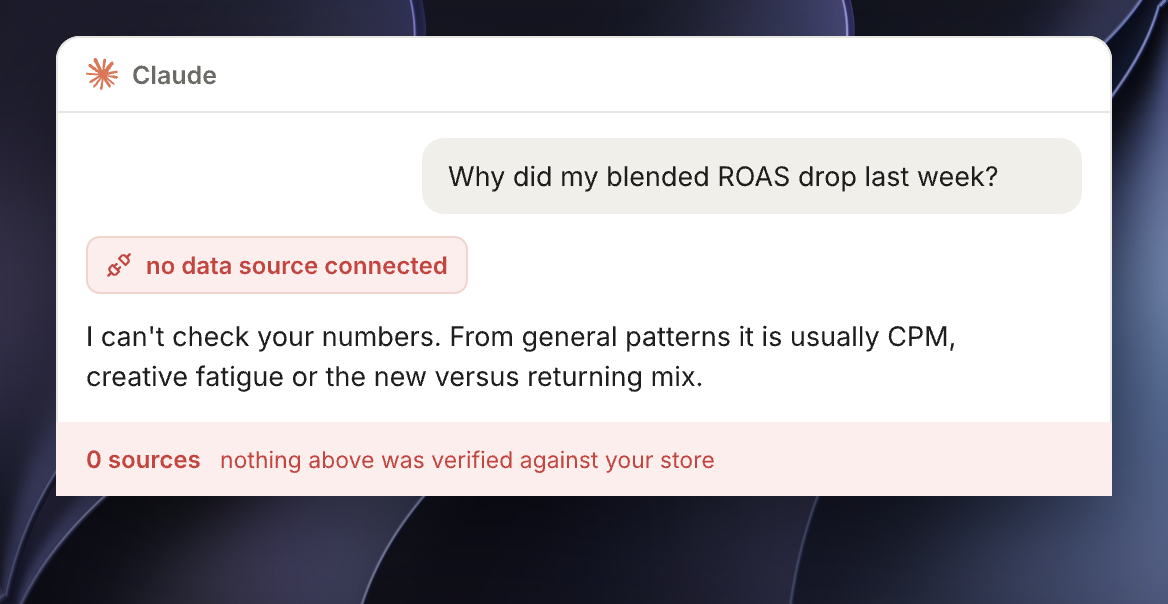
Claude with no data access
“Blended ROAS usually drops for one of these reasons: rising CPMs, creative fatigue, a shift in the new versus returning mix, or a tracking change. Check your prospecting campaigns first.”
Claude reading your data
“Blended ROAS fell 18% week over week. 92% of the drop comes from Prospecting-US, where CPM rose 34% while conversion rate held. Returning-customer ROAS is flat. Three ad sets account for most of it.”
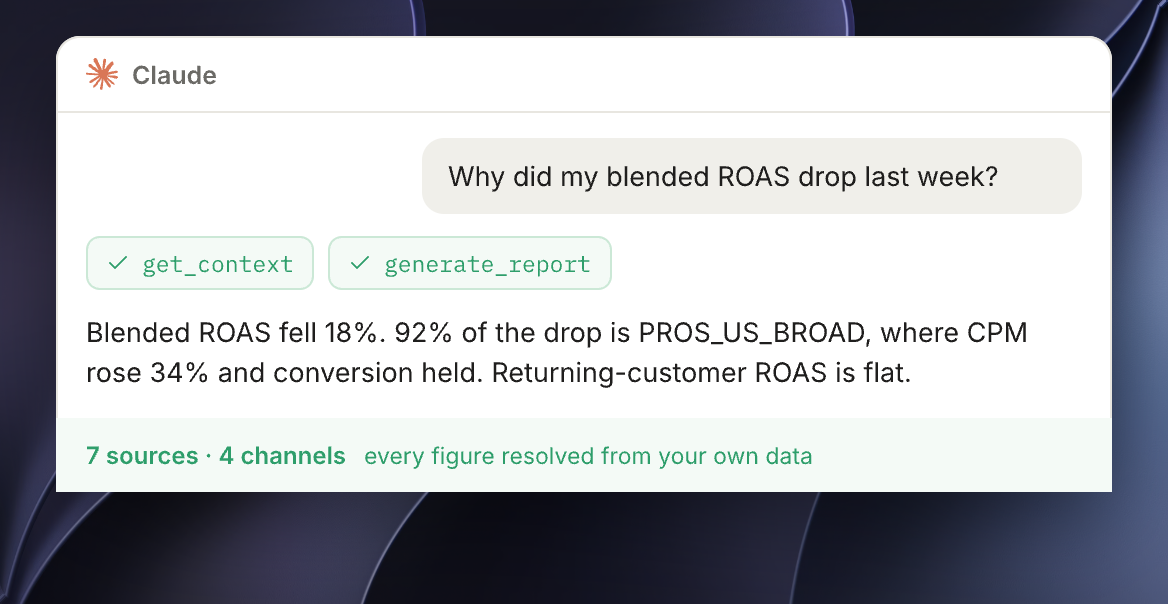
Same model, same prompt, one difference: the second Claude can see the numbers. Everything else on this page follows from that.
What Claude Can Do Across Your Ecommerce
Eight jobs your team runs every week, each one Claude can take the first pass at. It reads the data, proposes the answer, your team decides what ships. One model plus your data: connect it once and the same assistant covers all eight.
Media buying: ad performance down to the creative
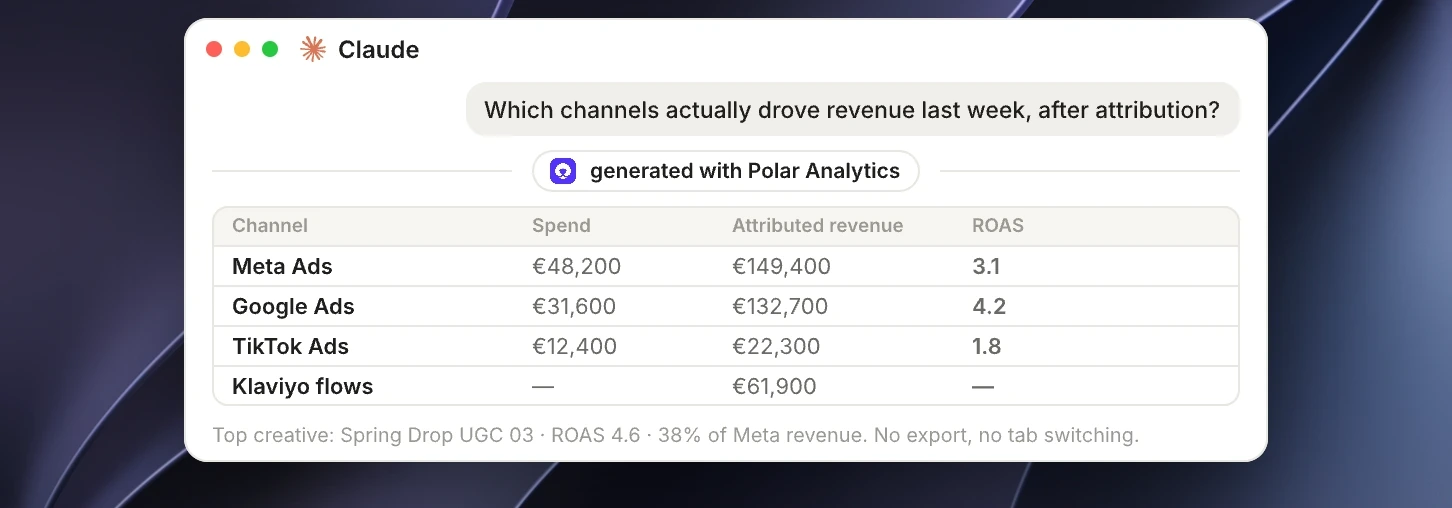
Spend, ROAS and creatives across every platform, in one answer.
Creative: the pattern behind your winners
It does not make the asset. It finds what your winners share and writes the brief.
Analytics: cohorts, LTV and the Monday brief
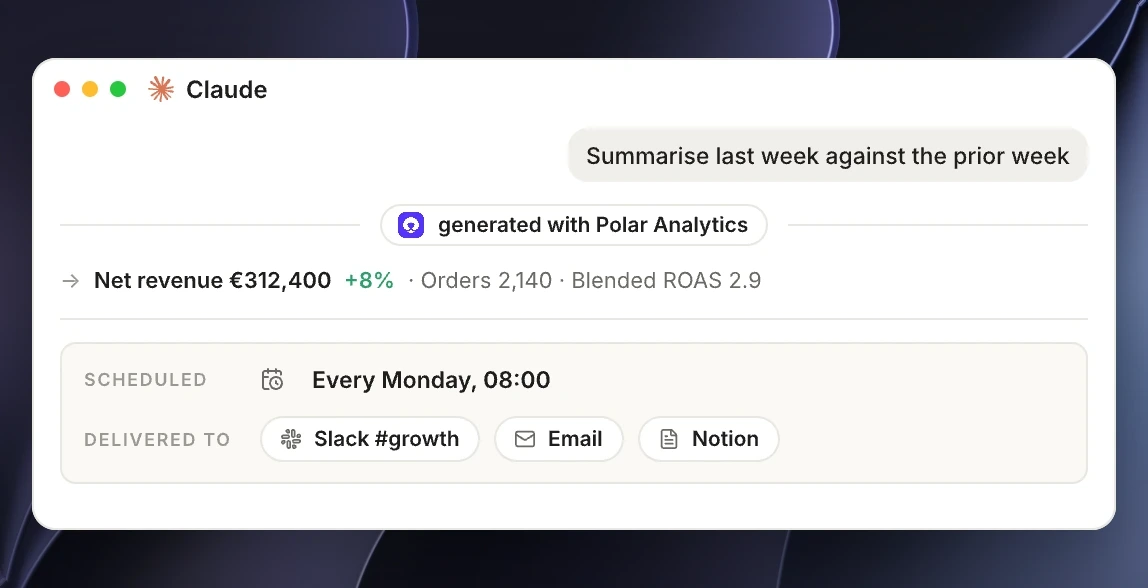
The question you ask today, and the Monday brief that arrives before anyone asks.
Copywriting: copy written against conversion data
Landing pages and emails rewritten where conversion data says it hurts.
Attribution: where your platforms disagree
Where your platforms disagree, by how much, and what it changes.
Inventory and merchandising: days of cover before the stockout
Velocity, stock and the lead time you set, in one reorder and markdown list.
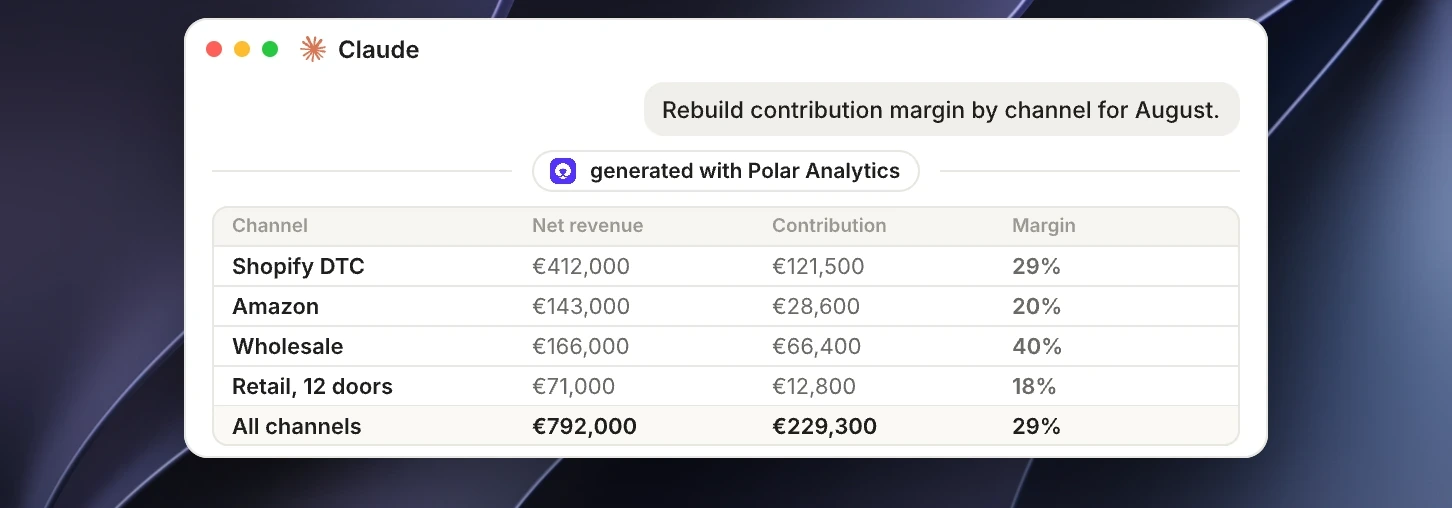
Finance: contribution margin by channel
Contribution margin by channel and product, on your definition of net revenue.
Support and CX: return rates and ticket patterns by SKU
Which SKUs drive returns, and which ticket theme is growing.
What Claude Cannot Do Alone for Your Store
Four honest limits. None of them are solved by a better model, and knowing that is what separates a setup people keep from one they drop.
It does not spend your budget
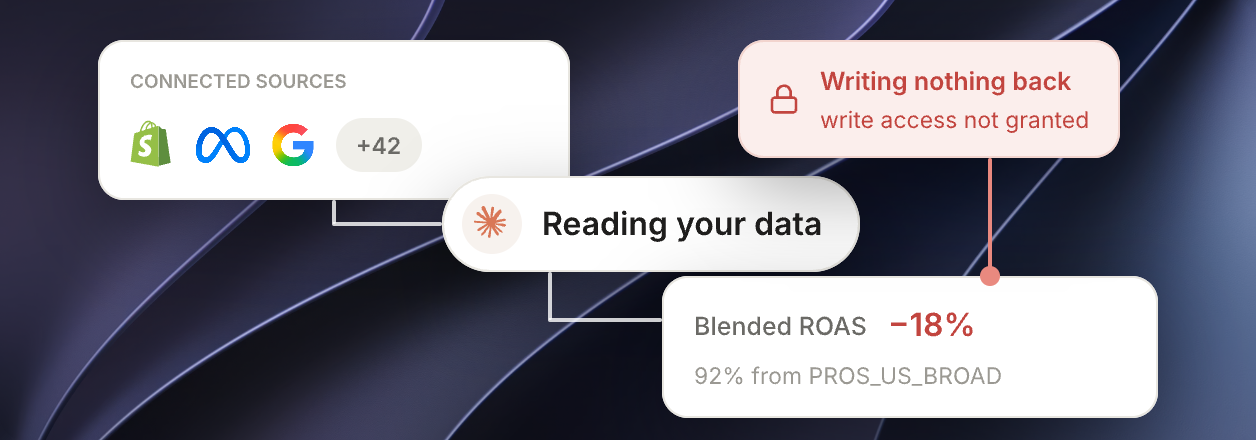
We grant read access only. Claude can tell you which ad sets to pause and draft the change. It has no ability to push it. Write access is a separate, deliberate grant.
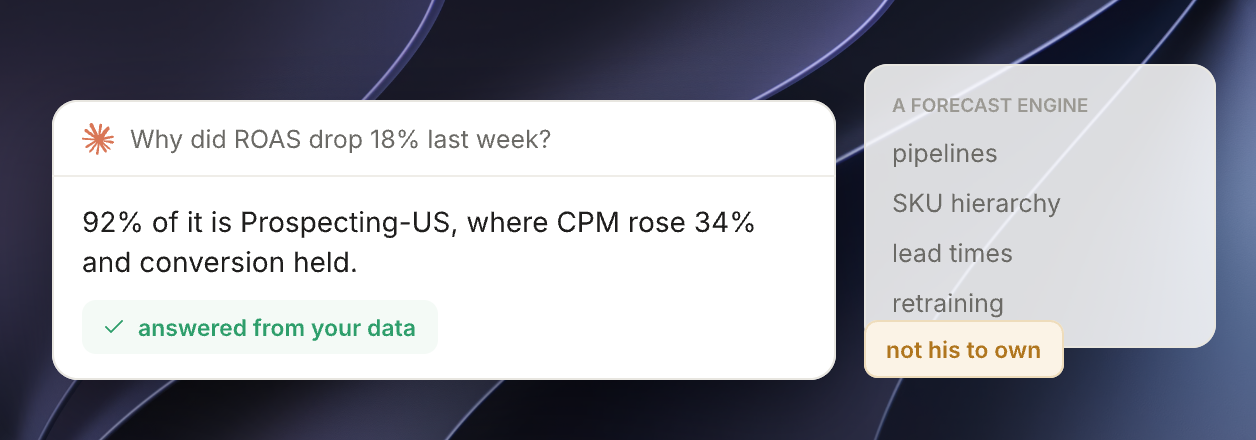
It is not a forecasting engine
Claude diagnoses and drafts well, and it can write the code that produces a forecast. What it does not replace is a demand planning system: the pipelines, the SKU hierarchy, the lead times, the retraining. Use it to interrogate a forecast, not to own one.
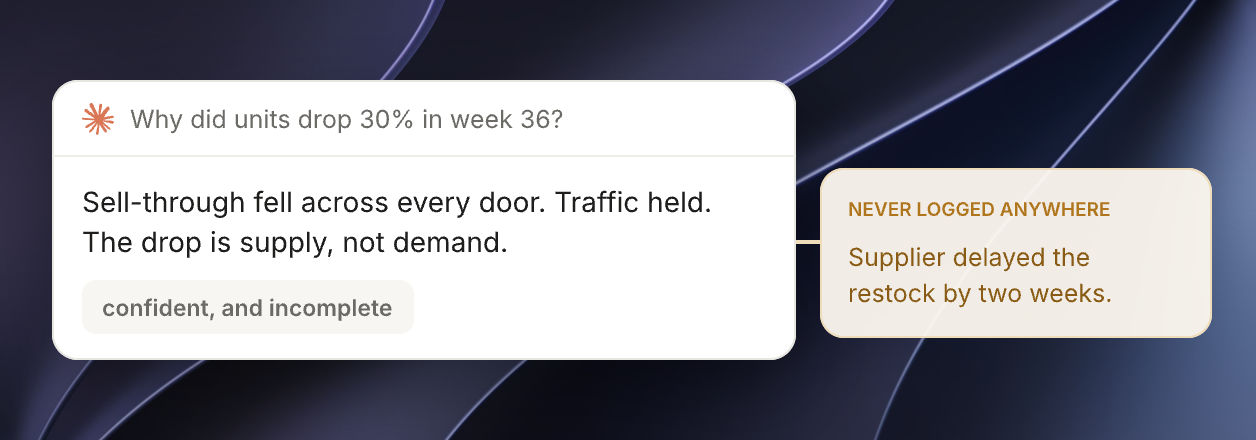
It misses what is not in the data
A supplier delay, a competitor’s promotion, a decision your team took in a meeting: none of it is in the warehouse. Claude will explain a 30% drop with what it can see, confidently, and miss the actual reason. The fix is not a better model, it is telling it what happened.
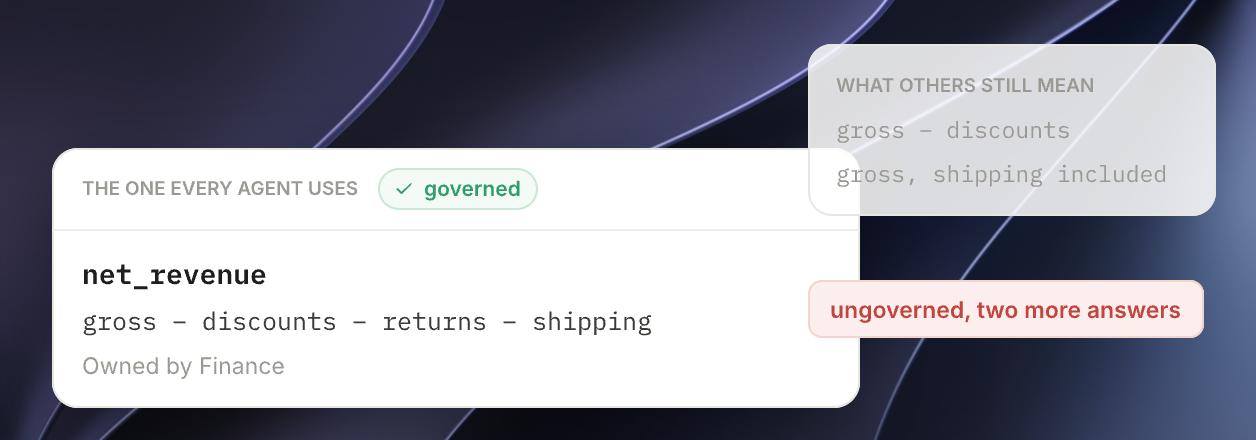
It inherits your definitions
Every capability on this page depends on the metrics being defined once and governed. Without that, Claude is a fast way to get a plausible number, which is worse than a slow way to get a correct one.
Why Claude Alone Isn't Enough
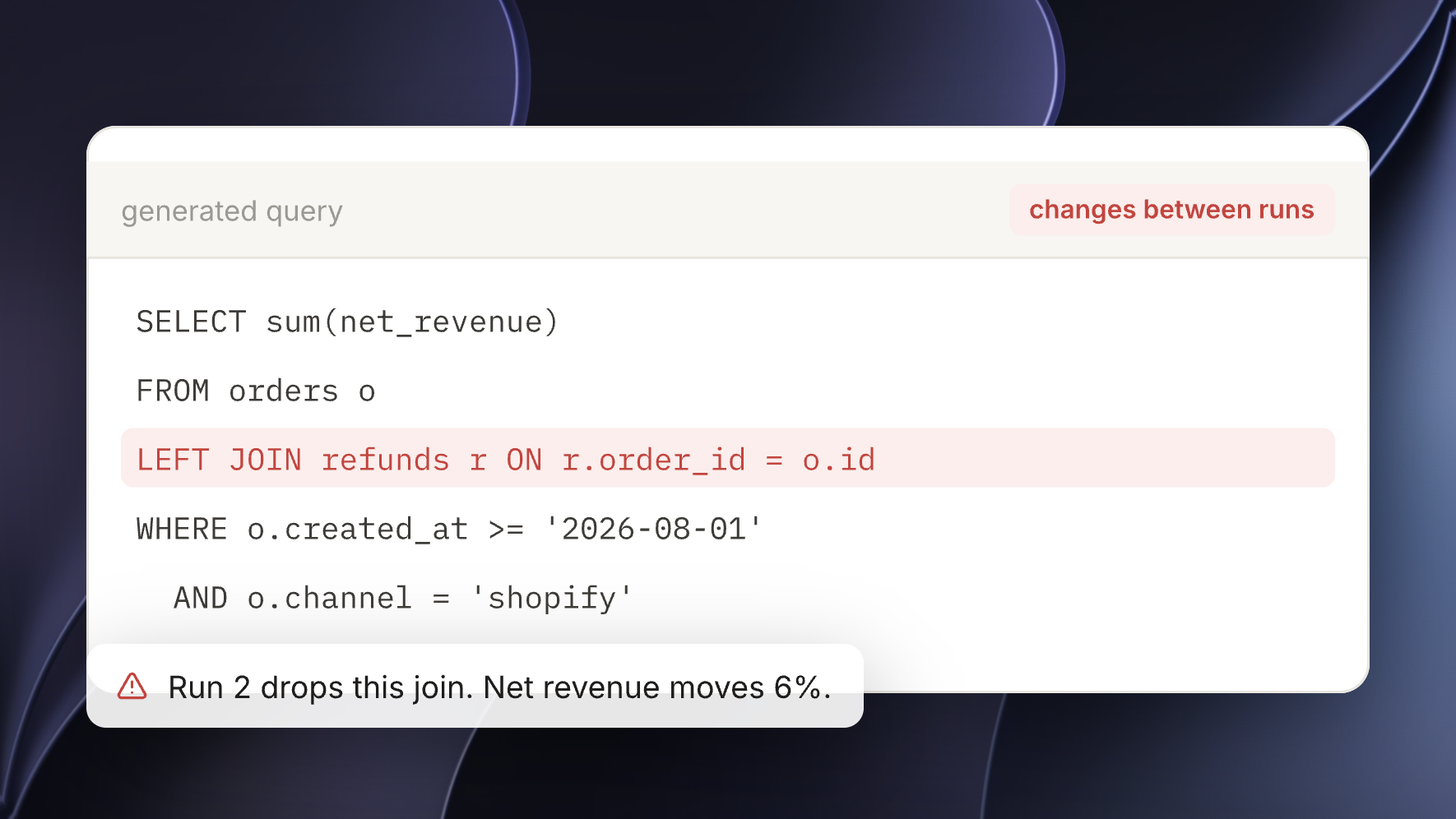
Point an LLM at an ungoverned warehouse and it answers confidently, plausibly, and differently every time you ask.
Raw Shopify data is ungoverned by default
Same query, three different SQL interpretations. Without structured modeling, queries shift and return drifting numbers.
Five definitions of ROAS, zero automatic fix
Your financial lead and your ad strategist don’t mean the same thing by ‘gross sales.’ Without preset definitions, numbers clash.
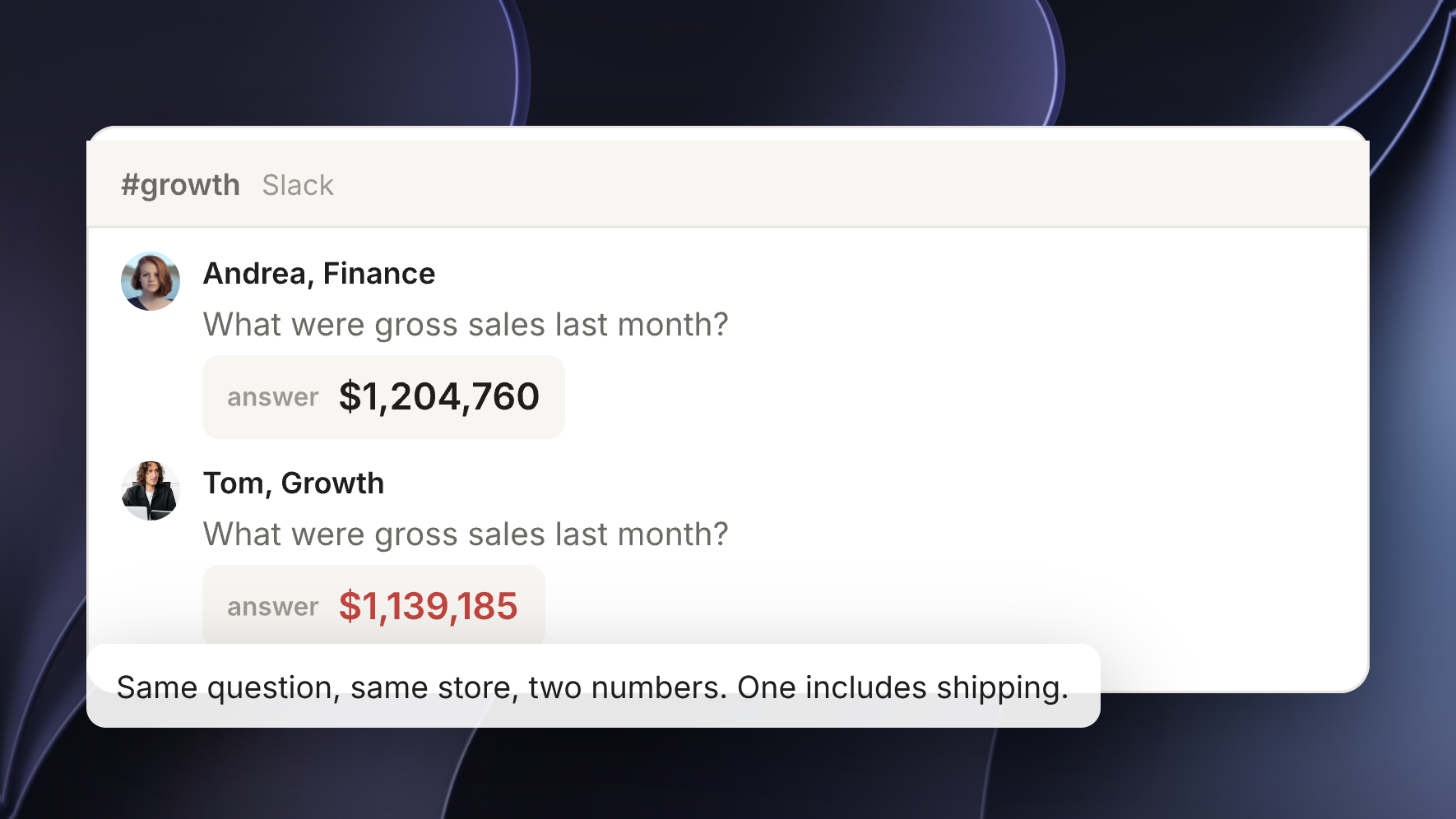
Why a semantic layer matters
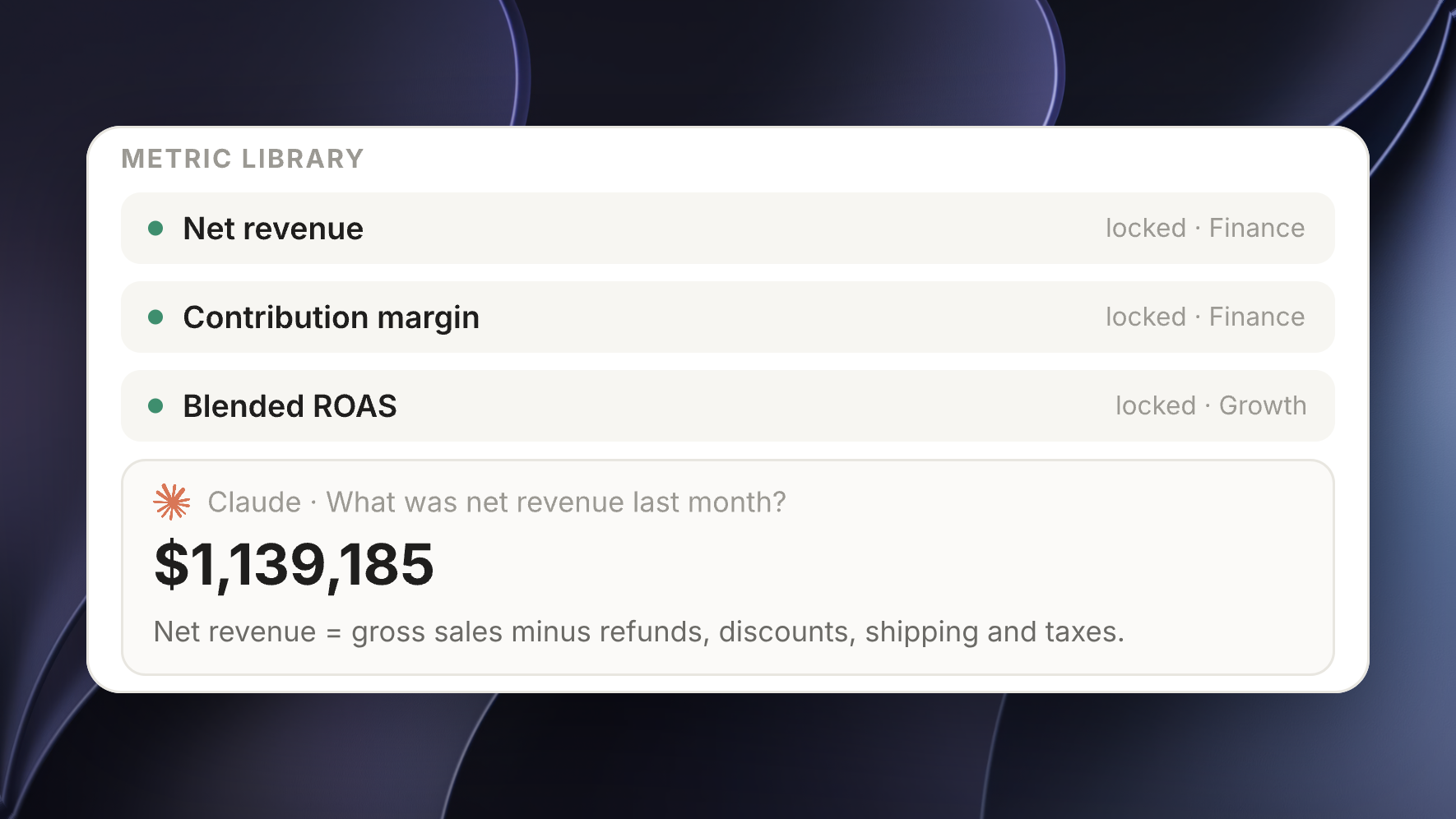
Align metrics once. Under a governed model, Claude operates with fixed parameters. Net Revenue is locked. Blended CAC stays clean.
How to Connect Claude to Your Ecommerce Data
Three ways to get your data in front of Claude. They differ on one thing that matters: whether a single question can cross more than one source. The rest is how much you build and maintain yourself.
With Native connectors
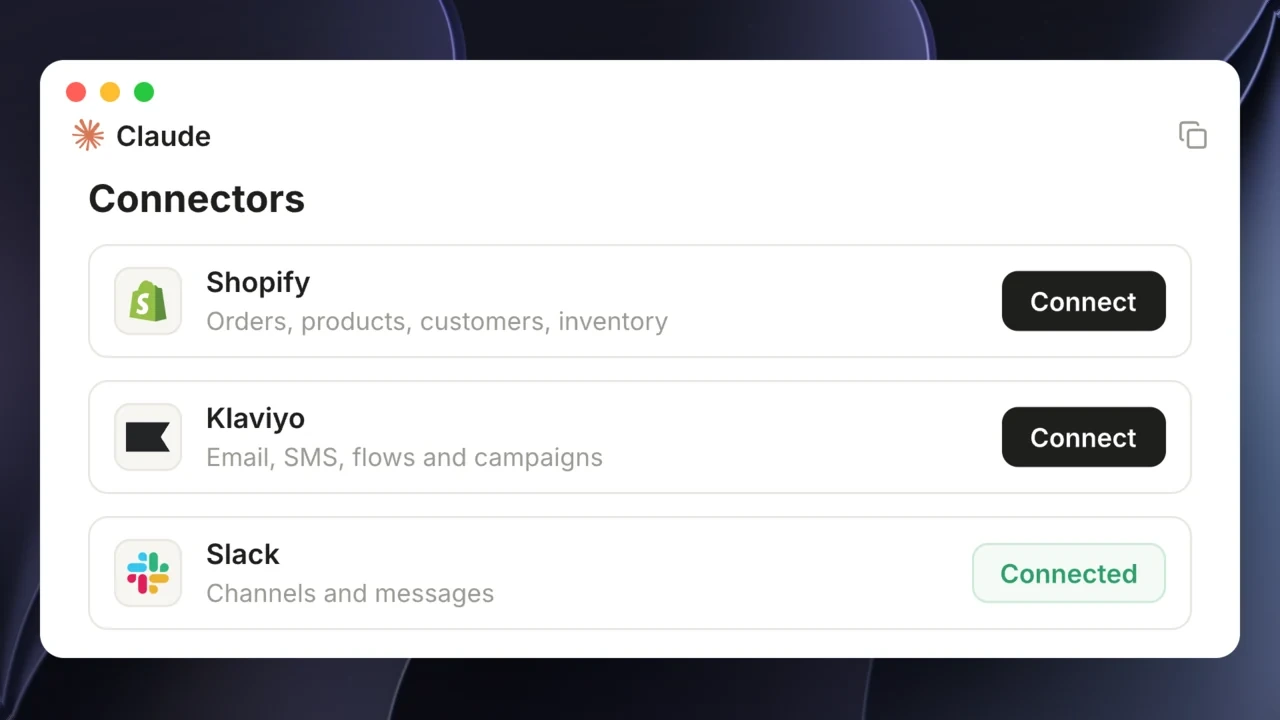
Claude’s own connector directory. Find a tool like Shopify or Klaviyo, click Connect and sign in. Quick to set up, one tool at a time, and each connector only answers for its own data.
With Polar
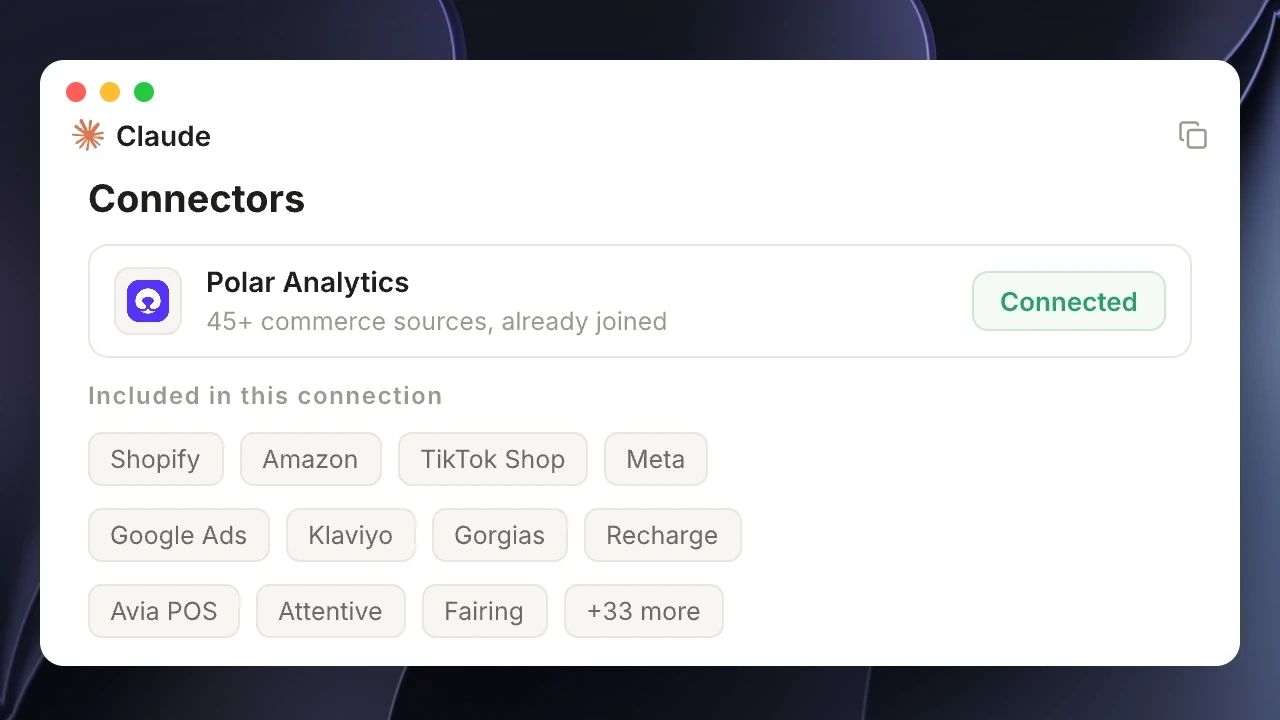
One connection that carries the whole stack: 45+ commerce sources already joined in a warehouse you own, with one definition per metric, so a single question can cross channels.
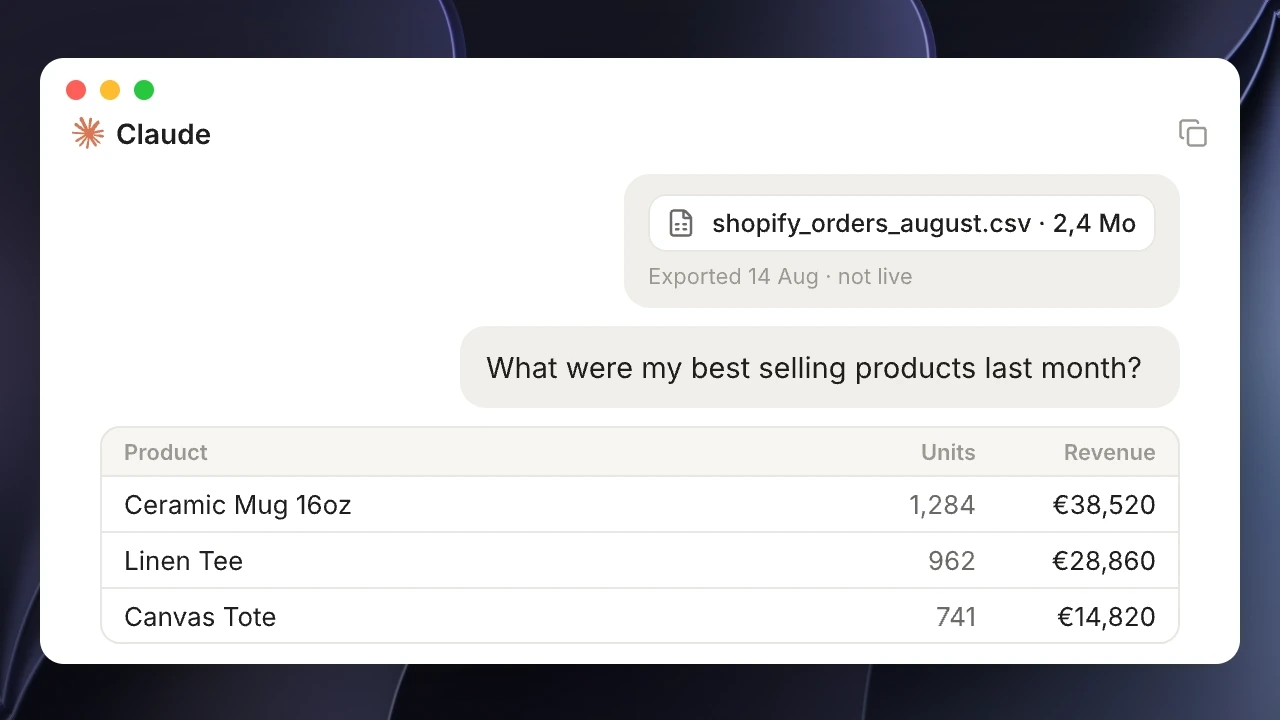
With a file export
Export a CSV from Shopify or your ad platform and drop it into the chat. Nothing to set up, and it answers one question well. It is a photograph: stale the moment you take it, and blind to every other source.
Claude Skills and Claude Code for Operators Who Do Not Code
Two capabilities come up constantly once a team has been using Claude for a month, and both sound more technical than they are.
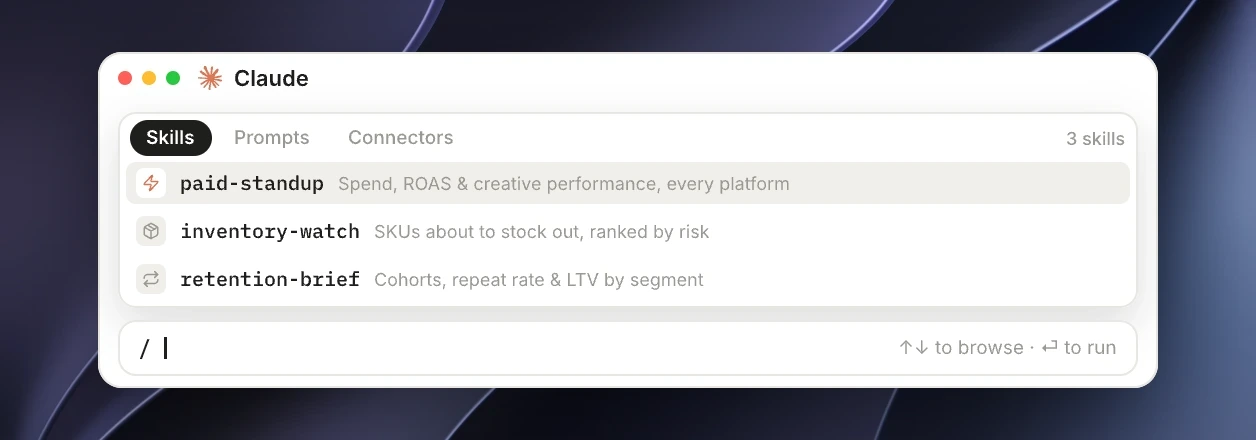
Skills: save a prompt so the whole team runs the same one
A skill is a prompt plus its instructions, saved and named. The first time you build a good paid media standup it takes twenty minutes of back and forth. Save it as a skill and it becomes a command anyone on the team can run, on any week, and get the same structure back. This is what stops an AI setup decaying into six people with six private prompt libraries.
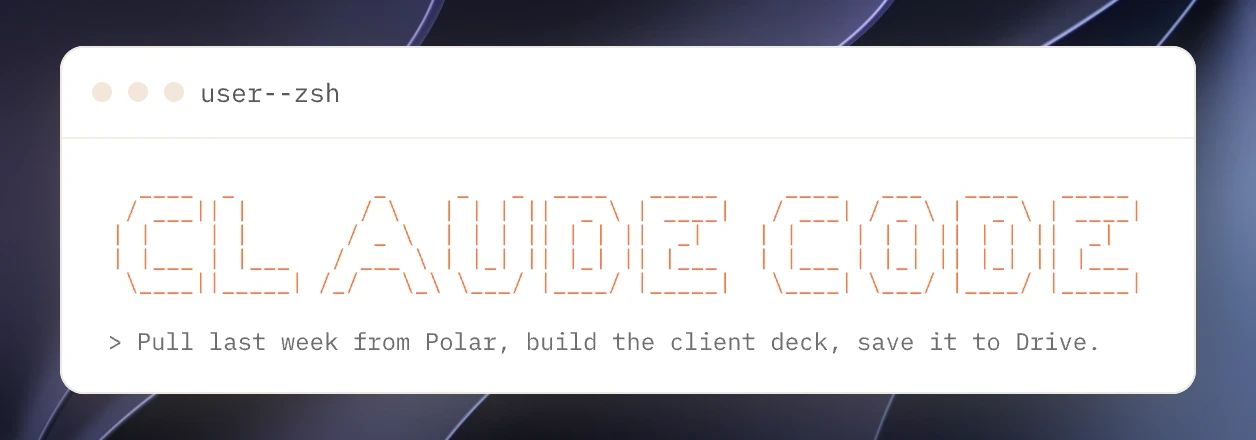
Claude Code: for the workflows a chat cannot hold
Claude Code is a terminal tool, which makes most operators assume it is not for them. In practice it is where the multi-step work lives: pull the numbers, run the analysis, build the deck, save the file. Agencies use it to produce a full client reporting pack in one run. You do not need to write code to use it. You need to be able to describe the steps in order.
What this changes in practice
The difference between a team that plays with Claude and a team that runs on it is almost always this: the second team turned the questions they repeat into something that runs itself, then spent their attention on the answers instead of the asking.
What Polar Does Before Claude Answers
Three things have to happen before a question can get a trustworthy answer. None of them are the model’s job.
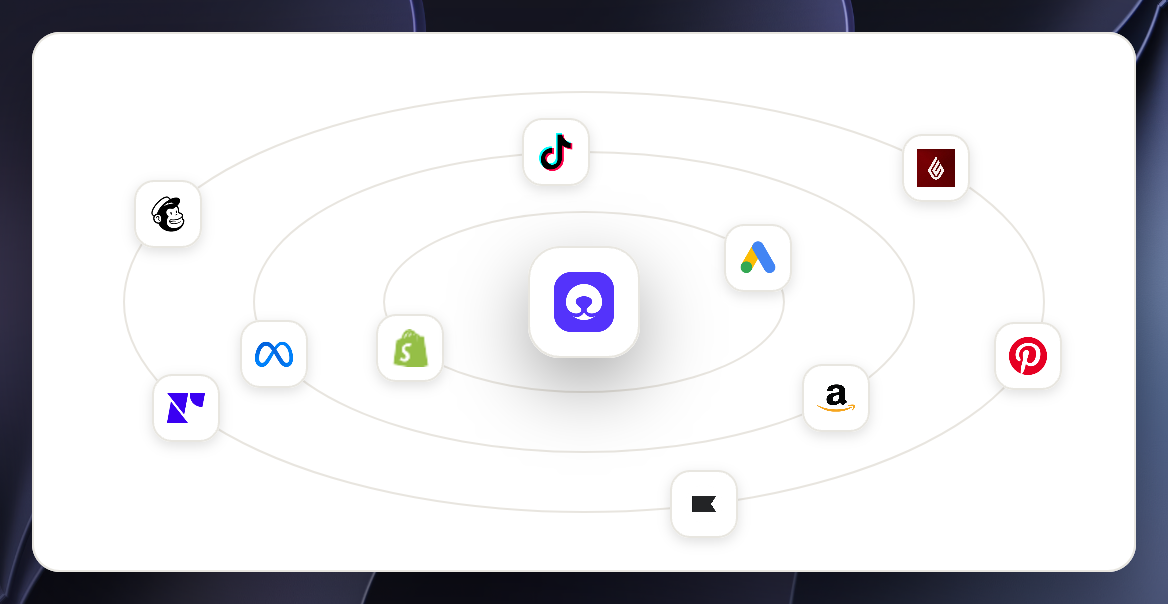
Unlimited connectors unified into one governed data model
Shopify, Amazon, TikTok Shop, retail and your ad platforms land in one warehouse you own. Storefronts, ad platforms, email, subscriptions and POS, connected in clicks, with no pipeline to maintain.
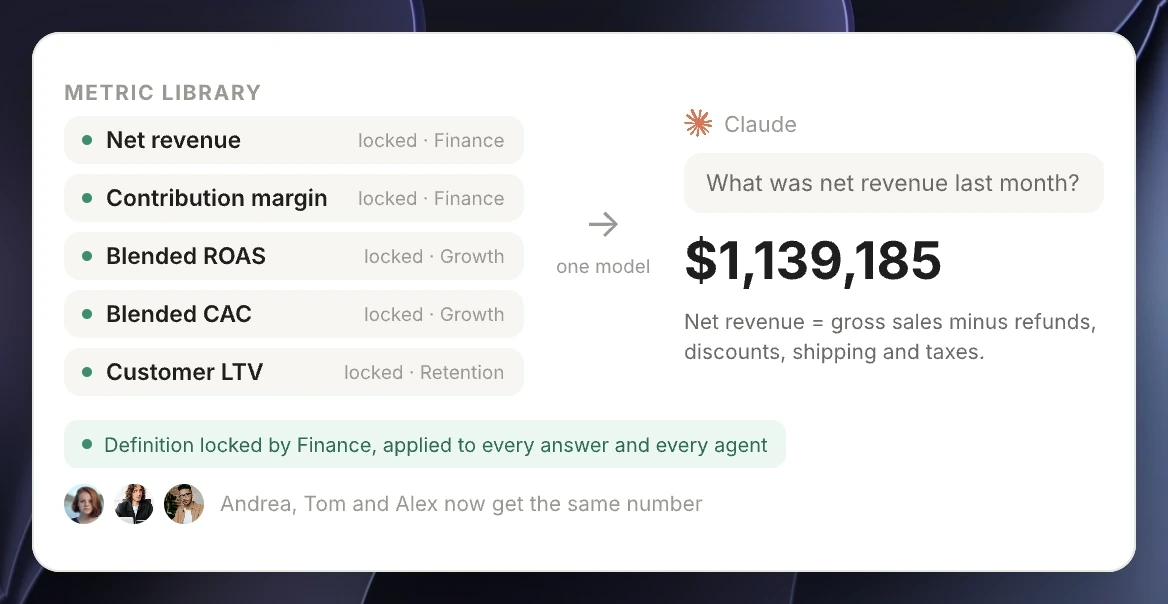
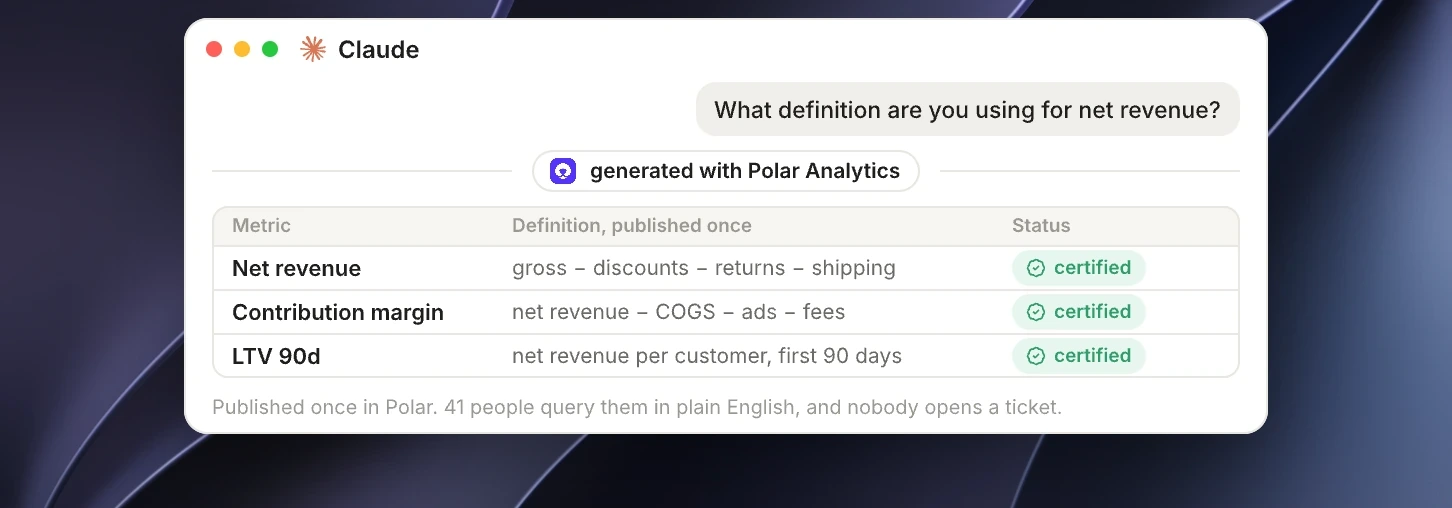
One definition per metric, locked across every team
Net revenue, contribution margin and blended ROAS defined the way your finance team defines them, then used by every person and every agent that asks.
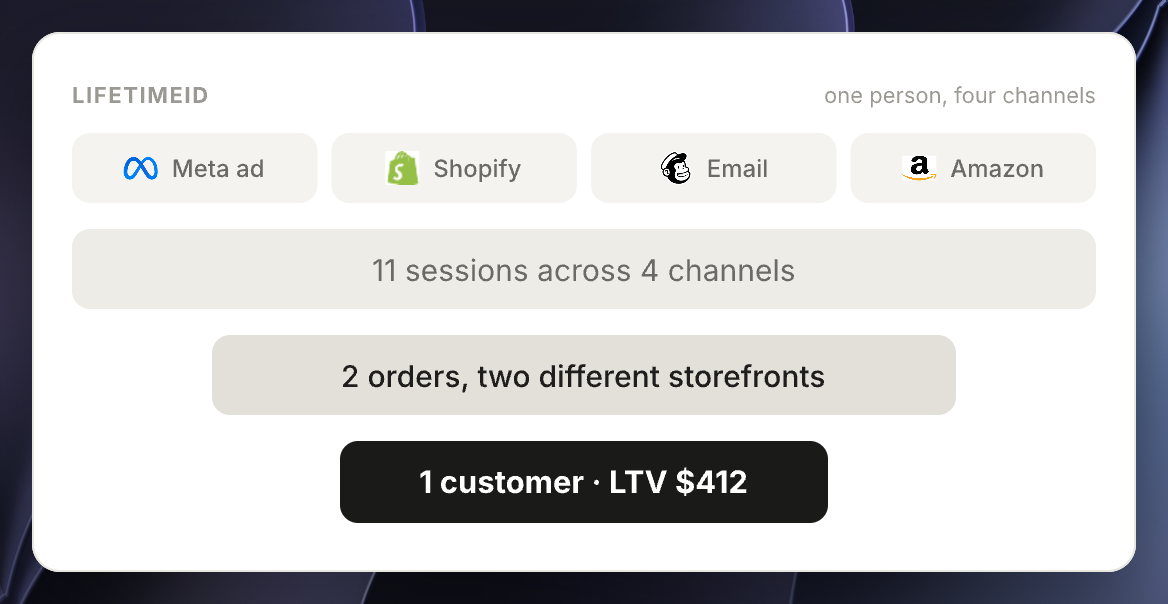
LifetimeID: one customer identity across every channel
The same person stitched across channels and devices, so new versus returning, LTV and cohorts still hold when someone buys on Shopify one month and on Amazon the next.
Claude for Shopify: What’s Possible with Real Data coming from Polar
Yes, Claude connects to Shopify, and on day one it answers what sold, to whom, how often, and what is left in stock. Every question that crosses into ad spend, margin or a second sales channel needs more than the store.
Where Shopify data alone stops
 No ad spend. CAC, ROAS and channel profit all live outside Shopify.
 Total price is not net revenue. Shipping, tax and refunds distort it.
 One store is not the business. Marketplace orders arrive without their fees.
 No email revenue. Flow and campaign performance lives in Klaviyo.
 No single customer. The same buyer is counted twice across channels.
 No true margin. Shopify’s one cost field is usually empty and excludes fees.
Claude for Retail and Wholesale, With Polar Underneath
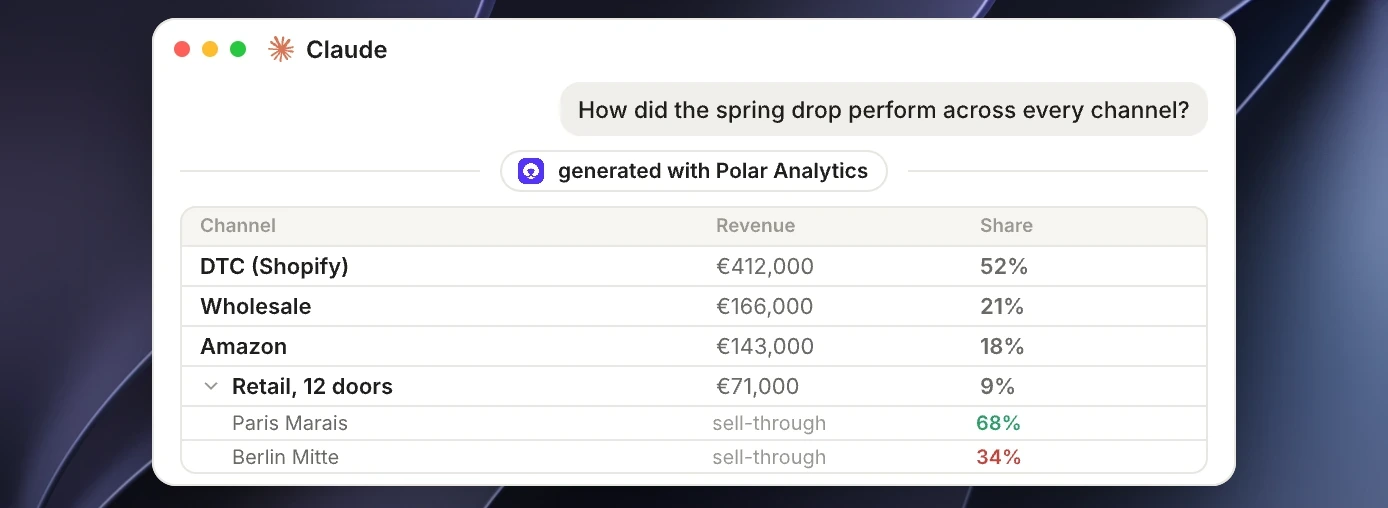
Your online store is one channel. Retail sell-through, wholesale orders and marketplace revenue land in the same data model, on the same definitions.
What becomes possible beyond the online store
Sell-through by door, wholesale revenue next to DTC, and Amazon alongside Shopify, in one answer.
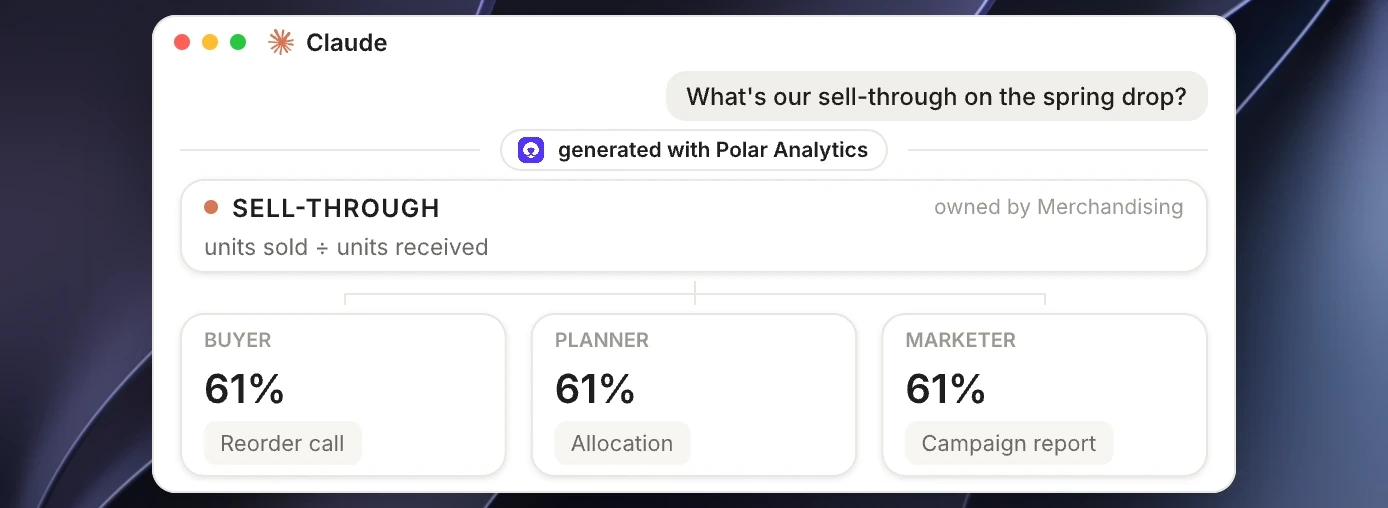
One definition of a metric for buyers, planners and marketers
The formula lives in one place instead of in each team’s spreadsheet. Change it once and every report that uses it moves with it.
Setting Up Claude With Polar in Three Steps
Connect
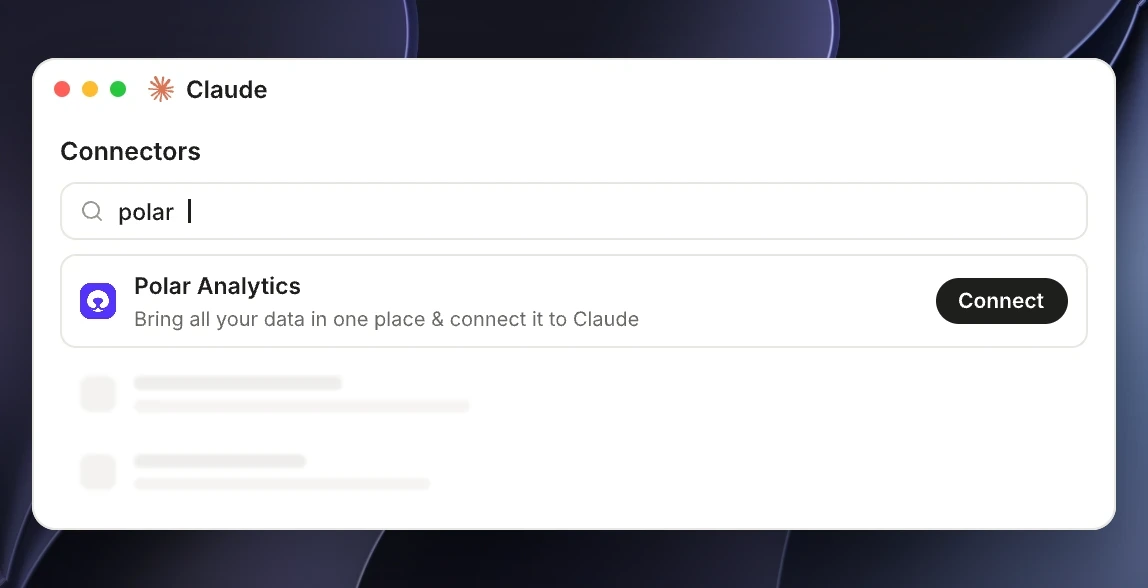
In Claude, open the connector directory, search for Polar, click Connect and sign in. There is no API key and no token to paste: it is an OAuth login, and the data starts flowing when it completes.
Prove you can trust it
Run get_context as your first prompt. It returns which sources are live, which metrics exist, and which dimensions you can slice by.
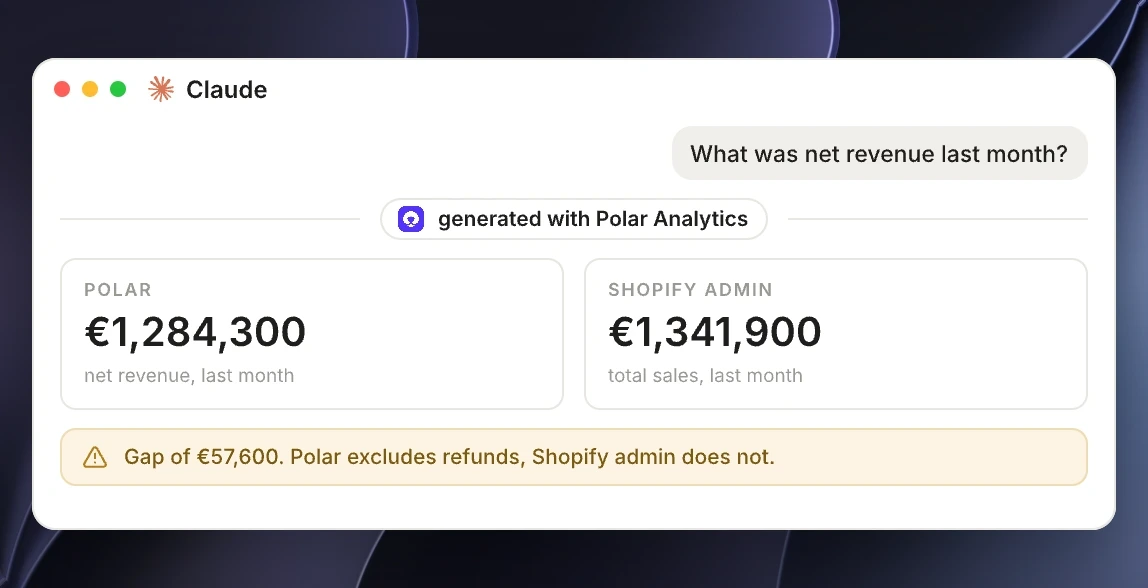
Then ask for one number you can check in ten seconds. Last month’s net revenue. Yesterday’s orders.
If it matches, you are done here. Go to step 3.
If it does not, you have found your real work. A number that disagrees is almost never a broken connection. It is two teams using two definitions, and you have just found which one. Settle it in the semantic layer now, before anyone builds a report on top of it. Every guide skips this. It is the step that decides whether your team trusts anything that comes after.
Put it to work, then let it run
Start with a question that works on the sources you connected today.
Who Uses Polar + Claude
Marketers who need channel attribution without the headache of tracking down the right flow.
Check spend, ROAS and creative performance across every platform each morning, with the attribution already resolved and nothing to export.
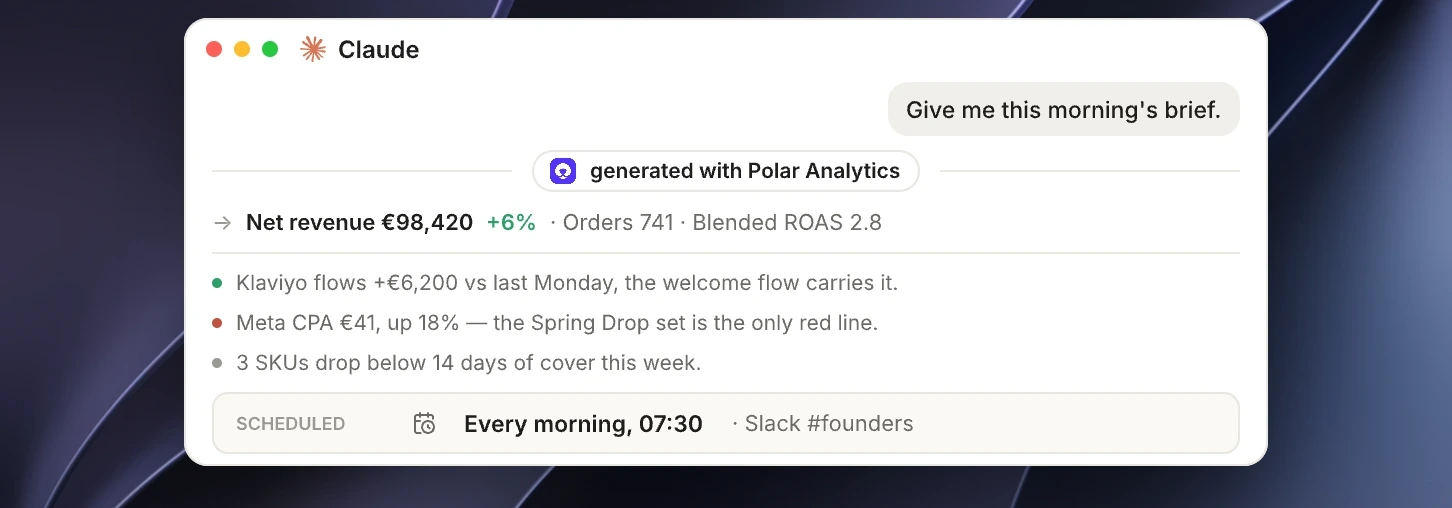
Founders who want a daily business brief without opening 5 dashboards
Read one scheduled brief instead of opening five dashboards across five platforms every morning.
Data engineers inheriting a governed model instead of building one
Publish governed definitions once, then let the rest of the company query them in plain English without a ticket.
Finance teams building a unified P&L across every sales channel
Rebuild contribution margin by channel and product on demand, using the company’s own definitions instead of four exports.
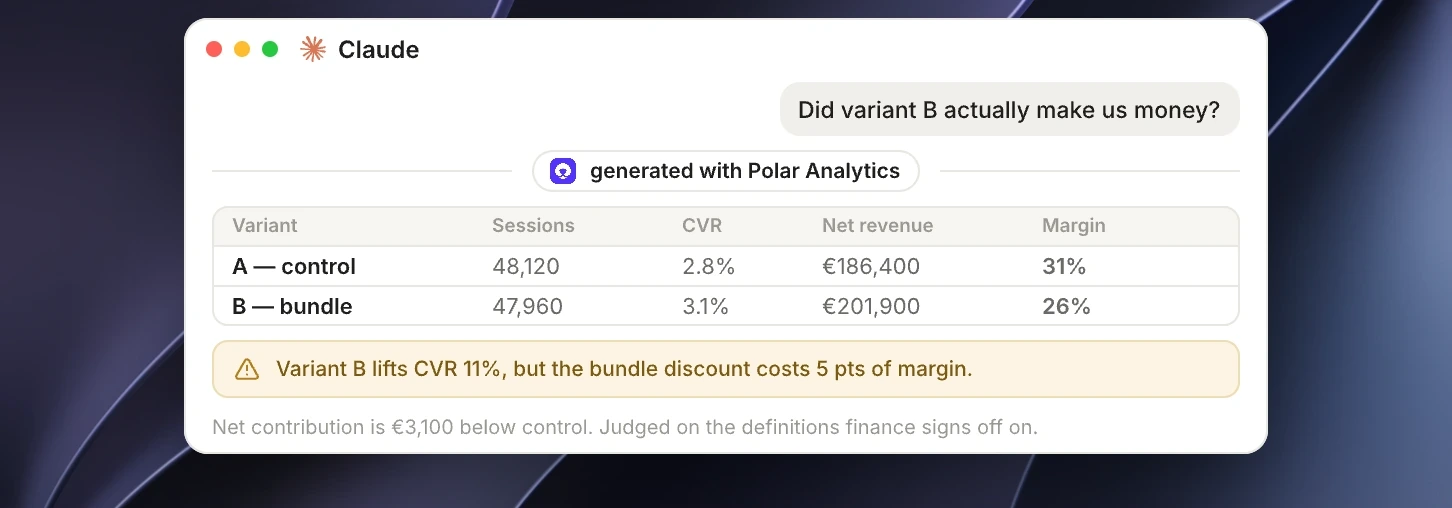
CRO teams connecting A/B test results to real revenue impact
Tie test results to net revenue and margin rather than sessions, using the same definitions finance signs off on.
Agencies managing multi-brand data in one workspace
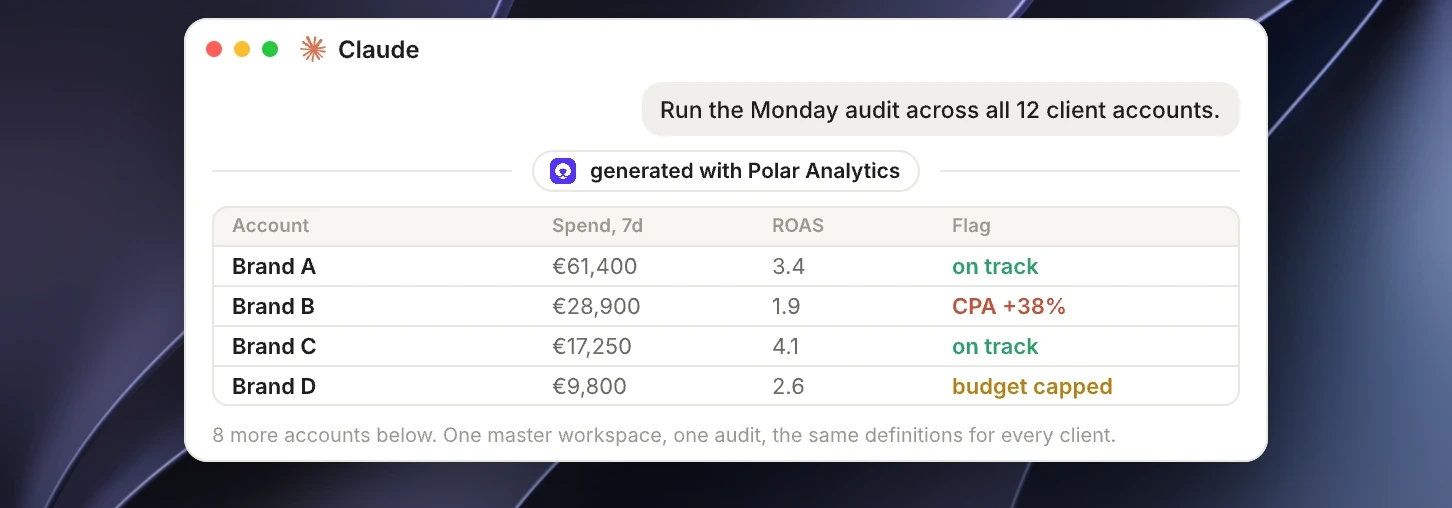
Run the same audit and reporting pack across every client account from one master workspace.