

MCP for Ecommerce: What It Is, How It Works, and Which Servers Actually Deliver
The MCP servers that matter to an ecommerce team, sorted by the job they do and by what you actually have to do to use them: one click from Claude, official from the vendor but wired up by hand, or community.





What Is MCP and Why Ecommerce Teams Care
The Model Context Protocol is an open standard for exposing one tool's data and actions to an AI agent. One protocol, instead of one custom integration per pair.
The Integration Problem Every Ecommerce Brand Hits
Your store, your ad accounts, your email platform, your 3PL and your warehouse each expose a different API, with a different auth model and a different idea of what an order is. Connecting M tools to N agents is M times N integrations, and every one of them is yours to maintain.
How MCP Solves It: One Protocol, Every Tool
MCP turns that grid into M plus N. A tool ships one server, an agent speaks one client, and anything that speaks the protocol can talk to anything else. That is why most of the big vendors shipped one within eighteen months.
How MCP Works in an Ecommerce Stack
The Three Layers: Host, Client, Server
The host is where you type: Claude, ChatGPT, Cursor, Slack. The client is the connector inside it. The server is what a vendor exposes. You install servers into a host, and the host decides what the model is allowed to call.
Consumer-Side vs Merchant-Side MCP
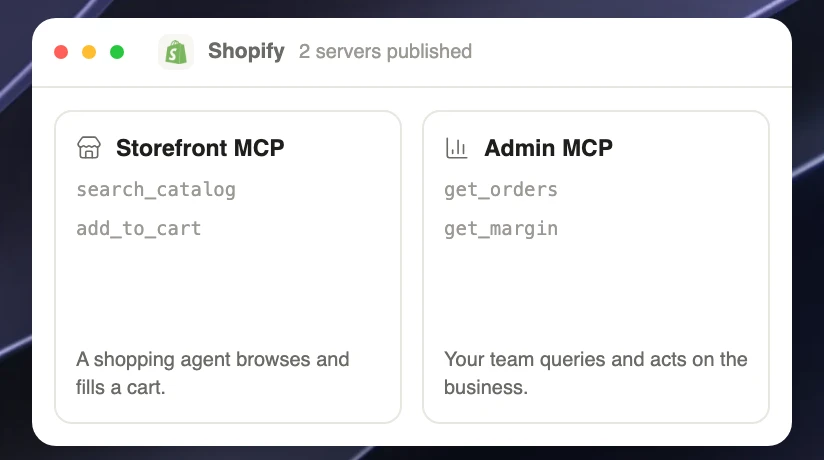
Two different things share the name. A consumer-side server lets a shopping agent browse your catalog and fill a cart. A merchant-side server lets your team query and act on the business behind it. Shopify ships both, and confusing them is the fastest way to pick the wrong one.
What Governed Metrics Actually Means for Your Data
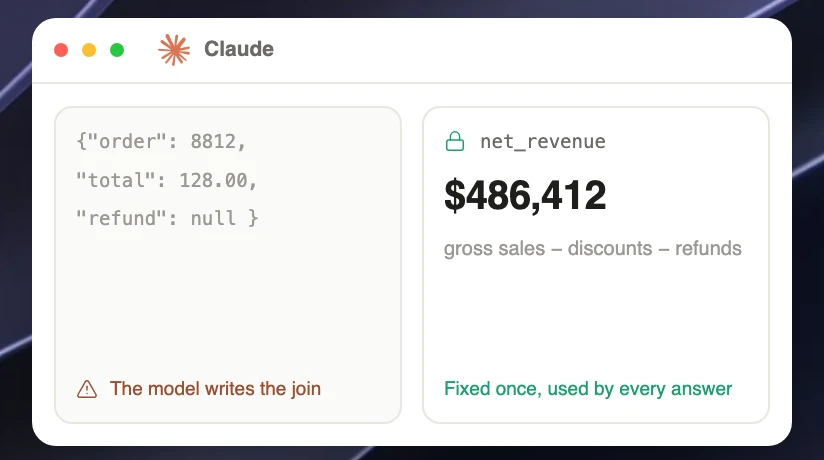
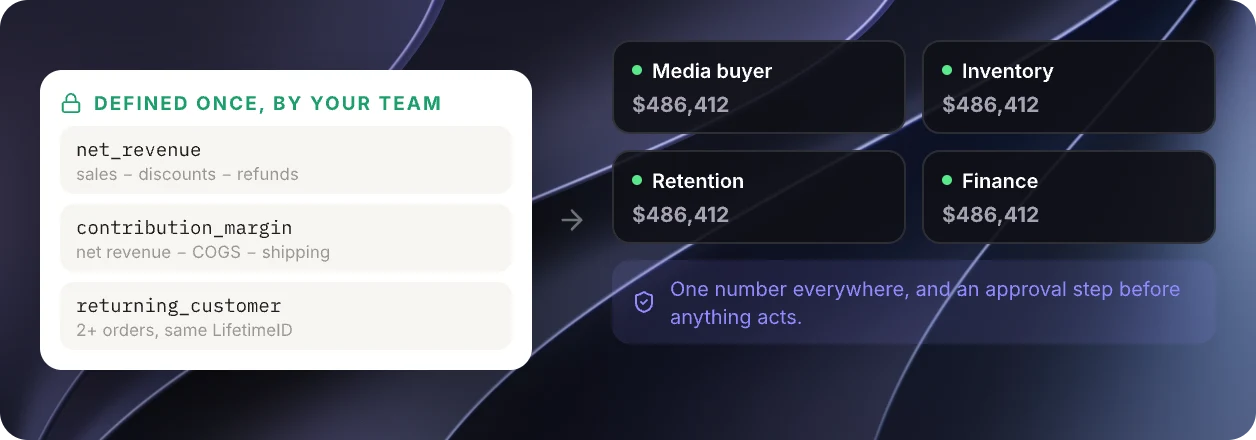
A server can hand a model rows, or it can hand it a metric. Rows mean the model writes the join and decides what revenue means. A governed metric means the definition was fixed once, by your team, and every answer uses it.
MCP Use Cases for Ecommerce Operations
What teams actually run once the servers are connected.
Inventory: Real-Time Alerts and Auto-Reorders
Sell-through crosses a threshold, the agent flags the SKU, drafts the reorder and waits for a human to confirm it.
Campaigns: Draft, Segment, Schedule in One Prompt
Build the segment in Klaviyo, draft the campaign, and check the spend against yesterday's contribution margin, without leaving the thread.
Attribution and Revenue Analytics Without SQL
Ask which channel made money last month after every cost, and get the answer on your own definitions rather than the model's guess.
Customer Support and Order Confirmation Workflows
The support agent reads the ticket, the order behind it and the shipment status in one pass, then proposes the refund or the reship.
AI Agent Teams: Running Ten Agents on Your Store Data
One agent per decision rather than one chatbot for everything, all reading the same numbers so they do not contradict each other.
Which Server for Which Job
Eleven categories, one verdict each. Most of the stack is one click away now, warehouses included. The hole that is left is attribution, and it is the one everything else depends on.

Ads
No ad platform is one click away. The big networks publish an official server, but you wire it up yourself, and the only thing sitting in the directory is an aggregator.

Platform
The best served category. Storefronts and payment providers are one click away, and the ones that are not ship an official server anyway.

Data
The main warehouses are one click away, transformation tooling included. Some of them still need an admin to switch the server on before anyone can connect.

Analytics
Well served, but each server only ever sees its own source.

Attribution
Almost empty. Attribution is the product: nobody opens it to a third-party agent.

Creatives
Well covered. The design and whiteboard tools your team already works in are all in the directory.

Copywriting
Well served. Hosted publishing platforms are one click away; it is the self-hosted setups that stay community-maintained.

SEO
The deepest server in the whole directory sits here: research, rank tracking and site audits on one connection.

AI Images
Nothing in the public catalog. Community or org-added servers only.

AI Videos
Nothing either. What exists is official, but you wire it up by hand.

Support & ops
Support is in the directory, logistics is not.
How to Set Up MCP for Your Ecommerce Store
Four steps, and none of them needs an engineering ticket.
Choose Your MCP Host
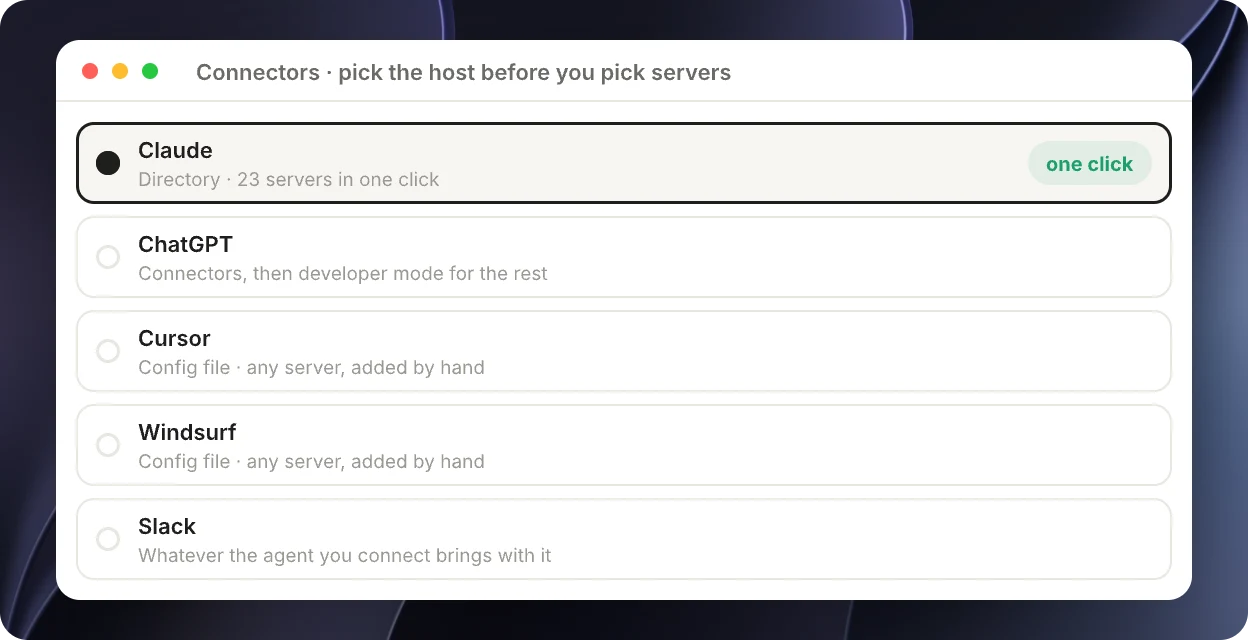
Claude, ChatGPT, Cursor, Windsurf or Slack. The host decides which servers you can install in one click and which ones you add by hand, so pick it before you pick servers.
Connect Your Shopify or Amazon Data Source
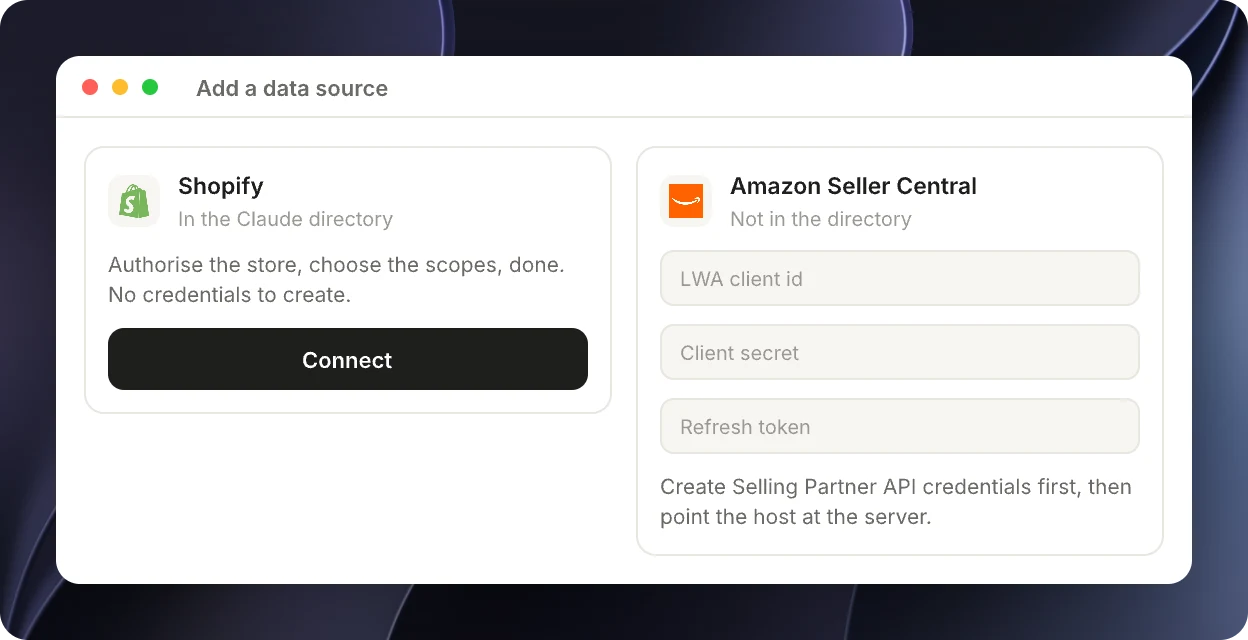
Shopify is one click from the Claude directory. Amazon Seller Central is not: you create Selling Partner API credentials first, then point the host at the server.
Configure Scopes and Security
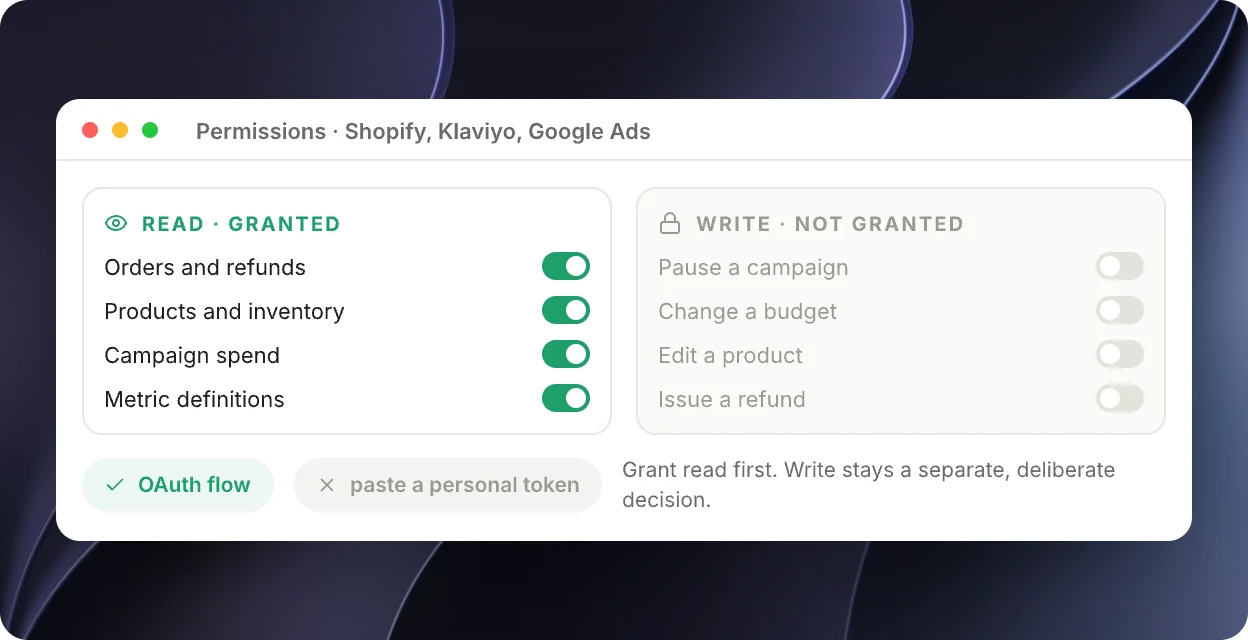
Grant read first. Keep write access a separate, deliberate decision, and prefer servers that use an OAuth flow over ones that ask you to paste a personal token.
Run Your First Query
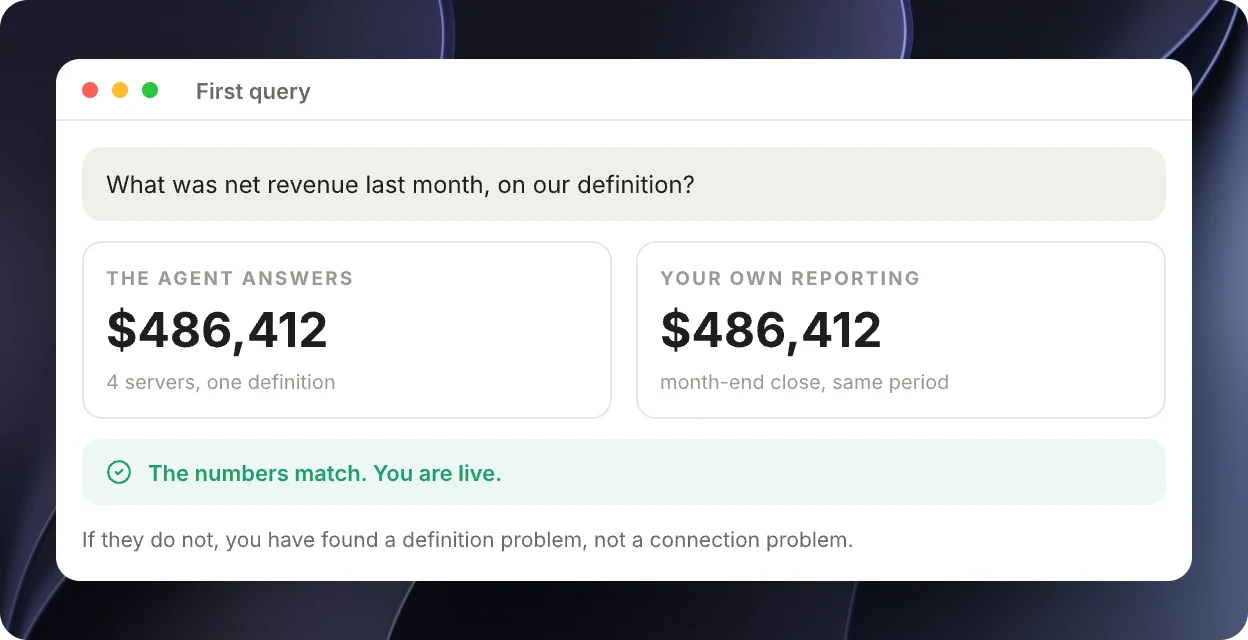
Ask something you already know the answer to. If the number matches your own reporting, you are live. If it does not, you have found a definition problem, not a connection problem.
What MCP Does Not Solve
Connecting ten servers gives your agent ten versions of the truth. The gap is not access, it is the layer that reconciles them.
Raw Rows vs Governed Metrics: The Hidden Risk
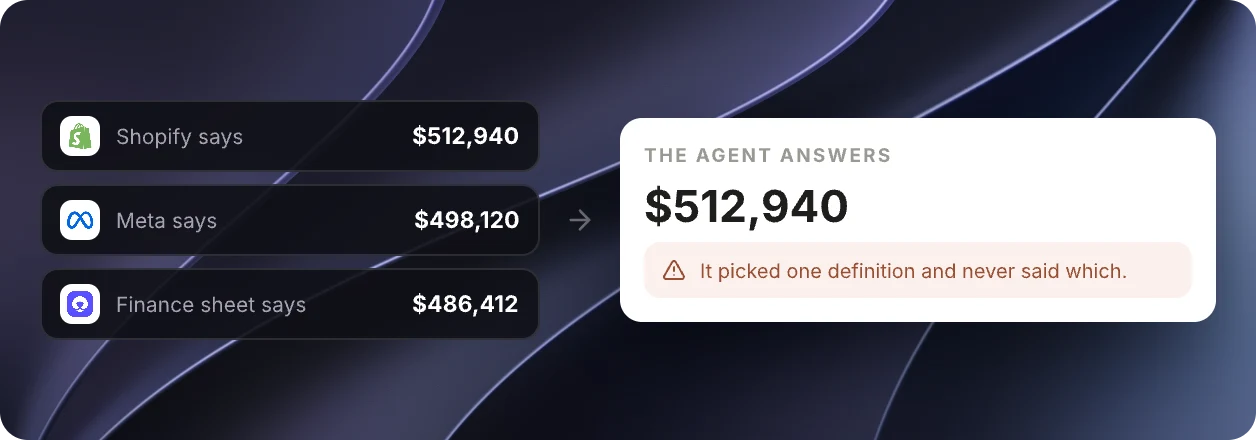
Most servers return API objects. The model still has to join, dedupe and attribute, and that is exactly where it invents. Shopify counts revenue one way, Meta another, your finance sheet a third: the agent will pick one and never tell you which. Nothing in the protocol stops it, because the protocol is about access, not meaning.
When You Still Need a Semantic Layer
The moment a question crosses two sources, you need one place where revenue, margin and a returning customer are defined, and every agent answers on that basis. A server also has no memory of what your team already decided and no approval step before it acts. That is the work a governed layer does, and we go deeper on it in our piece on MCP and the semantic layer.
MCP vs Traditional APIs and Integrations
MCP does not replace the API underneath. It replaces the bespoke glue you used to write on top of it.

An API is for a developer
It assumes someone reads the docs, handles the auth, writes the pagination and ships the code. Every new tool starts that work again.

An MCP server is for an agent
It describes its own tools, so the model discovers what it can do at runtime. The integration work happens once, on the vendor's side.

Neither one reconciles your business
Both hand back one system's view. Joining Shopify, Amazon and your ad accounts into one set of numbers is a separate job, and it is the one that decides whether the answer is right.