Why AI Agents Need a Semantic Layer (And How Polar Does It for Shopify)

TL;DR
We are in the era of agentic analytics where AI does not just visualize your data but actively queries it, interprets it, and surfaces actionable insights on demand. But there is a problem most vendors gloss over: AI agents are only as reliable as the data infrastructure underneath them. Without a structured, governed semantic layer, even the most sophisticated language models will return confidently wrong numbers.
Your AI analytics tool just told you ROAS is 4.2x. Is it blended or channel-specific? Does it include returns? Does it account for the attribution window your team agreed on last quarter? Without a semantic layer defining those business rules up front, your AI agent is guessing. And its guesses look exactly like real answers same formatting, same decimal places, same confident presentation.
Polar Analytics built its semantic layer specifically to solve this problem for Shopify brands and ecommerce organizations. This article explains what a semantic layer is, why agentic analytics tools get numbers wrong without one, and how Polar's semantic layer is the core reason Ask Polar delivers accurate, trustworthy answers every time.
What Is a Semantic Layer? (The 60-Second Explainer)
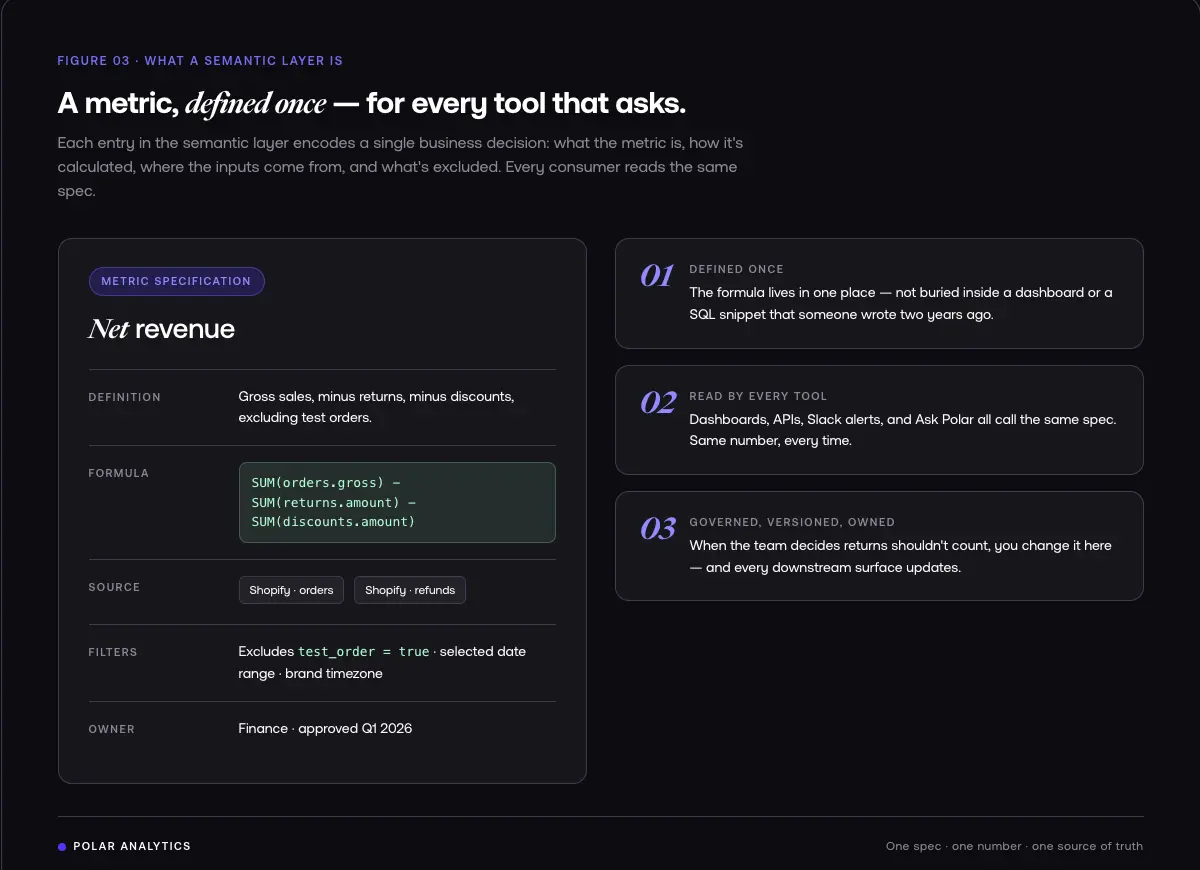
A semantic layer is a translation layer between your source data and the tools that query it. Think of it as a business dictionary plus a rulebook a structured model that defines every metric in terms your whole organization can agree on.
When someone asks "What is our revenue?" the semantic layer does not leave that question open to interpretation. It says: revenue means gross sales minus returns, minus discounts, using Shopify order data, excluding test orders, for the selected date range. These business rules are defined once, in one place, and every tool that queries the data dashboards, APIs, AI agents gets the same governed result.
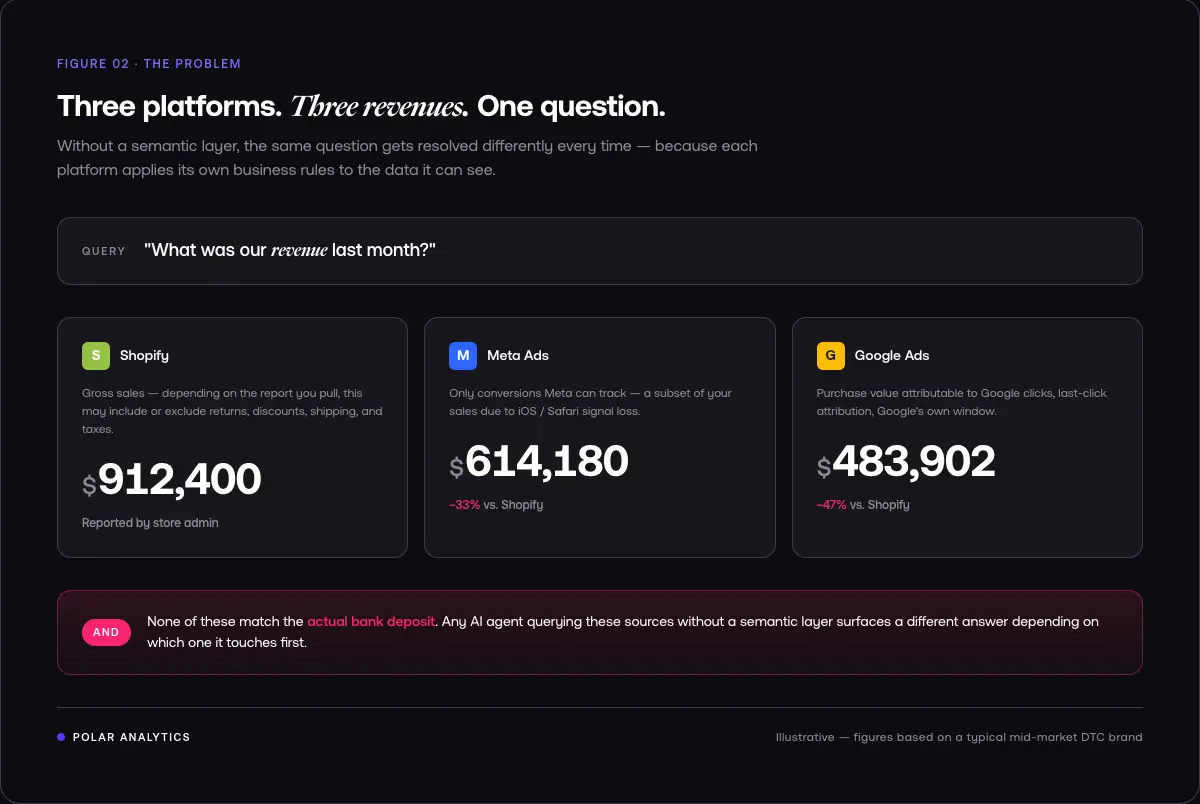
Without a semantic layer, the same question gets resolved differently every time. An AI tool might pull Shopify's total sales. Another might pull Google Ads conversion value. A third might pull Meta's reported figures. Three different numbers. All labeled "revenue." All confidently presented. All inconsistent.
Semantic modeling eliminates this ambiguity by building a unified layer of business concepts above your data warehouse. Every metric, dimension, and business logic rule lives in one governed place. Every downstream consumer whether a dashboard or an AI agent reads from the same source of truth. This is what makes agentic analytics reliable: not the AI model itself, but the structured knowledge it draws from.
According to Google and Looker research, semantic layers reduce AI analytics errors by up to 66%. That is not a marginal improvement. It is the difference between data you can trust and data that leads your team in the wrong direction.

The Problem with AI Agents in Ecommerce Analytics
Ecommerce is one of the hardest domains for agentic systems because it involves more data sources, more metric definitions, and more potential for conflict than almost any other industry.
Every Platform Defines Metrics Differently
When you run ads on Google, Meta, and TikTok simultaneously, each platform reports its own version of revenue, conversions, and ROAS. These numbers are not comparable because each platform applies different business rules.
Shopify's revenue includes gross sales, returns, discounts, shipping, and taxes depending on which report you pull. Meta's reported revenue only includes conversions that Meta can track, which is a subset of your actual sales due to iOS tracking limitations. Google Ads conversion value counts the purchase value that Google can attribute to its clicks, using last-click attribution and its own attribution window.
The result: three "revenue" numbers that do not match each other, and none of them matches your actual bank deposits. Any AI agent querying these data sources without a semantic layer will surface different numbers depending on which platform's data it touches first.
Generic AI Just Guesses
Text-to-SQL accuracy drops dramatically on complex queries. On the BIRD-Interact benchmark which tests multi-step, real-world database interactions even advanced models achieve approximately 16.7% accuracy. Simpler benchmarks like Spider show higher numbers, but those benchmarks test isolated, single-table queries. Ecommerce analytics is closer to BIRD-Interact in complexity: multi-platform joins, attribution logic, return handling, and time-window calculations are the norm, not the exception.
A generic AI connected to your ecommerce data warehouse has no understanding that "orders.total_price" excludes refunds, that "sessions.source" uses a specific referrer classification, or that a "returning customer" is defined as someone with more than one order. When you ask "What was our ROAS last month?" it does not know if you mean blended or channel-specific, if your formula uses gross sales or net figures after returns, or whether to include transaction fees. So it constructs SQL against the underlying schema, returns a number that looks precise, and presents it with the same confidence as a governed result.
Wrong Numbers Look Right
The most dangerous thing about AI hallucinations in analytics is that they are indistinguishable from correct answers. A hallucinated number has the same formatting, the same decimal places, and the same confident presentation as a real one. There is no obvious signal that the agent is uncertain.
This is worse than no answer at all. No answer prompts investigation. A wrong answer prompts action based on false information. In the era of agentic data analysis where agents are making or recommending business decisions autonomously the cost of that failure compounds quickly. That is why governed semantic layers are the foundation: without one, human intervention becomes necessary to validate every output, erasing the productivity gains that autonomous systems promise.
How Polar's Semantic Layer Works
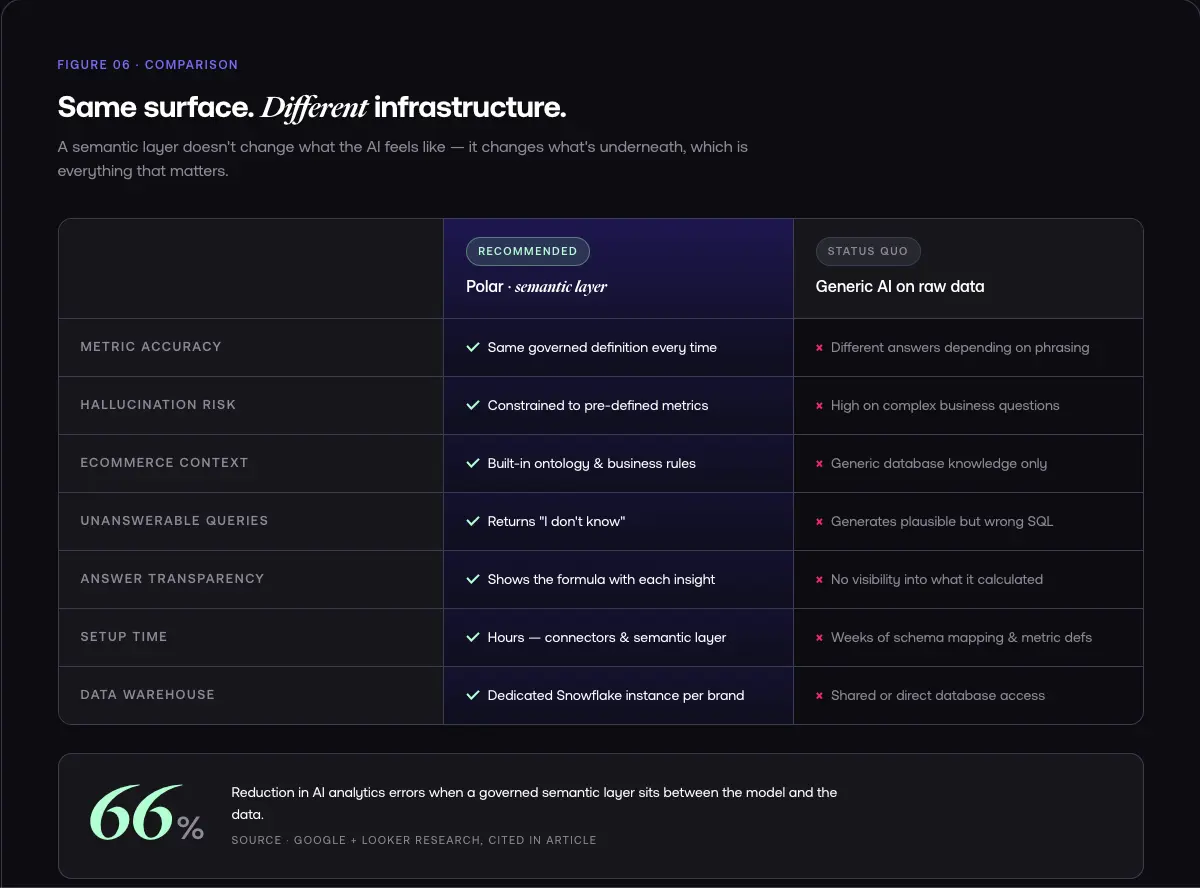
Polar Analytics built its semantic layer specifically for ecommerce. It is not a generic data abstraction tool it is a governed layer with contextual understanding of how Shopify, ad platforms, email tools, and subscription services all define their metrics, and it reconciles them into a single, consistent model.
The Ecommerce Ontology
Polar's semantic layer starts with an ecommerce ontology a structured model of how ecommerce businesses work. It defines the entities that matter (customers, orders, products, sessions, campaigns, channels), the relationships between them (orders belong to customers, campaigns generate sessions that generate orders), and every metric with exact formulas, business rules, and data sources.
This ontology is what gives Polar's AI its contextual understanding. When Ask Polar fields a query about customer lifetime value, it is not inferring a definition from a column name it is calling a pre-defined LTV calculation from the semantic layer, complete with the business logic your team has agreed on.
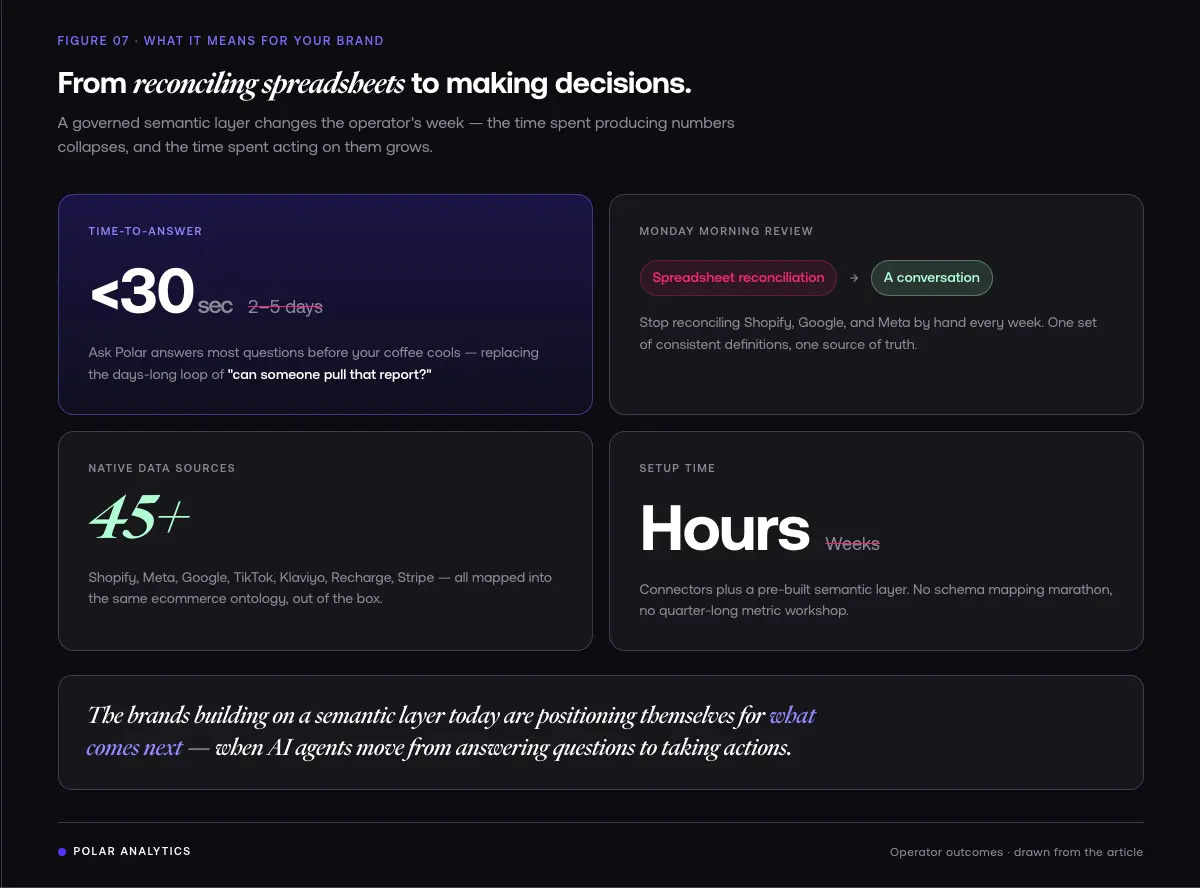
The layer connects to 45+ native data sources: Shopify, Meta Ads, Google Ads, TikTok Ads, Klaviyo, Recharge, Stripe, and more and maps each source's data into the unified ontology. When Shopify says "revenue" and Meta says "reported revenue," the semantic layer knows these are different concepts, applies the appropriate definitions, and surfaces them as distinct metrics. No conflation. No silent assumptions.
From Source Data to Business-Ready Metrics
The data flow inside Polar works like this:
- Connectors pull data from Shopify, ad platforms, email tools, and more into a dedicated Snowflake data warehouse
- Transformation layer cleans, normalizes, and joins the data using consistent business logic
- Semantic layer applies the ecommerce ontology mapping each metric to its exact definition, data source, and calculation rules
- Ask Polar queries the semantic layer rather than unstructured tables, ensuring every response is governed and accurate
When you ask Ask Polar about ROAS, it does not construct SQL against an orders table directly. It calls a pre-defined ROAS calculation from the semantic layer: blended ROAS equals net sales divided by total ad spend across all connected channels, using last-touch attribution, excluding returns, for the selected date range. The AI never invents this formula. It uses the one already defined and governed.
This is how agentic analytics should work: the AI provides the interaction layer, the semantic layer provides the knowledge, and the data warehouse provides the facts.
Dedicated Infrastructure and Access Control
Every Polar customer gets their own dedicated Snowflake data warehouse instance. Your data is fully isolated, and your semantic layer sits on top of clean, governed data specific to your business. No shared infrastructure risk, no bleed between accounts.
The semantic layer also enables role-based access control. You can define which users see which metrics, ensuring the analytics available to your marketing team are scoped appropriately while finance accesses the full set of cost and performance metrics. Security and accessibility are built into the architecture from the start.
Meet Ask Polar: AI Agents Built on the Semantic Layer
Ask Polar is Polar's built-in AI Data Analyst a conversational agent grounded in the semantic layer. When you ask a question, Ask Polar does not write SQL against raw tables. It calls pre-defined metrics: ROAS (blended and by channel, using Shapley attribution to recover iOS/Safari-stripped conversion signals), LTV (cohort-based across repeat purchase behavior), CAC, AOV, contribution margin, new vs. returning customer splits.
Every metric is pre-modeled with exact business logic, connected to 45+ data sources. The AI's job is natural-language understanding; the semantic layer's job is business logic and governance. This separation is what makes it trustworthy: the AI cannot invent metrics or hallucinate definitions. It calls certified operations only. If a question falls outside the governed model, Ask Polar returns an error rather than a guess.
How Ask Polar Answers Questions
- Natural language understanding: Ask Polar parses your question, identifies intent, and maps it to the relevant metrics, dimensions, and filters
- Semantic layer lookup: Instead of constructing SQL from scratch, Ask Polar calls metric specifications from the semantic layer using pre-governed business logic
- Governed query execution: The semantic layer translates the request into optimized SQL against your Snowflake data
- Answer delivery: Ask Polar formats the result as a clear insight, showing the metric definition it used so you know exactly what you are looking at
The key difference from generic AI: Ask Polar never writes SQL directly against unstructured tables. It only uses pre-defined operations from the semantic layer. If you ask a question without a corresponding metric definition, Ask Polar tells you it cannot provide an accurate result, rather than guessing.
Example Queries
"What was my blended ROAS last month?" Ask Polar responds: "Blended ROAS for [month] was 3.2x. This is calculated as net sales (gross revenue minus returns and discounts) divided by total ad spend across Google, Meta, and TikTok, using last-touch attribution. Net sales: $847,000. Total ad spend: $264,000." The response includes the definition and the logic behind it. No follow-up investigation required.
"Which channel drove the most new customers last quarter?" Ask Polar uses multi-touch attribution data, breaking down new customer acquisitions by channel with first-touch attribution showing real performance across Google Ads, Meta, TikTok, and organic against consistent definitions.
"Compare LTV of Meta vs. TikTok acquired customers" Ask Polar runs a cohort analysis comparing 90-day lifetime value of customers acquired through Meta versus TikTok, showing average order value, repeat purchase rate, and total LTV for each cohort. These are governed calculations drawn from your actual Shopify order data.
"Flag any anomalies in my conversion rate this week" Ask Polar surfaces performance signals against your baseline metrics, alerting your team when something material changes without requiring a human analyst to monitor dashboards manually.
When It Cannot Answer, It Says So
Generic AI analytics tools always return something, even when extrapolating from insufficient data. Ask Polar is designed to return "I do not have the data to accurately address that question" when a query falls outside the governed metrics. This is a feature, not a limitation.
In analytics, silence is better than a confident lie.
The Semantic Layer in Agentic Commerce
The semantic layer is becoming the critical infrastructure for the next generation of agentic commerce. As AI agents move from answering questions to taking actions rebalancing ad budgets, triggering inventory reorders, adjusting pricing the stakes of metric accuracy rise dramatically.
Consider what happens when an autonomous agent is tasked with reducing spend on underperforming channels. Without a semantic layer, the agent might define "underperforming" differently each time it runs. With a semantic layer, the business rules are fixed: underperforming means below a defined ROAS threshold, calculated using net sales after returns, compared against a 30-day rolling baseline. The agent acts on governed knowledge, not improvised inference.
The Model Context Protocol (MCP) is accelerating this shift. MCP enables AI agents to call structured data tools including semantic layers directly, making it possible to build multi-agent workflows where each agent draws from the same governed business logic. Polar's architecture supports MCP integration, enabling teams to extend Ask Polar's capabilities into their own workflows via API and embed governed analytics into any surface from a Slack notification to a fully automated decision engine.
This is the future of data-driven ecommerce: not a single AI interface on top of a data warehouse, but a network of specialized agents drawing from a shared semantic layer that enforces consistent definitions across every interaction.
Polar vs. Generic AI Analytics: A Side-by-Side Comparison
What This Means for Your Shopify Brand
Stop Reconciling Dashboards
If you spend time every week manually reconciling numbers between Shopify, Google Ads, and Meta Ads Manager, you are doing work that a semantic layer should handle automatically. Polar gives you one set of consistent definitions for every metric, from a single source of truth. Your Monday morning review becomes a conversation with Ask Polar instead of an hour of spreadsheet reconciliation.
Build Trust in AI-Generated Insights
For AI-generated insights to drive real business decisions, the people receiving them need to trust the underlying data. Polar's semantic layer makes that trust possible. You can share Ask Polar's outputs with your leadership team, your investors, or your agency, knowing the numbers mean what they say because the business logic behind them is defined, governed, and consistent.
Reduce the Analytics Bottleneck
The average time from "can someone pull that report?" to having an answer in a growing ecommerce brand is 2 to 5 days. Ask Polar answers most questions in under 30 seconds. For a team making 10 data requests per week, that recovers hours every month and removes the data analyst as a bottleneck between your team and the insights they need.
Non-technical users can access complex analytics without understanding SQL or warehouse structures. The semantic layer handles translation. The agent handles interaction. Your team focuses on decisions.
Position Your Brand for Agentic Commerce
The brands that build on a semantic layer today are positioning themselves for what comes next. As AI agents take on more analytical and operational work, the companies with structured, governed data will move faster and make better decisions.
Polar is not just an analytics tool, it is the knowledge infrastructure that makes agentic systems reliable for ecommerce.
FAQ
Table of contents
Frequently asked questions
.webp)