AI Ecommerce Analytics: How to Get Answers From Your Store Data Without Writing SQL

TL;DR
Every Monday morning, an ecommerce operator asks a question their dashboard can't answer.
"What were my best-selling SKUs by margin last week, broken down by acquisition channel, and how does that compare to the same week last year?"
The question takes ten seconds to ask. The answer, if it ever arrives, takes a week of agency back-and-forth, $400 in analyst time, and a SQL query you can't read. By the time the chart lands, the week is over and the decision's been made on gut.
This is the gap AI ecommerce analytics is built to close. AI ecommerce analytics turns plain-English questions into instant, trustworthy answers for operators who don't write SQL, by sitting on top of unified commerce data, a semantic layer that defines metrics consistently, and an LLM that's been grounded so it can't make things up.
By the end of this guide, you'll understand what AI ecommerce analytics actually is, why most "AI dashboards" still fail operators, the seven questions you couldn't answer without SQL until now, and what to look for when you evaluate a tool.
What Is AI Ecommerce Analytics?
AI ecommerce analytics is a class of analytics platform where the primary interface is natural language. You ask, the system answers. The underlying data is unified across every ecommerce surface you care about: orders, ad spend, email engagement, retention, inventory, returns, customer cohorts and the channels beyond your storefront: POS, wholesale, and Amazon.
Three layers make it work and Polar ships all three as one platform:
- Unified data. 45+ connectors feeding a dedicated Snowflake instance, one per customer. Every source your store relies on (checkout platform, ad accounts, email and SMS, attribution pixel, ERP, 3PL, POS, marketplaces) lands in a warehouse you own and can export, refreshed as often as every 15 minutes.
- A semantic layer. A dictionary that defines, once and for all, what net sales, CAC, LTV, contribution margin, and new customer revenue mean across your business. The semantic layer is the difference between an AI that gives you the right answer and an AI that gives you a confident wrong one.
- Natural-language interface. Ask Polar. You ask in plain English; the AI queries the semantic layer's pre-validated definitions, never raw SQL so the number it returns is auditable, not guessed.
This is different from a generic AI chatbot bolted onto a dashboard, which usually means a "text-to-SQL" model that tries to guess your schema on the fly. We'll get to why that matters in a minute.
Why SQL Is the Wrong Skill for an Ecommerce Operator
SQL is a beautiful, precise, and totally inappropriate skill for the people running an ecommerce brand.
The operator's job is to make ten small decisions a day under time pressure. Which campaign do I scale? Which SKU is quietly dying? Which cohort is dropping off? Are we losing margin on a hidden discount stack? Every question needs an answer in minutes, not days.
But the path from question to answer for most brands looks like this:
Operator has a question, Slack's data analyst, analyst writes SQL, analyst joins three tables wrong on the first attempt, analyst sends a CSV, operator opens it in a spreadsheet, operator realizes it doesn't include returns, loops back to analyst, answer arrives Thursday.
We've started calling this the Question Latency Tax, the compounding cost of every question that takes longer to answer than the decision can wait. Two things happen as the tax grows:
- Decisions get made on intuition because the data didn't arrive in time.
- Questions stop being asked because the operator learns the round-trip isn't worth it. This is the more dangerous outcome: a backlog of unasked questions is invisible.
One brand operator we spoke with put it bluntly: "We're not in the business of writing connectors. We sell physical goods. But somehow we decided we needed a 12-tool data stack and our team spends weeks waiting for answers."
The honest framing is this: SQL is the tax operators pay because the tools were built for analysts, not them. AI ecommerce analytics is the first generation of tooling built for the operator workflow first.
How AI Removes the SQL Layer
Here's what the operator workflow looks like in a properly-built AI ecommerce analytics platform. We'll walk through one real query end-to-end.
You type into a chat interface:
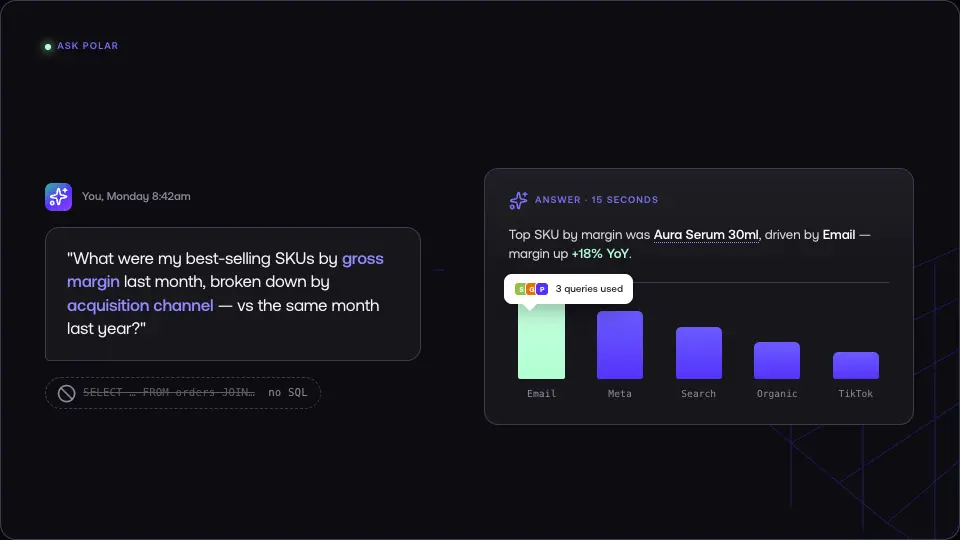
"What were my best-selling SKUs by gross margin last month, broken down by first-purchase acquisition channel, compared to the same month last year?"
What happens behind the scenes:
- The LLM parses your intent. It identifies the entities (SKU, gross margin, acquisition channel, time period) and the comparison logic (year over year).
- The semantic layer translates intent into a defined query. "Gross margin" is a metric your team has already configured once, with your COGS logic, discount treatment, and shipping costs. "Acquisition channel" maps to your first-touch attribution model. The AI doesn't guess at definitions, it reads them.
- The query executes against your unified warehouse. Orders, ad spend, returns, and inventory data (already modeled) return in seconds.
- The answer comes back as a chart, a written summary, and citations on every number. This is Data Citations in Ask Polar: cited values carry a dotted underline and a tooltip ("3 queries used"), and clicking any number opens a Data Debug Sheet the metric's definition, the exact semantic queries that produced it, the parameters, and the source connectors (Shopify, GA4, and the rest). You're not auditing the AI's word; you're reading the lineage of the number, down to the connector it came from.
The whole flow takes about fifteen seconds. There is no SQL anywhere in your line of sight.
This last point (audit the result) is the part most "AI dashboards" skip, and it's the part operators care about most.
Seven Questions You Couldn't Answer Without SQL (Until Now)
If you're still skeptical, here are five questions that historically required a SQL-fluent analyst and now don't. Each one is a real pattern we see asked weekly.
1. Real LTV by acquisition channel
Not blended LTV. Not Shopify's default LTV. Actual 12-month customer lifetime value broken out by the channel a customer was acquired on, net of returns, with the option to slice by first-purchase product category. The kind of question that informs CAC ceilings by channel for the next quarter.
2. Repeat purchase windows by product category
When do customers come back after their first order? How does that window differ for consumables versus durable goods? Which category has the tightest predictable re-order curve, and which is so spiky it's not worth retargeting?
3. Inventory at risk of stockout in the next 14 days
The AI cross-references current sell-through velocity, in-transit shipments, returns reentering inventory, and planned ad spend, then surfaces the SKUs about to bleed revenue. This is one of the questions that takes a data team a full sprint to model and an AI agent built on a proper semantic layer about twenty seconds.
4. True ROAS net of refunds and discount stacking
Reported ROAS is almost always inflated. The number that actually matters is contribution-margin ROAS net of returns and net of stacked discounts, plus the breakdown of where the gap between reported and true ROAS is widest. Few brands look at this number weekly because few brands can.
5. Cohort retention curves by first-purchase product
Customers acquired on Product A might churn fast. Customers acquired on Product B might be three times more valuable over twelve months. This shapes both your acquisition strategy and your merchandising. It also requires four joins and two window functions in SQL. In a properly-built AI ecommerce analytics platform, it's one sentence.
6. True ROAS with view-through stripped out and POS revenue out of the CAC denominator.
Most tools count Meta's view-through conversions and quietly fold POS/wholesale revenue into your blended numbers. Polar's attribution is click-based by default, so reported ROAS isn't inflated by impressions someone never clicked. And for omnichannel brands, the blended-CAC denominator can be configured to exclude POS and wholesale the difference between a real $52 CAC and a phantom $178 one. The kind of distinction that's invisible until your storefront isn't your only channel.
7. How much abandoned-flow revenue is Klaviyo silently missing?
Klaviyo's cookie-based tracking expires fast so a chunk of your Browse/Cart/Checkout abandoners never trigger a flow at all. Polar's Klaviyo Flow Enricher uses first-party Polar Pixel identity resolution to recover the shoppers Klaviyo lost, and reports the net-new revenue from reaching them (deduped against anyone who already got your baseline flow). "What am I leaving on the table because of cookie loss?" is not a question a SQL query can answer the data isn't even in your warehouse until Polar recovers it.
Can You Trust AI Analytics? The Honest Take on Hallucinations
Here's the section most vendor pages won't write.
The first generation of "AI analytics" tools were built on text-to-SQL: the user types a question, an LLM converts it into a SQL query on the fly, and an answer comes back. It sounds clean. In practice, accuracy on real business questions lands around 60–70%. The LLM guesses your schema, your metric definitions, and your business logic every time you ask and ask the same question two slightly different ways, you can get two different answers.
We've heard the story dozens of times: the AI was confident, the numbers were wrong, teams stopped trusting it. One brand saw a $178 CAC when the real number was $52 off by 3.4x because the system guessed at the wrong assumptions.
The fix is to ground the LLM in a semantic layer so it can't hallucinate metric definitions. In Polar, every question routes through the semantic layer first — it resolves your net-sales logic, your attribution model, your COGS treatment and only then does the LLM format the answer. The LLM never writes SQL against your raw tables. Here's what that difference looks like in practice:
A practical checklist for testing any AI analytics product before you commit:
- Ask the same question two different ways. Do you get the same answer? If not, the product is guessing.
- Verify against your checkout dashboard. Run an AI query that should match your checkout platform exactly (e.g., gross sales for a specific day). If the numbers don't tie out, the data layer is broken.
- Ask the AI to show its work. A trustworthy tool will let you see the underlying logic: which tables, which filters, which metric definitions. If it's a black box, you're being asked to trust a confident guess.
- Try a question you know is ambiguous. A good AI will ask you to clarify (which definition of new customer?). A bad one will pick one and never tell you.
This is the difference between AI ecommerce analytics that gets used daily and AI ecommerce analytics that gets a "wow" reaction in a demo and then sits in a tab nobody opens.
How to Evaluate an AI Ecommerce Analytics Tool
If you're putting AI ecommerce analytics on your shortlist, here's what to test in any demo or trial.
Connector depth. Does the tool natively connect to every data source your decisions actually depend on: checkout, every ad platform, email and SMS, your subscription platform if you have one, your 3PL, your returns provider? "We have an API" is not a connector. Native, maintained integrations are.
Semantic layer transparency. Can you see the metric definitions? Can you edit them? Can you create your own metrics, like a contribution-margin definition unique to your business, without writing code? A semantic layer you can't inspect is just a black box with better marketing.
Query auditability. When the AI gives you an answer, can you open the underlying logic and verify it? This is the single biggest predictor of whether your team will trust the tool in six months.
Attribution flexibility. Out-of-the-box attribution models are a starting point, not an answer. The tool should let you switch between models (first-touch, last-touch, multi-touch, incrementality-informed) and explain which one is being used in any given query.
The agent layer. The serious AI ecommerce analytics platforms have moved past Q&A. They ship dedicated agents for specific operator jobs: a media-buying agent that monitors ROAS by campaign and suggests rebalances, an inventory agent that flags stockout risk, an email-marketing agent that surfaces underperforming flows. The chat interface is the front door. The agents are what makes the platform stick.
External AI access. The newest layer is an MCP integration that lets you query your commerce data from inside the AI tools your team already lives in Claude, ChatGPT, n8n, Lovable, Manus, Slack bots, and your own custom apps. Polar MCP shipped in August 2025, one of the first ecommerce MCPs to market. If you're investing in an internal AI stack, this is the point: one source of trustworthy ecommerce data that every AI tool in your org can read not a walled garden.
Pricing that scales with you, not your headcount. Beware seat-based pricing if you want broad adoption: the whole point of AI ecommerce analytics is that everyone can ask questions, and a per-seat model punishes exactly that. Polar isn't priced per seat, it's priced on the GMV it actually impacts, so the whole team can ask away and the cost tracks your business, not your org chart.
Getting Started: From First Question to Daily Use
The fastest path to value follows a predictable arc:
- Connect your sources. Checkout, ads, email, attribution pixel. You're live in 24 hours, and your Snowflake refreshes every 15 minutes and you hold the keys to the warehouse.
- Validate one trusted metric. Pick one number you check every day in your existing dashboard, usually gross sales or net new customers, and confirm the AI tool returns the exact same value. This is the trust foundation. Without it, nothing else matters.
- Move one daily question over. The first habit to break is the morning check-in. Stop opening five tabs. Start the day by asking one question in Ask Polar.
- Train the team on question patterns. The teams that get the most out of AI ecommerce analytics share a library of high-impact questions internally. "Where am I losing margin?" "What changed yesterday?" "Which cohort is underperforming our LTV target?"
- Layer in agents. Once daily questions are flowing, turn on the agents that match your biggest cost centers: media buying, inventory, retention.
The brands that win with AI ecommerce analytics aren't the ones with the most sophisticated data team. They're the ones who lowered the cost of asking a question to near zero and let the whole team start asking.
The Test That Matters
The dashboard era of ecommerce analytics is closing. Operators don't want twenty tabs and a SQL bottleneck. They want answers, in the time it takes to ask the question, that they can trust enough to act on.
AI ecommerce analytics, done right, is the first generation of tooling built for that workflow. The catch is that done right matters. A semantic layer, query auditability, and an honest stance on hallucinations are the difference between a tool that gets used daily and one that becomes a demo trophy.
If you're evaluating a platform, test the two things that matter most: do the numbers match what your checkout platform shows, and can you see how the AI got to its answer. Everything else is a feature list.
If you want to see Ask Polar answer a question against your live Shopify data, with numbers that tie out to your checkout platform, book a 20-minute.
Table of contents
Frequently asked questions