20 Best AI Tools for Ecommerce in 2026

TL;DR
AI comes with some hefty promises - doubling your conversion rate, slashing customer churn, and automating tedious tasks. All while freeing up your time to grow your business.
But with so many guarantees, how do you know what to trust? And how can you find the right AI ecommerce software that fits your unique business needs?
In this guide, we cut through the noise.
We’ve tested the AI tools for commerce that everyone’s talking about, examined their real-world impact, and separated fact from fiction.
All to help you discover which tools can truly transform your ecommerce strategy—and start adding them to your tech stack.

{{button-popup}}
AI Tools for Ecommerce, Nice-to-Have or Must-Have?
First things first. Do you actually need to use AI tools in ecommerce?
The short answer is: You do if you want to stay competitive.
While most of the tasks could be done by a human, there are some benefits of using AI ecommerce tools that keep you on top of your game:
- Better analytics and decision-making: AI can analyze massive datasets, revealing important insights humans might miss. This helps you find points of growth and bottlenecks, boosting your company’s overall performance.
- Smarter marketing: AI helps you target the right customers, with the right message, at the right time. The result? Higher conversion rates and better ROI of your marketing efforts.
- Improved customer experience: You can use AI ecommerce tools to create personalized experiences, provide tailored product recommendations, and enhance customer service. All this increases customer satisfaction, encourages loyalty, and promotes repeated purchases.
- Optimized operations and security: AI tools for inventory management predict demand patterns and automate various operational tasks. AI can also help you detect fraudulent activities and build trust with your customers.
How Etsy Personalizes Gift Shopping with AI
Let’s look at an example of a smart AI application in ecommerce.
Etsy, a successful ecommerce business, uses easy AI and machine learning algorithms to improve search results and product recommendations.
The company recently launched an AI-based gift recommendation service to simplify this task for their customers—and increase conversion rates.

Top 20 AI Tools for Ecommerce in a Nutshell
The rule of thumb: Choose AI ecommerce tools that will actually aid your business.
Don’t try to do everything at once and buy every tool. Instead, identify areas that need extra work—due to underperformance or employee frustration—and scale over time.
It’s also best to choose software created specifically for ecommerce companies. Remember, it should simplify your workflow, not add more to your workload.
💡Not sure where to start? Download our free AI readiness assessment and get a personalized roadmap for integrating AI tools into your ecommerce business.
{{button-popup}}
Before diving into each tool and how it’ll help your business, let’s look at our overview of the best AI ecommerce tools to set yourself up for success in 2026:
Now, let’s deep dive into each AI ecommerce platform. We’ll look at everything from ratings and price to use cases and top features.
1. Polar Analytics: Best AI Ecommerce Tool for Data-Driven Decision Making

- Rating: 5.0 (Shopify App Store)
- Price: Pricing is based on gross merchandise value (GMV), starting at $300/month for businesses with up to $1.5M in annual GMV
Polar Analytics is an ecommerce analytics platform that combines the power of a business intelligence tool with data enrichment and AI technology.
It centralizes your data from various sources into customizable dashboards that cover everything from retention and LTV to profitability and customer acquisition.
It even provides data enrichment for ad platforms and Klaviyo workflows so you can use your data to directly generate extra revenue.

The best part? Polar Analytics offers conversational AI, Ask Polar, for generating custom reports and data insights.
You can simply ask AI to create any report—e.g., “How is my weekly sales performance for August compared to the previous month?” The tool will return correct, clean data tables and charts protected from AI hallucinations.

Key use cases:
- Consolidating and analyzing data from multiple sources (ecommerce platforms, marketing channels, customer service tools, etc.)
- Performing advanced customer segmentation and cohort analysis
- Generating real-time sales forecasts and identifying performance trends
Key features:
- AI-powered "Ask Polar" for conversational report building
- "Ask Polar Insights" for a detailed analysis of your customer reports and performance explanations
- Pre-built ecommerce dashboards with advanced customization options
- Advanced attribution models and customer journey tracking
- Email and ad platform enrichment for improved marketing performance
What we like about this tool:
- User-friendly interface with customizable dashboards
- Comprehensive data integration (45+ connectors)
- AI-driven insights and conversational AI capabilities reduce the need for manual analysis
- Innovative approach to prevent AI hallucinations in reports by using a query builder API instead of direct AI-generated queries
2. Gorgias AI Agent: Best for Automated Customer Support

- Rating: 4.6 (G2)
- Price: Pricing depends on the number of support tickets you receive every month. For example, it costs $360/month for 1,200 fully automated resolutions.
Meet your newest team member: Gorgias AI Agent. AI Agent is an extension of your customer support team, autonomously resolving routine inquiries with empathy, quality guardrails, and the power of AI.
AI Agent is part of the larger Gorgias platform, an all-in-one customer experience solution for ecommerce brands.
Key use cases:
- Automating responses to questions about order updates, returns, subscriptions, and other common queries
- Instantly updating shipping addresses and modifying orders when requested, before fulfillment
- Improving CX and CSAT scores by massively reduce response and resolution times
Key features:
- AI-powered ticket analysis and response generation
- Ability to perform actions in Shopify and other ecommerce tools
- Escalation of complex issues to human agents
- Continuous learning and improvement through feedback
What we like about this tool:
- It’s designed specifically for ecommerce customer support
- Can automate up to 30% of email tickets (up to 60% when combined with the rest of Automate’s suite of features))
- Acts like a human member of your team, learning your brand processes, policies, and tone of voice
3. Tidio: Best for Conversational Customer Service

- Rating: 4.7 (G2)
- Price: Free plan available. Paid plans start at €29/month.
Tidio is a modern customer service platform that combines live chat, help desk, and AI-powered chatbot features. It helps ecommerce businesses accelerate growth through improved customer service and automation.
Tidio also offers customizable automation flows for sales and support, helping ecommerce businesses engage visitors, recover abandoned carts, etc.
Key use cases:
- Automating responses to common customer inquiries
- Engaging website visitors in real-time
- Automating sales and support processes
Key features:
- AI-powered chatbot answering common questions that can solve up to 70% of customer problems
- Live chat for real-time communication with website visitors
- Centralized ticket management system
- No-code automation for sales and support processes
What we like about this tool:
- Combines AI chatbot, live chat, and help desk in one platform
- Offers a free plan and affordable pricing for small businesses
- Includes no-code automation builder for custom workflows
4. Yuma AI: Best for Boosting Support Productivity

- Rating: 4.8 (G2)
- Price: Yuma charges only for tickets fully resolved by its AI. Monthly packages start at $350/month for 500 automated resolutions.
Yuma AI is an AI customer service automation platform for Shopify sellers. It integrates with popular helpdesks like Zendesk and helps you ensure consistent support quality.
Created specifically for ecommerce, this tool is perfect for improving customer satisfaction and freeing up your team’s time for more complex tasks.
Key use cases:
- Enhancing support reactivity, quality, and consistency
- Maximizing cost efficiency of customer support
- Managing demand spikes and 24/7 availability
Key features:
- Unlimited AI Agents & SOPs
- Unlimited processed tickets, only charged on a fully automated resolution basis
- Pre-trained ecommerce knowledge base for accurate intent detection
- Dedicated support regardless of plan
What we like about this tool:
- Covers the entire customer journey from pre-sales to post-purchase support
- Charges apply only to fully automated resolutions; partially automated tickets are free.
- Claims to offer 5x faster setup than other AI platforms
5. Prediko: Best for AI-Powered Inventory Management

- Rating: 5.0 (Shopify)
- Price: Starts at $119/month for businesses with up to $500K annual revenue
Prediko is an AI inventory management and forecasting tool for Shopify brands.You can use it to make more accurate predictions and timely purchase orders, reducing stockout and overstock.
It offers AI-powered forecasts, real-time restock recommendations, automated inventory reports, and more.
Key use cases:
- Forecasting sales and demand at SKU, product, category, and store levels
- Managing and tracking purchase orders and production orders
- Monitoring stock health and receiving restocking alerts
Key features:
- AI-powered sales forecasting
- Purchase order management system
- Stock health monitoring with alerts
- Inventory reports with 100+ filters for customization
What we like about this tool:
- Claims to help decrease stockouts (e.g., from 4% to 1% in 2 months)
- Offers a comprehensive solution from forecasting to PO management and financing
- Includes features for managing complex inventory setups (multi-store, multi-warehouse, bundles, subscriptions)
6. Genie: Best for Simplified Inventory Planning

- Rating: 5.0 (Shopify)
- Price: From $49.99/month, 14-day free trial
Genie is another modern inventory management platform for Shopify store owners. It simplifies inventory analysis, planning, and ordering.
This tool stands out with its intuitive data visualization, easy-to-create reports, and team collaboration features.
Key use cases:
- Analyzing inventory data and sales metrics
- Managing supplier relationships
- Collaborating with team members on inventory tasks
Key features:
- Intuitive dashboard for quick inventory insights
- Customizable views for data analysis
- Automated alerts for stock issues (e.g., running low, overstocked)
- Supplier information management
What we like about this tool:
- Offers a scalable solution that grows with the business
- Provides a unified platform for inventory, sales, and supplier data
- Focuses on team collaboration and breaking down information silos
7. FERMÀT: Best for Personalized Post-Click Experiences

- Price: Request a demo to get a quote
FERMÀT is an innovative CRO platform for ecommerce businesses that helps you design personalized post-click experiences.
It’s perfect for tailoring the entire conversion funnel, from landing pages to cart optimization.
Key use cases:
- Creating custom shopping experiences, from landing page to cart, for digital ads
- Optimizing conversion rates for ecommerce stores
- Developing shoppable content experiences
Key features:
- AI-powered automated CRO
- Pre-validated landing page templates
- Influencer-branded shops
- Embedded shopping functionality
What we like about this tool:
- Offers a wide variety of tools for experimenting with post-click experiences, from landing pages to offers and cart optimization
- Enables AI-generated content creation
- Saves you time by automating various CRO operations
- Re-routable "forever links" that allow you to change landing destination from an ad, without throwing the ad back into the learning phase
8. AI Peekaboo: Best for AI Search Visibility
- Rating: 4.8 (G2)
- Price: Pricing is based on what you track (brands, prompts, AI models and how often prompts run), starting at $30/month, with a discount for annual billing.
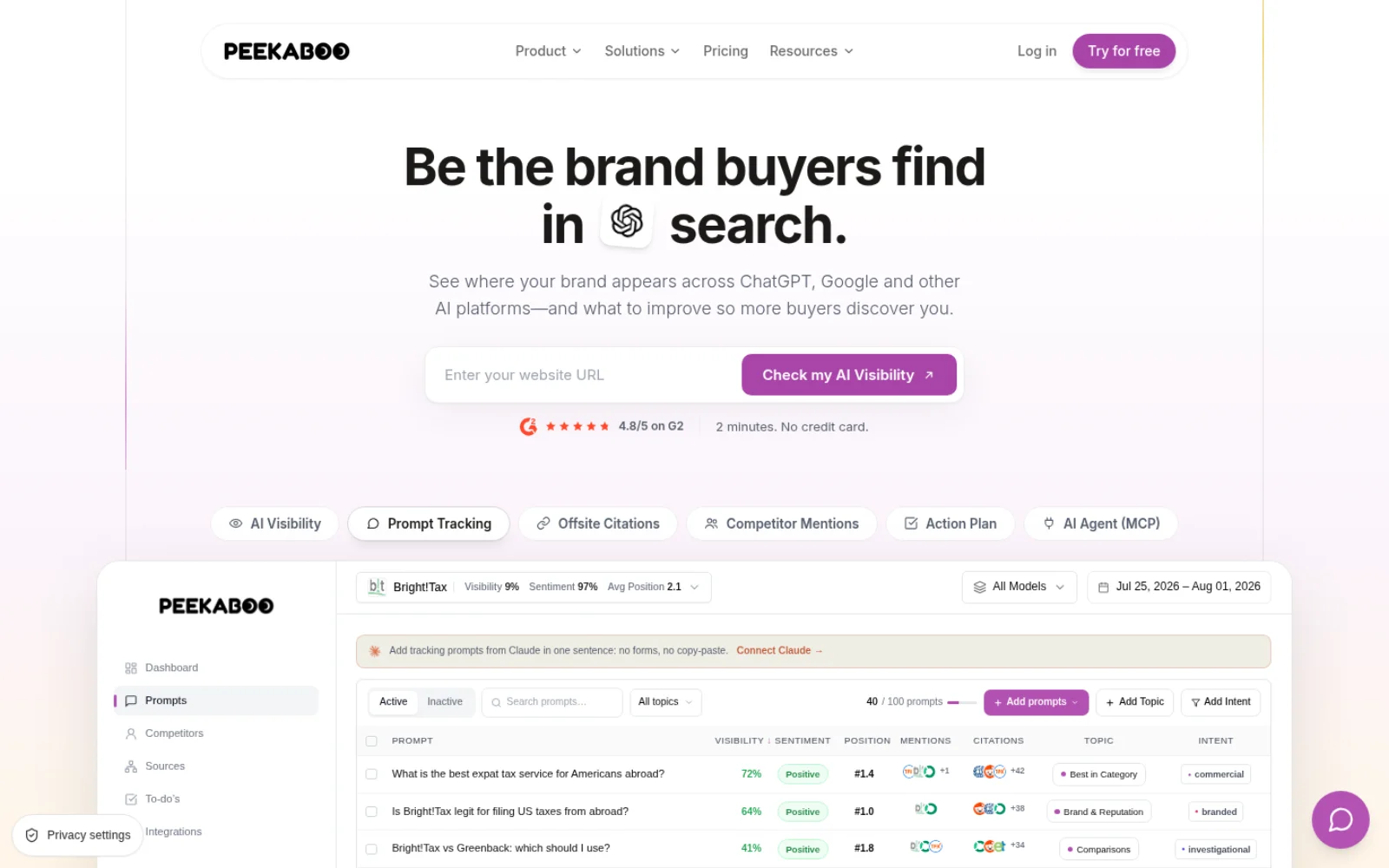
AI Peekaboo is an AI visibility platform that tracks what AI assistants like ChatGPT, Google AI Overviews, Gemini, Claude and Microsoft Copilot say about your brand and your products.
More shoppers now ask an AI assistant for a shortlist before they ever visit a store, so a brand can lose the sale before a session shows up in analytics. AI Peekaboo runs the buyer questions that matter in your category, shows which products and competitors get recommended, and links every visibility score back to the AI answers and cited sources behind it.
Its AI Crawlers feature shows which AI bots (GPTBot, ClaudeBot, PerplexityBot and more) read your site, how often, and which of those pages end up cited in AI answers. It also flags pages AI reads but never cites, so you know which product and category pages need work.
Key use cases:
- Tracking which products AI assistants recommend for the buyer questions in your category
- Benchmarking your share of voice against competing brands and products
- Finding the review sites, publications and Reddit threads AI cites, so PR and content work goes where it counts
- Seeing which product and category pages AI bots crawl and which ones get cited
Key features:
- Brand and product visibility across ChatGPT, Gemini, Perplexity, Google AI Overviews and Google AI Mode, with Claude and Microsoft Copilot as add-ons
- Competitor share of voice, sentiment and the citation sources behind every answer
- AI Crawlers, showing which AI bots read your site and which pages get cited
- GA4 and Google Search Console data alongside AI visibility, plus Looker Studio reporting
- Gaps turned into prioritized to-dos and content briefs, with MCP and REST API access on every paid plan
What we like about this tool:
- Captures answers from the real AI interfaces shoppers use, not just APIs
- Flexible pricing, so a single store brand can track a handful of key prompts without paying for an enterprise tier
- No per-seat pricing, so marketing, content and ecommerce teams can all work in it
- Every score is backed by the actual answer and its sources, which makes it easy to act on
9. Creatopy: Best for Automated Ad Creation

- Rating: 4.6 (G2)
- Price: Starts at $45/month
Creatopy is an ad design automation platform for creating, customizing, and scaling ad production and delivery.It covers the entire cycle of ad production and management—from bulk ad creation to personalization and publishing.
Key use cases:
- Designing animated creative assets for multiple channels
- Automating repetitive ad creation tasks
- Personalizing and localizing ads for different audiences
Key features:
- AI-powered ad creation and editing tools
- Extensive template library for various industries and platforms
- Ad serving and performance optimization
- Brand management tools
What we like about this tool:
- Offers a comprehensive solution for the entire ad creation process
- Provides AI-assisted tools for faster and easier ad production
- Includes collaboration features for team efficiency
10. Schedpilot: Best for Social Media Scheduling
- Price: Starts at $29/month ($21/month billed yearly), 7-day free trial
Schedpilot is a social media scheduling and content planning tool that lets you plan and publish posts across networks like Instagram, LinkedIn, and TikTok from one calendar, with AI agent support through MCP.
It fits ecommerce teams that post on several networks every week and want one calendar for product launches, promotions, and evergreen content instead of logging into each platform.
Key use cases:
- Planning a content calendar around launches and promotions
- Cross-posting the same campaign to several networks
- Managing social accounts for several brands or clients
Key features:
- Scheduling and cross-posting to 9 networks, including Instagram, TikTok, LinkedIn, Facebook, Pinterest, and YouTube
- AI post suggestions, generated posts, and hooks
- Account analytics and reports
- API access and MCP support for AI agents
What we like about this tool:
- One calendar for every network
- AI helps fill the calendar when ideas run dry
- Workspaces and approval workflow on higher plans for teams and agencies
11. Photoroom: Best for AI-Powered Product Photography

- Rating: 4.6 (Product Hunt)
- Price: Free plan available. Pro plan starts at €9.99/month.
PhotoRoom is an AI-powered photo editing tool for product photography and ecommerce visuals. It offers various features to help online sellers create professional-looking images quickly and efficiently.
Key use cases:
- Removing and replacing image backgrounds
- Creating product photos for online stores
- Generating social media content
Key features:
- AI background remover
- AI-generated realistic backgrounds
- Batch editing capabilities
- Customizable templates for social media
What we like:
- Offers free and affordable pro plans
- Targets specific ecommerce needs
- Available on both mobile and desktop platforms
12. Bloomreach: Best for Cross-Channel Personalization

- Rating: 4.6 (G2)
- Price: Custom pricing (request a quote)
Bloomreach is an AI ecommerce personalization platform that integrates real-time customer and product data. It helps you improve marketing, product discovery, and content across various channels.
Key use cases:
- Personalizing customer experiences across websites, apps, and emails
- Improving product search accuracy and relevance
- Customizing marketing campaigns with real-time data
- Simplifying content management
Key features:
- AI personalization for tailored content, search results, and product recommendations
- Advanced ecommerce search with NLP and AI
- Headless CMS for creating and managing shoppable content
- Automated SEO tools to improve keyword rankings and site structure
What we like about this tool:
- Offers a full suite of AI tools for personalized ecommerce experiences
- High level of customization for ecommerce businesses
- Facilitates cross-channel marketing with integrated analytics
13. Octane AI: Best for Interactive Product Discovery

- Rating: 4.9 (Shopify)
Price: Starts at $50/month
Octane AI targets Shopify stores, enabling them to create product quizzes that increase customer engagement and drive sales.
These quizzes act as powerful tools to plug leaks in the customer journey, guiding potential buyers toward purchases that best suit their needs and preferences.
Key use cases:
- Creating product quizzes that guide customers to the right products
- Collecting zero-party data to personalize marketing campaigns
- Reducing returns by providing accurate product recommendations
- Enhancing email and SMS marketing with customer insights
Key features:
- Simple no-code interface for creating and customizing quizzes
- Seamless integration with Shopify, Klaviyo, and other major platforms
- AI-powered product recommendations based on customer inputs
- Engagement analytics to track and measure quiz performance
What we like about this tool:
- Integrates smoothly with existing Shopify operations
- Claims to increase average order value (AOV) and reduce return rates
- Offers innovative and data-driven features for ecommerce stores
14. Klaviyo AI: Best for Ecommerce Marketing Automation

- Rating: 4.6 (G2)
- Price: Offers a free plan. Paid plans start at $60/month for email and SMS and $45/month for email only.
Klaviyo is an all-in-one marketing automation platform for creating personalized customer campaigns across email, SMS, and push notifications.
It’s designed specifically for ecommerce businesses, unifying customer data and marketing automation to boost cross-channel performance.
Key use cases:
- Automating personalized email, push, and SMS marketing campaigns
- Segmenting customers based on behavior, preferences, and predictive analytics
- Unifying customer data across all touchpoints for better targeting
Key features:
- Real-time segmentation for personalized marketing
- AI insights for smarter campaign execution and customer predictions
- Drag-and-drop automation builder for custom workflows
- Comprehensive customer data platform for centralized data management
What we like about this tool:
- Offers a unified platform for various channels, including email, SMS, and mobile push
- AI features simplify complex tasks like segmentation and campaign creation
- Strong focus on data-driven growth with powerful analytics and reporting tools
15. Shopify Magic: Best All-in-One Ecommerce Marketing Tool

- Rating: 4.7 (Shopify)
- Price: Included with Shopify plans
Shopify Magic covers tasks like creating product descriptions, editing product images, and responding to customer queries.
Any merchant using Shopify can access this platform for free.
Key use cases:
- Editing product images with AI
- Generating SEO-friendly product descriptions
- Automating customer FAQs
- Optimizing email campaigns with AI-generated content
Key features:
- AI-powered image editing
- Smart product description generator
- Automated FAQ suggestions
- AI-driven email optimization
What we like about this tool:
- Available to all Shopify users
- Covers various use cases, saving you time and money
- Provides access to Sidekick, Shopify’s AI assistant
16. Jasper: Best for AI Content Generation

- Rating: 4.7 (G2)
- Price: Starts at $49/month
Jasper is an AI writing assistant that creates on-brand content in various formats, from blogs and social media to emails and product descriptions.
It’s a great platform for generating product marketing content and product descriptions at scale.
Key use cases:
- Writing product descriptions, blogs, and social media posts
- Automation of on-brand content creation across various channels
- Improving content performance and writing product marketing content
Key features:
- AI-powered copywriting in various formats
- Creation of your unique brand voice
- Analytics and insights for optimizing content performance
- Advanced team collaboration tools to speed up content production
What we like about this tool:
- Provides powerful AI tools to create and optimize content at scale
- Helps ensure your content is on-brand and consistent across channels
- Improves productivity and reduces content creation costs
17. SurferSEO: Best for Long-Form SEO Content

- Rating: 4.8 (G2)
Price: Starts at $89/month
Surfer is an SEO content writing tool for finding topic ideas for your blog, optimizing your content, and generating SEO-friendly articles.
It’s a great option if you’re planning to attract organic traffic with blog posts and other long-form content.
Key use cases:
- Generating SEO-friendly articles with AI
- Optimizing articles for SEO to improve Google rankings
- Conducting content audits to enhance existing pages
- Automating internal linking for better site structure
Key features:
- AI-powered content optimization
- Generation of articles optimized for SEO
- Content auditing and AI content humanizer
- Topic and keyword exploration
What we like about this tool:
- Generates content optimized for search engines
- Scores your drafts and helps you improve them
- Uses real-time SEO data alongside AI models
18. Zavvy by Deel: Best for Employee Development

- Price: Request a custom quote
- Rating: 4.8 (G2)
Zavvy is an all-in-one AI people enablement platform that focuses on employee development, performance management, and engagement.
It offers tools for the entire employee lifecycle, from onboarding to ongoing training and career development. For example, you can create personalized learning paths and generate insights into employee performance.
Key use cases:
- Streamlining employee onboarding
- Facilitating continuous performance feedback and reviews
- Developing career frameworks and growth plans
Key features:
- Customizable onboarding workflows
- Learning management system with AI-assisted course creation
- Career pathing and skills matrix tools
- Engagement surveys, 360-degree feedback tools, and eNPS tracking
What we like about this tool:
- It’s a comprehensive suite of HR tools in one platform
- AI-powered content creation for various HR processes
- Strong focus on employee development and growth
19. Kanal: Best for WhatsApp Marketing
- Price: Starts at €89/month
- Rating: 5/5 (Shopify App Store)
Kanal is a WhatsApp marketing platform built for Shopify stores. It connects to your store data to send WhatsApp campaigns, recover abandoned carts, and answer shoppers through an AI agent.
It works well for brands whose customers already use WhatsApp daily and want a channel next to email and SMS for cart recovery and repeat purchases.
Key use cases:
- Recovering abandoned carts over WhatsApp
- Sending segmented promotional campaigns
- Automating upsells and post-purchase messages
Key features:
- Abandoned cart recovery flows
- WhatsApp campaigns with Shopify segmentation
- AI agent to answer customer questions
- Chat widget and shared inbox
What we like about this tool:
- Built specifically for Shopify brands
- Higher plans include flow setup by their experts
- Covers marketing and customer conversations in one place
20. HeyOz: Best for AI Video and Image Ads
- Price: Starts at $19.99/month
HeyOz is an AI ad creator that turns a website link or product photo into ready-to-run image and video ads. It picks up your brand colors and voice, then generates ads with AI actors, voiceovers, and music.
It is a quick way to produce enough creative variations to test on Meta and TikTok without a studio or an editor.
Key use cases:
- Producing UGC-style video ads with AI actors
- Generating product shoots without a studio
- Refreshing ad creatives to fight creative fatigue
Key features:
- Image and video ad generation, up to 60-second videos
- AI avatars and voices in 10 languages
- Brand kit pulled from your website
- Publishing and scheduling to Instagram, TikTok, Facebook, and YouTube
What we like about this tool:
- Goes from a product link to a finished ad in minutes
- Covers both static and video formats
- Low entry price for small teams
Other AI Tools for Ecommerce Businesses
Are you looking for something else? Here are some other AI ecommerce tools to include in your suite:
- AI Dynamic Pricing by Intelis: AI tool enabling dynamic pricing for your store
- AI SEO Optimizer & SEO Booster: AI app for creating SEO-rich product descriptions
- StoreSEO: AI app covering various use cases, from improving technical SEO to bulk-generating SEO metadata
- Semrush’s Keyword Strategy Builder: AI-driven tool that uses Semrush’s SEO data. It helps you create keyword clusters for your site by inputting one seed keyword.
- Onestream: AI-powered platform that offers solutions for financial planning, reporting, financial closing, integrating business planning, and more.
- Signifyd: AI-powered tool that provides advanced fraud protection and payment security solutions to optimize checkout processes and increase conversions.
- Chargeflow: Automated chargeback management solution that helps you recover lost revenue and reduce chargebacks.
- ChatGPT: The most famous AI chatbot you can use for various generic tasks, from short-form copy creation to brainstorming and basic analysis.
How to Choose the Best AI Tools for Ecommerce
Before you make the decision, here are some tips for choosing the right AI tools for your ecommerce business:
- Prioritize user-friendliness and quick integration. A good AI tool shouldn't require a massive learning curve or weeks to implement. Look for solutions with intuitive interfaces, detailed onboarding support, and clear documentation.
- Start with the areas that need the most attention. This could be underperformance in certain metrics or processes that frustrate your employees. You can spot these by analyzing performance metrics or surveying your teams.
- Choose ecommerce specific platforms whenever possible. These tools are tailored to the unique realities of online retail and are often easier to integrate with popular ecommerce platforms.
- Consider scalability. As your business grows, your AI tools should be able to grow with you. Look for solutions that offer flexibility and can handle growing data volumes and complexity.
- Evaluate the vendor's support quality and platform updates. Reliable customer support and regular software updates are crucial for long-term success with any AI tool.
- Check for compatibility with your existing systems. The AI tool should integrate smoothly with the specific ecommerce platforms and any other software you use.
If you'd rather have someone set these tools up for you, start with this list of the best AI automation agencies.
Final Thoughts: Navigating AI Hype
AI helps modern ecommerce companies grow better.
It promises to optimize and enhance nearly every aspect of your operations—from marketing and customer service to data analytics. But remember, not every AI tool will deliver the game-changing results it claims.
The key is to approach AI with a strategic mindset.
Rather than getting swept up in the latest trends, focus on selecting tools that genuinely address your unique business challenges.
Start small, integrate new solutions over time, and always measure the impact before fully committing.
If you’re ready to cautiously dip your toes into the AI waters, here’s a solid starting lineup:
- Polar Analytics: Unify your data and generate actionable business insights.
- Shopify Magic: Manage marketing tasks from one place, from creating product descriptions to setting up live chats
- Octane AI: Create simple product quizzes to guide customers and gather data.
- Klaviyo: Engage your customers with relevant, personalized marketing campaigns.
- Gorgias: Start automatically handling customer inquiries 24/7.
- PhotoRoom: Improve your product photography without any design expertise.
Ready to create a strategy for your AI transformation? Start by completing our free AI readiness test designed for ecommerce leaders.
{{button-popup}}
Table of contents
Frequently asked questions