Semantic Layer vs Metrics Layer vs Data Catalog: What Is the Difference?

TL;DR
If you have spent time researching the modern data stack, you have likely run into three terms that seem interchangeable but actually describe different things: semantic layer, metrics layer, and data catalog. Understanding the distinction matters for data teams and business users who want to build a coherent data architecture that delivers trustworthy insights.
The confusion is understandable. All three sit between your data warehouse and your analytics tools. All three deal with how data is organized and exposed. And vendors use the terminology inconsistently marketing a metrics store as if it were a full semantic layer, or calling a product a "semantic layer" when it only handles query logic.
Here is the simplest framework:
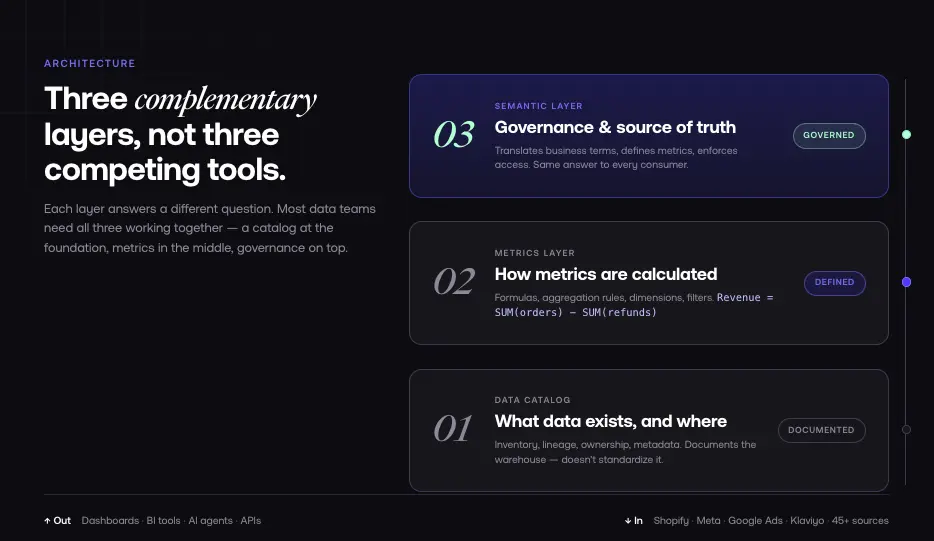
- Data Catalog = what data you have and where it lives (inventory + lineage)
- Metrics Layer = how business metrics are calculated (definitions and formulas)
- Semantic Layer = all of the above, plus governance, business logic enforcement, and a single source of truth for every consumer
They are complementary layers, not competing categories. Most data teams need all three working together.
Why the Terminology Is Confusing
These concepts create confusion because they all address the same root challenge: data teams build clean pipelines and models, but business users still get different numbers depending on which tool they use or which analyst they ask.
The market has not settled on standard definitions. Some vendors call their product a "semantic layer" when it only stores metric definitions. Others claim their data catalog solves the governance problem when it only documents what exists.
The practical result: organizations buy a tool thinking it creates a single source of truth, then discover it does not handle business logic, role-based access, or metric definitions the way they expected.
What Is a Semantic Layer?
A semantic layer is the complete business logic and governance layer between your data sources and your analytics tools. It is the authoritative framework that defines what every metric means, who can access it, and how it should be queried across all downstream consumers.
A full semantic layer does four things:
Translates. It converts business terms into database queries. When a user asks "What was revenue this quarter?", the semantic layer generates SQL against the right tables with the right filters and joins. Business users never write queries.
Defines. It encodes business definitions directly into the architecture. Revenue is not just a column it is a specific formula: gross sales minus returns, minus discounts, excluding test orders, from confirmed orders only. These definitions live in one place and flow to every tool.
Enforces. It governs access at the metric level. Security rules are embedded in the semantic layer, not left to individual tools.
Enables trust. When all users query the same semantic layer, they get the same answers. That is what creates a real single source of truth not just documentation, but technical enforcement.
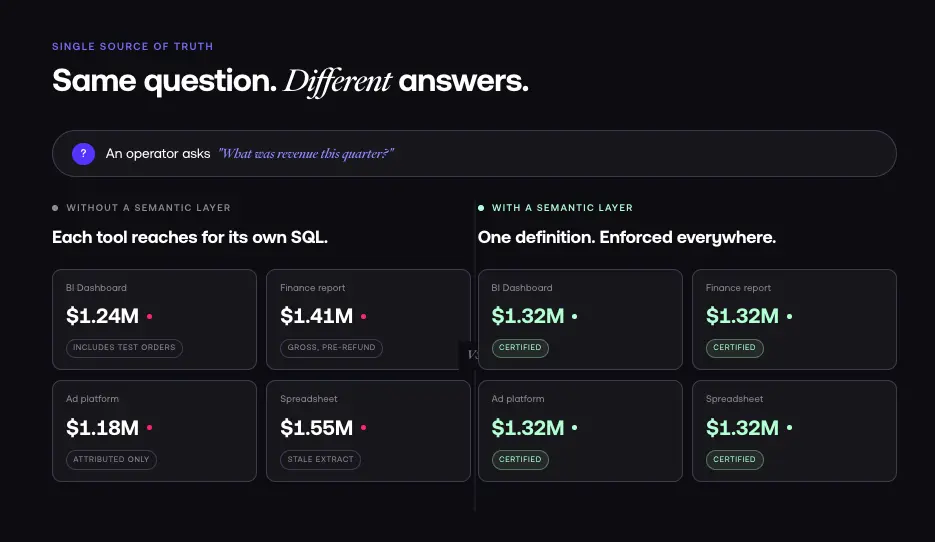
Semantic layers have existed in BI for decades. Looker's LookML was one of the first widely deployed implementations a modeling language that defines metrics, dimensions, and relationships in code, ensuring every Looker user queries governed definitions rather than raw SQL. LookML demonstrated the value of centralizing business logic, though it is embedded inside Looker (now part of Google Cloud) and does not serve tools outside the Looker ecosystem without additional work. Cube is an open-source headless semantic layer that exposes governed metrics via API to any downstream consumer. Polar Analytics takes a managed approach for Ecommerce, combining pre-built metric definitions with governance and AI query capabilities.
What Is a Metrics Layer?
A metrics layer sometimes called a metrics store is focused specifically on metric definitions and calculation logic. It answers one question: how are business metrics calculated?
A metrics layer defines metric formulas (Revenue = SUM(order_amount) - SUM(refund_amount), scoped to confirmed orders), aggregation rules (SUM, COUNT, AVG, COUNT_DISTINCT), dimensions (how metrics can be broken down by channel, product, customer segment), and filters (what data to include and exclude).
dbt Semantic Layer is the most prominent implementation in this category. Built on the MetricFlow framework (open-sourced under Apache 2.0), dbt's Semantic Layer went GA in 2025 and has evolved beyond a pure metrics layer. It now supports API access (SQL API, GraphQL API), integrates with downstream BI tools (Tableau, Hex, Mode, Google Sheets), and aligns with the Open Semantic Interchange standard. dbt Labs explicitly markets it as a "semantic layer"and the product increasingly justifies that label. It defines metrics in version-controlled code alongside data transformations, with testing, documentation, and lineage.
Where dbt's Semantic Layer currently stops short of a full enterprise semantic layer: it does not include a natural language query interface for business users, does not provide a managed connector layer for non-technical teams, and still assumes a data engineering team to build and maintain the dbt project. For organizations with strong data engineering, dbt's Semantic Layer is a serious option. For teams without engineering resources which describes most Ecommerce brands under $20Ma managed platform with pre-built definitions is more practical.
Lightdash and similar tools also operate in the metrics layer space, often building on top of dbt's modeling framework.
What Is a Data Catalog?
A data catalog is an inventory and documentation system for your data assets. It answers the question: what data do we have, where does it come from, who owns it, and how does it flow through our infrastructure?
A data catalog documents data structures (what tables, columns, and models exist), data lineage (how data flows from sources through pipelines into the warehouse and downstream), ownership (which team owns each dataset), metadata (when data was created, refresh frequency, quality standards), and business terms (human-readable descriptions of what each column represents).
Tools like Alation, Atlan, and Amundsen are purpose-built data catalog platforms. Apache Atlas is a common open-source option.
What a data catalog does not do: it does not define metric formulas, enforce business logic, or create a single source of truth for metric calculations. It documents what exists it does not standardize how data is used to calculate metrics.
Head-to-Head Comparison
How the Three Layers Work Together
The Complementary Structure
Foundation: Data Catalog. Documents what data exists across all sources. "We have Shopify orders, Meta conversion data, Google Ads spend, and Klaviyo email events all flowing through these pipelines into our warehouse."
Middle: Metrics Layer. Defines the business metrics that transform raw data into measures. "Revenue = orders.amount minus refunds, for confirmed orders only. ROAS = revenue divided by ad spend, by channel."
Top: Semantic Layer. Adds governance, access control, and enforcement. "Revenue is defined this way, certified as authoritative, accessible to these stakeholders based on their role, and used consistently by all tools, dashboards, and AI agents."
Where Layers Overlap in Practice
In reality, these layers are not always cleanly separated. Most semantic layer implementations include some form of metric documentation and discoverabilityLooker's Explore interface, Cube's playground, and Polar's metric catalog all let users browse available metrics and their definitions without needing a separate data catalog for that purpose. Similarly, dbt's Semantic Layer includes documentation and lineage features that overlap with catalog functionality.
The layers are most useful as a mental model for evaluating what a tool actually provides versus what it claims. When evaluating any product, ask: does it define metrics (metrics layer)? Does it document and track data assets (catalog)? Does it enforce governance and serve consistent answers to every consumer (semantic layer)? Most tools do one or two well. Few do all three completely.
When Gaps Exist
The practical problems emerge when you have metric definitions but no governance different teams use the same formulas with different underlying data, and nothing enforces consistency. Or when you have documentation but no standardized calculations users can discover data but still debate what the numbers mean. Understanding which capabilities you have and which you are missing is more useful than asking "do I have all three layers?"
The Role of dbt in the Modern Data Stack
dbt deserves a standalone discussion because its position in this landscape has shifted significantly. The dbt metrics layer (built on MetricFlow) brought metric definitions into the data modeling layer for the first time, allowing data engineering teams to define metrics in version-controlled code alongside their data transformations.
With the GA release of the dbt Semantic Layer in 2025, dbt Labs moved beyond pure metric definitions. The product now includes API access for downstream consumers (SQL API, GraphQL API), integrations with BI tools, and alignment with the Open Semantic Interchange standard an industry effort to standardize how semantic layer metadata is shared across tools.
For data teams evaluating dbt: it is no longer accurate to call dbt "just a metrics layer." It is moving toward full semantic layer capabilities. The current gaps are in managed data integration (dbt assumes you handle your own ELT), natural language query interfaces for non-technical users, and out-of-the-box metric definitions for specific verticals.
Teams with strong data engineering can build a comprehensive semantic layer on dbt.
Teams without engineering resources need a managed alternative.
Headless BI and the Emerging Architecture
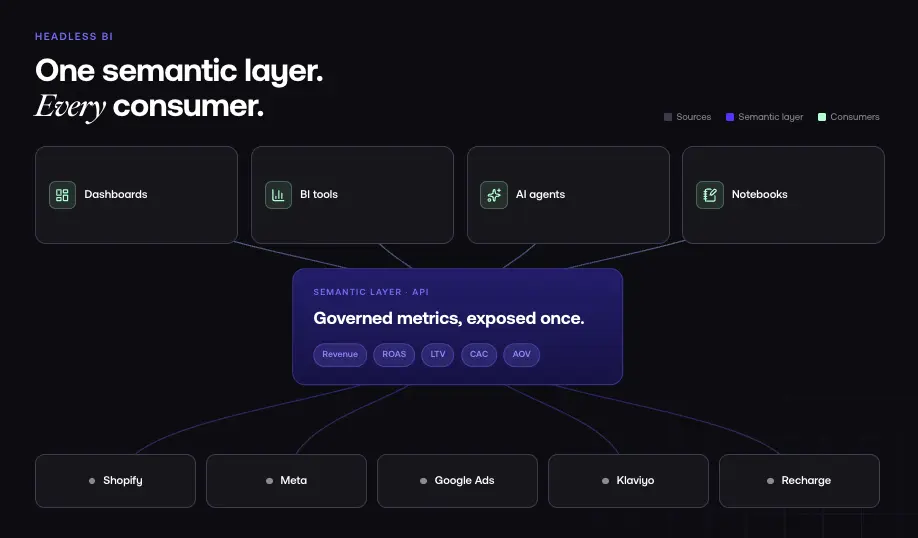
One of the most important architectural patterns in this space is headless BI, where the semantic layer is fully decoupled from the visualization layer. Instead of embedding metric definitions inside specific BI tools, organizations define all business logic in a central semantic layer and expose it via API to any downstream consumer: dashboards, data science notebooks, AI agents, or natural language query interfaces.
This approach matters because it prevents metric drift (definitions live in one place, not inside each BI tool), it enables AI-readiness (AI tools need governed, structured access to metrics, not raw data), it supports self-service (business users query directly without analyst mediation), and it scales (new tools connect to the same layer rather than building their own logic).
Looker pioneered aspects of this approach with LookML, though it remains embedded in the Looker platform. Cube is a purpose-built headless semantic layer. dbt's Semantic Layer with its API access is moving in this direction. Polar Analytics applies the headless pattern specifically for Ecommerce with pre-built metric definitions.
Which Do You Need?
Small Ecommerce Team (Under 10 People)
You need a single platform that combines metric definitions, governance, and data documentation. You do not have the engineering resources to build and maintain separate systems.
The critical requirement is metric definitions that all stakeholders trust ROAS, LTV, CAC, AOV calculated consistently across every channel. A managed platform like Polar Analytics provides a semantic layer with pre-built Ecommerce metric definitions, so your team can analyze performance without arguing about which number is right. The Polar Pixel installs in minutes and data flows within 24 hours not the months required to build a custom dbt project from scratch.
Growing Brand with Multiple Analytics Tools
You need the full stack: discoverability across your growing data infrastructure, standardized metrics, and governance to ensure all stakeholders get the same answers.
As your data sources multiplyShopify, Meta, Google Ads, TikTok, Klaviyo, Recharge each source has its own definitions and structures. A governed semantic layer is what turns that complexity into coherent insights.
Enterprise Scale
You likely already have components of each layer. The question is integration and governance. Audit what you have: do you have a catalog but inconsistent metrics? Build or buy a metrics layer. Do you have metrics but no governance? Add semantic layer capabilities. Do you have both but poor discoverability? Strengthen catalog capabilities. Do you have all three but no API for downstream services? A headless semantic layer may be the next step.
How Polar Analytics Fits
Polar Analytics provides a managed semantic layer for Ecommerce. It ships with 400+ pre-built Ecommerce metric definitions ROAS, LTV, CAC, AOV, contribution margin, MER, repeat purchase rate, and hundreds more with eEommerce-correct business logic and reconciliation rules across 40+ data sources. 80% of metrics work out of the box; 20% are customizable to your specific business logic.
What Polar does well: governed metric definitions enforced across all consumers. A first-party server-side pixel captures every customer event including those lost to iOS restrictions, Safari cookie limits, and ad blockers and performs cross-device stitching via email, IP, and device identifiers.
A separate Shapley-based attribution model takes that complete event data and distributes credit across every touchpoint, replacing platform self-reported last-click logic. Ask Polar provides natural language queries against governed definitions. Polar MCP exposes the semantic layer to Claude, ChatGPT, and Cursor.
For most Ecommerce teams, Polar's connector-level visibility is sufficient.
FAQ
Table of contents
Frequently asked questions