How Maui Nui Venison Built a Customer Drop-off Agent That Became Its #1 Performing Klaviyo Flow
connected
per month
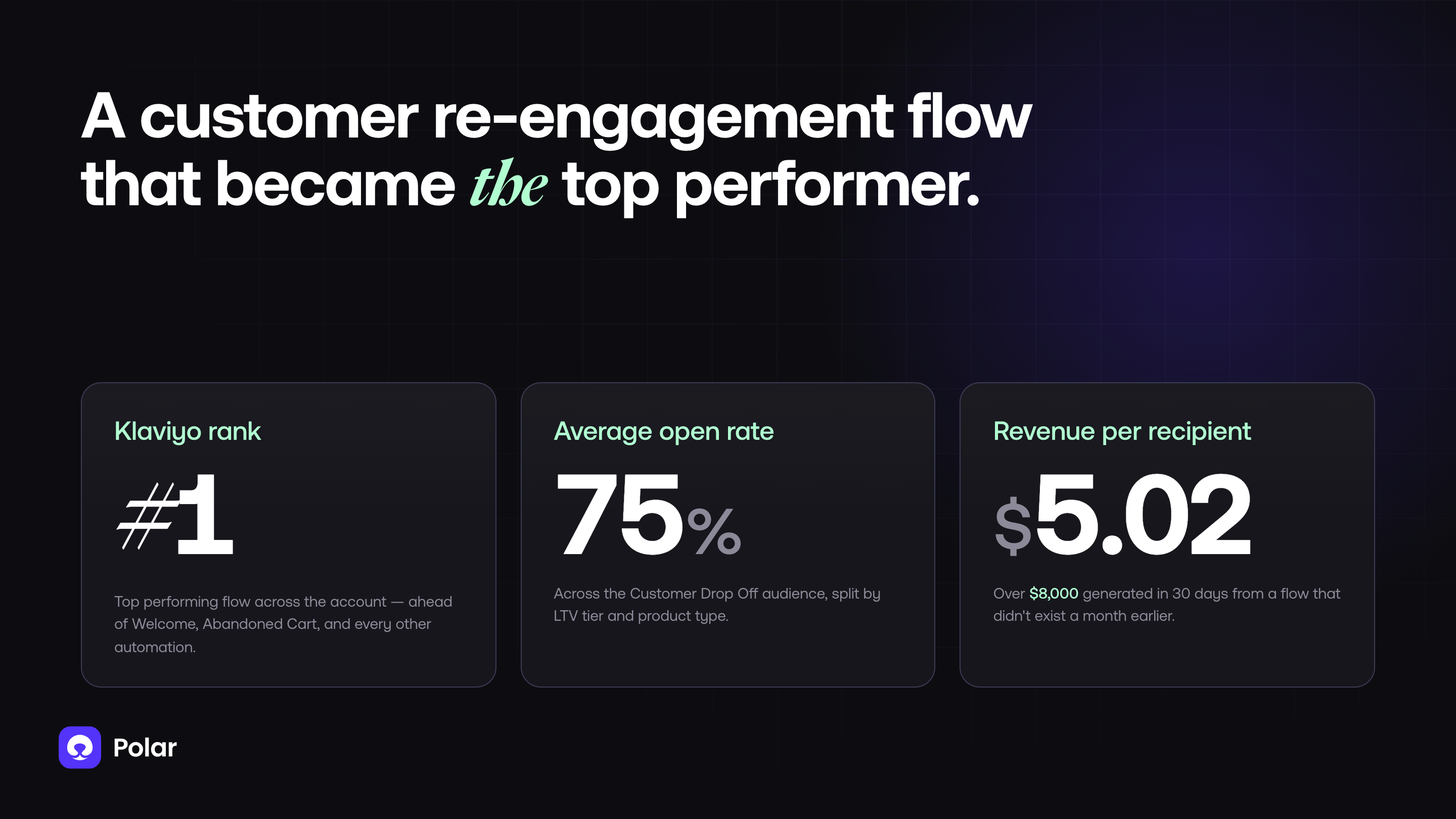
Results at a Glance
- #1 Top performing Klaviyo flow (last 30 days)
- 75% Average open rate
- $5.02 Revenue per recipient
The Challenge
Maui Nui Venison is a mission-driven DTC brand selling premium wild-harvested venison from Maui, Hawaii. With 85% of their revenue coming from subscriptions, customer retention is the lifeblood of the business.
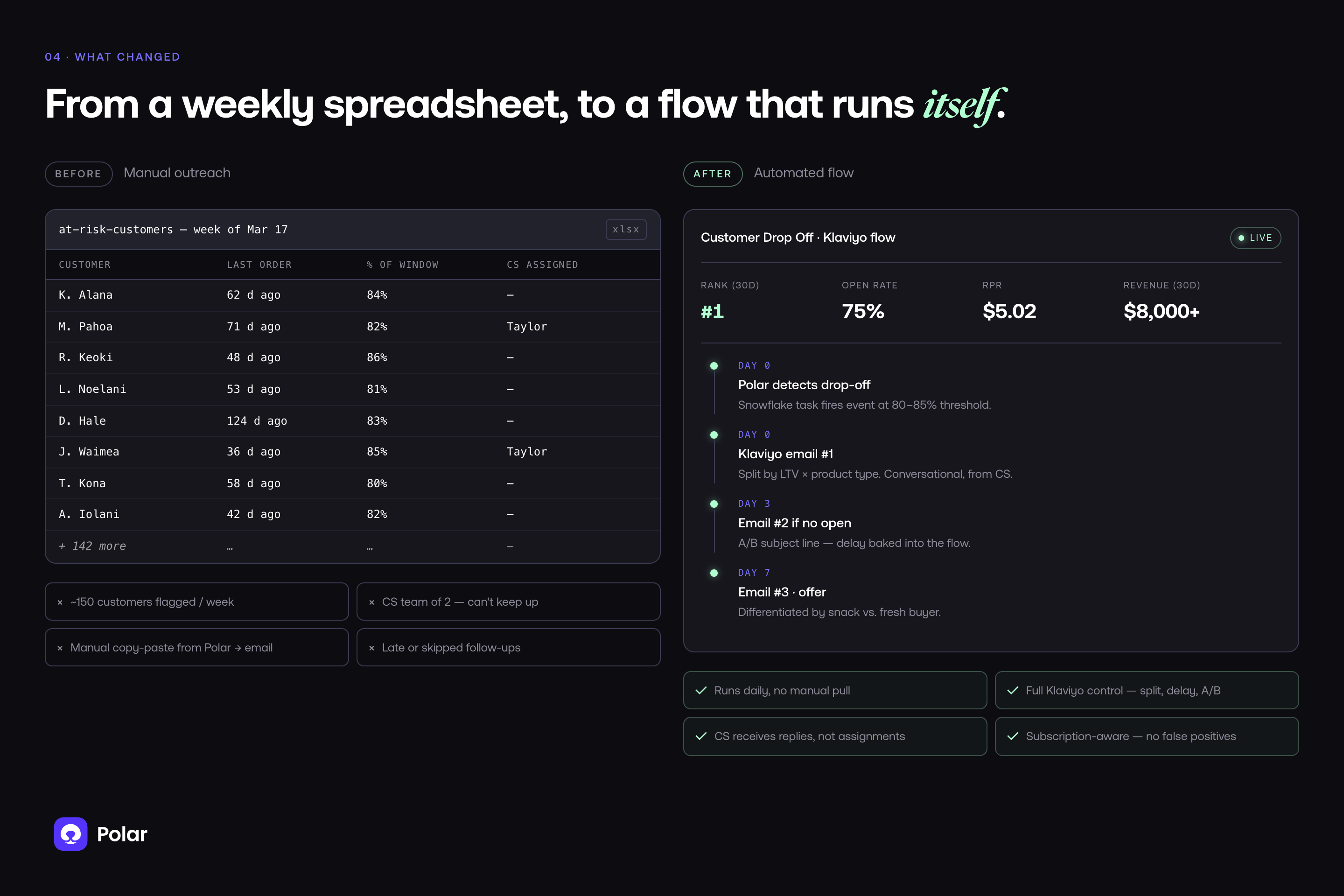
Taylor, who leads growth and retention at Maui Nui, was already tracking customer drop-off manually inside Polar. Every week, he pulled a list of customers who had crossed 80% of their expected re-purchase window and sent it to the customer service team for personal outreach.
The problem: the list was consistently around 150 people per week, and with a CS team of only two, it was impossible to keep up.
Manually monitoring and proactively reaching out to customers who are at risk of churning is proving to be much more work than our CS team is able to handle. I'd love to automate this outreach by using Polar's data to trigger automated flows in Klaviyo.

The Approach
Polar's solutions team, led by Alexis Laks, worked directly with Taylor to turn his manual workflow into an automated, data-driven system. The project moved from idea to production in under a month.
1. Building the Customer Drop-off Agent
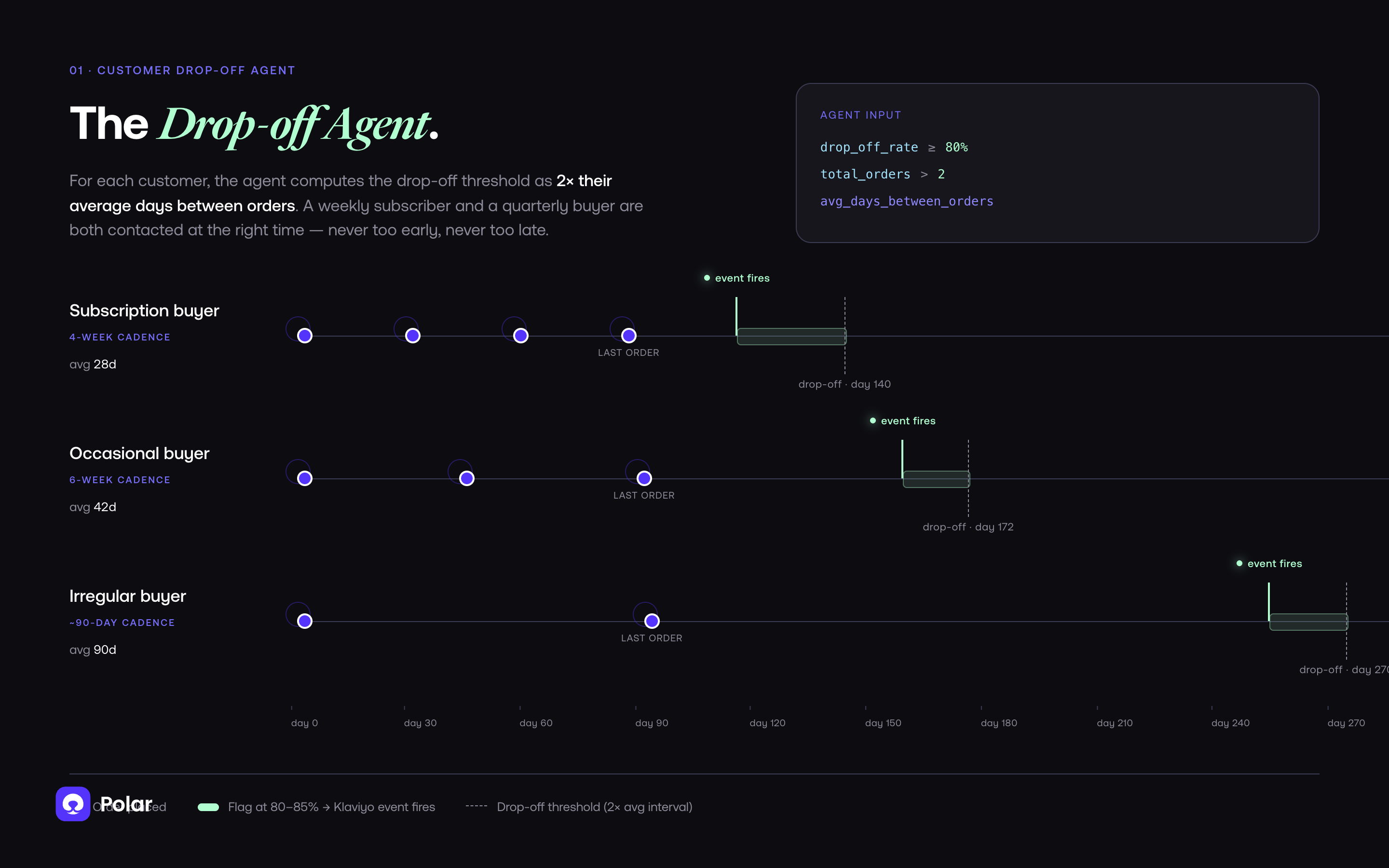
Instead of using a static “60-day inactivity” window, Polar built a Customer Drop-off Agent that calculates each customer’s average time between orders and sets their drop-off threshold at 2x that interval. A customer who orders every 30 days has a 60-day drop-off window. A customer who orders every 14 days has a 28-day window.
This matters because Maui Nui’s customer base is diverse: subscription customers with tight cadences, gift buyers with irregular timing, and one-time purchasers. A one-size-fits-all threshold would miss some customers and spam others.
2. Agent Input — defining the right audience
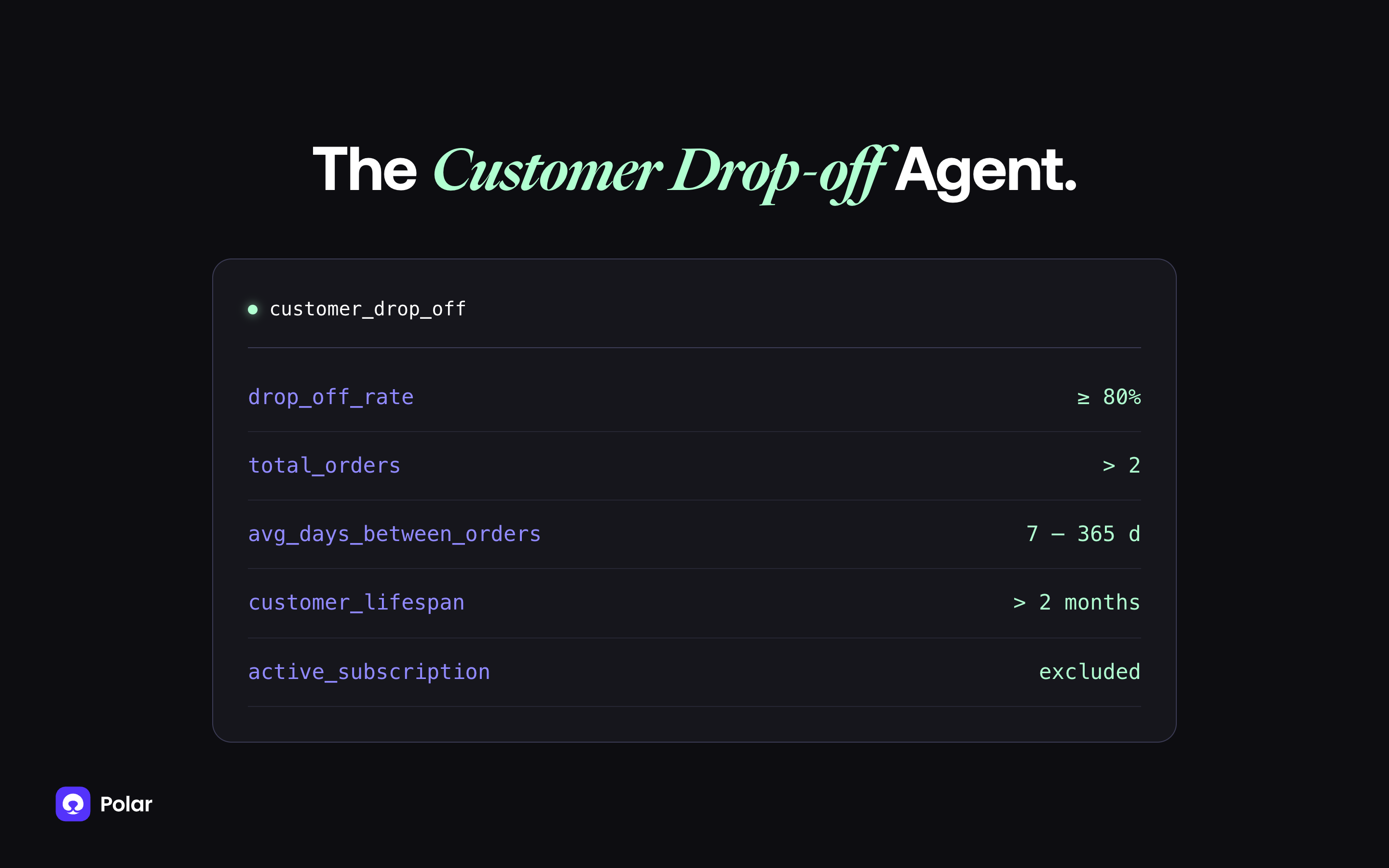
Early syncs surfaced edge cases. One-time buyers had no meaningful purchase cadence, so their drop-off threshold was meaningless. Holiday gift buyers who placed five orders in a week ended up with a four-day frequency. Taylor and Alexis iterated on the filters together. These filters define the agent’s input criteria — what it evaluates before flagging a customer:
The 80-85% window was intentional: it catches customers just before they fully lapse, giving the CS team and Klaviyo flows the best chance of re-engaging them before it’s too late.
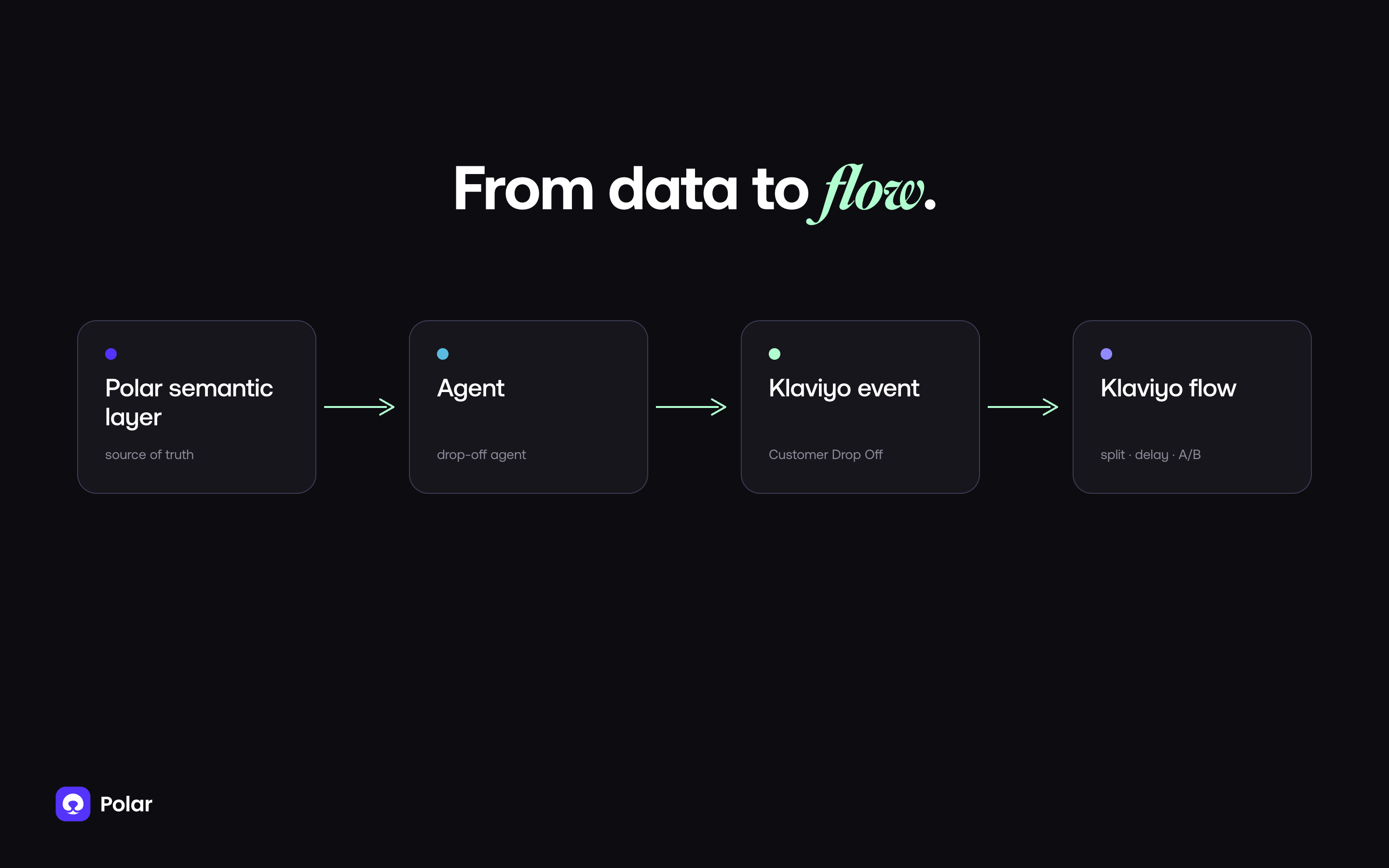
3. The agent syncs to Klaviyo as events
Rather than pushing a static list or tag, Polar sends a custom Klaviyo event (“Customer Drop Off”) for each qualifying customer. This was a deliberate choice: events trigger flows, and flows give Taylor full control over the messaging, timing, and segmentation logic inside Klaviyo without needing to touch the underlying data.
The agent runs daily via a Snowflake task, diffs against previously synced records, and pushes only new ‘Customer Drop Off’ events to Klaviyo. To handle re-engagement cycles, each event uses a unique ID of customer ID + current month. If a customer is saved by CS in January but drops off again in March, the system catches them again.
“So basically there’s nothing that needs to be done on our end in Klaviyo to make sure someone gets filtered in whenever they are eligible - that will happen automatically in the data that Polar provides.”
Taylor, Maui Nui Venison
4. Subscription-aware filtering
Once live, a new edge case appeared: some customers were being flagged even though they had active Recharge subscriptions with upcoming charges on schedule. Their average time between orders was skewed by a past frequency change (e.g., switching from a 4-week to an 8-week subscription), making them look overdue when they weren’t.
The agent is subscription-aware: if a customer’s next scheduled Recharge charge is in the future, they’re excluded automatically — no false positives. The logic is computed entirely from order history, so it doesn’t rely on Recharge’s charge status fields.
The Result
Taylor’s team built a Klaviyo flow on top of the “Customer Drop Off” event that splits customers two ways: by spend tier (over or under $1,000 lifetime value) and by product type (snack vs. fresh). The emails are written to feel personal and conversational, as if they’re coming from the CS team.
“We got an email sequence live for the customer drop off last week. It splits between high value over $1k and under $1k spend, then splits again if someone purchases snack product or fresh product. We’ve sent a couple hundred people through it and the emails are averaging a 75% open rate. Customer service is loving the continual flow of replies.”
Taylor, Maui Nui Venison
Within weeks, the flow became Maui Nui’s number one performing Klaviyo flow, at $5.02 revenue per recipient - outperforming their Welcome Series, Abandoned Cart, and every other automation. The CS team, previously overwhelmed by manual outreach, now fields responses from an automated system that does the heavy lifting.
Why it worked
Individualized thresholds, not static rules. The agent adapts to each customer’s actual purchase behavior, so a weekly subscriber and a quarterly buyer both get contacted at the right time.
Iterative refinement with the customer. The agent was refined iteratively through real-world feedback. One-time buyers got filtered out. Holiday bulk buyers got excluded. Subscription-active customers got carved out. Each iteration made the signal sharper.
Event-based activation. By sending events rather than lists, Maui Nui’s marketing team has full control inside Klaviyo. They can split, filter, delay, and A/B test without asking Polar to change the data pipeline.
The insight already existed. Taylor was already doing this manually. Polar didn’t invent the use case - it removed the bottleneck. The data was already in the platform. What changed was the bridge to Klaviyo.
Looking ahead
Maui Nui and Polar are now exploring the next layer: enriching the agent with Recharge subscription data and exploring predictive churn signals.
The fastest growing Shopify brands use Polar Analytics