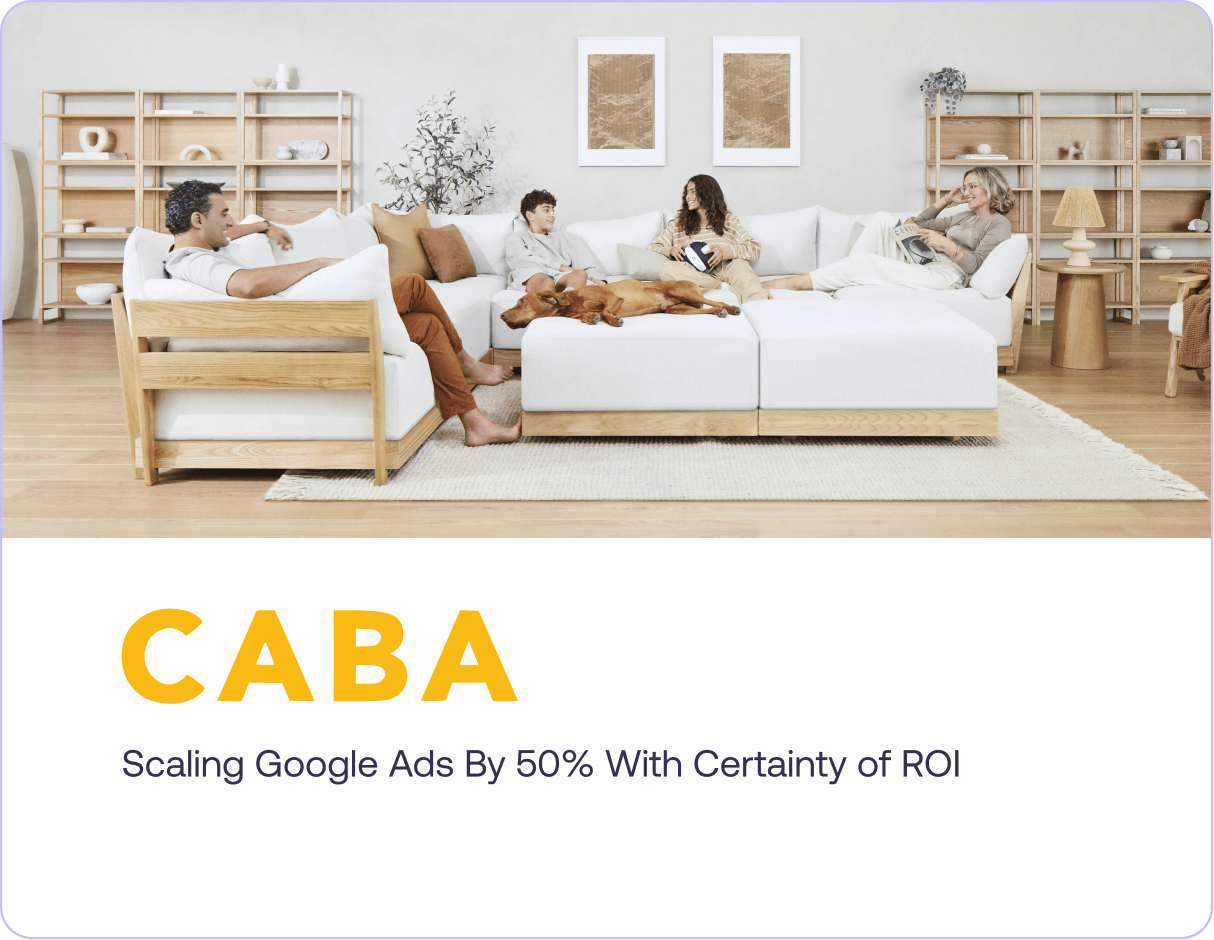
Polar vs. Triple Whale: CABA Design’s First-Touch Attribution Audit

connected
per month
Quick Stats
We ran a head-to-head audit of Polar against Triple Whale. Polar recovered earlier valid first touches in 100% of disputed orders. When Triple Whale showed a first click on September 2nd, Polar found the real first touch was August 25th - a week earlier. That kind of gap changes everything about how you allocate budget.

The Problem: Long Funnels Make Bad Attribution Expensive
Building the next generation of home brands - with the wrong attribution map.
Some companies sell furniture. CABA Design is building an ecosystem.
Founded in 2017 by serial entrepreneur Ben Parsa (previously of Dot & Bo), CABA Design set out to challenge traditional furniture norms. The company develops sustainable, high-quality furniture brands that give customers unprecedented choice through customization and modularity. Today, CABA operates seven distinct brands with a lean team of just 30 people - a testament to their focus on efficiency and scalability.
But for a DTC furniture company, the math is unforgiving. High-consideration purchases. Long customer journeys. And a marketing spend that needed to work harder than ever.
CABA was using industry-standard attribution tools to understand which channels were driving growth. The problem? They started to suspect those tools were telling an incomplete story.
A $2,000 Sofa Doesn’t Sell From One Click
When a customer finally purchases a $2,000 custom sofa, they didn’t just see one ad. They saw dozens of touchpoints across weeks or months. The question is: which touchpoint actually started the journey?
For CABA, this wasn’t academic. Budget allocation depended on it. If their attribution tool was crediting the wrong channel as “first touch,” they were potentially over-investing in bottom-funnel campaigns while starving the prospecting efforts that actually filled the pipeline.
The team decided to run a rigorous head-to-head audit.
The Audit: Polar vs. Triple Whale, Order by Order
A transparent, auditable head-to-head attribution audit.
In October 2025, CABA ran a comprehensive head-to-head comparison of Polar and Triple Whale - evaluating each platform’s ability to identify the true first touchpoint in customer journeys.
The methodology was simple but demanding:
- Pull raw touchpoint data for disputed orders
- Compare first-touch timestamps, channel attribution, and session capture
- Validate each platform’s claims with cross-referenced IP, user agent, and journey data
What they found changed how they thought about their entire marketing stack.
The Finding: Polar Recovered Earlier First Touches Every Time
 Polar
First touch found
Polar
First touch found
 Triple Whale
First touch missed
Triple Whale
First touch missed
When comparing Polar and Triple Whale on disputed orders, Polar found an earlier valid first touch in all cases - 100%.
One example stood out: Triple Whale’s “first click” for a customer was September 2nd. Polar’s data showed the real first touch was August 25th - a full week earlier, attributed to a top-of-funnel Facebook traffic campaign.
The implication? In this case, Triple Whale credited bottom-funnel retargeting for a conversion that actually started with prospecting - and budget decisions based on that kind of gap can systematically under-invest in awareness campaigns.
Why Polar Saw What Triple Whale Missed
Polar
Triple Whale
- The Polar Pixel: Polar built its proprietary attribution technology end-to-end, so it can record more quality ad clicks as valid touchpoints. The pixel is best-in-class, and CABA’s audit proved it.
- Cross-store stitching: For multi-brand companies like CABA, Polar unifies identities across stores. Triple Whale couldn’t.
The verdict: Transparent, auditable, and trustworthy
After completing the audit, CABA’s team was confident in their conclusion:
The Payoff: Budget Decisions CABA Could Defend
Attribution you can trust - and budget decisions you can defend
The audit gave CABA something more valuable than better data: confidence.
With Polar’s transparent, in-house attribution, they could:
✅ Audit every touchpoint - Raw exports at order, user, and IP level. No black boxes.
✅ Credit the real first touch - Top-of-funnel campaigns finally got the credit they deserved.
✅ Unify multi-brand journeys - Cross-store identity stitching meant accurate LTV and deduped conversions across their seven brands.
✅ Optimize prospecting budgets - With bounce capture that competitors miss, CABA could finally see the real top-funnel lift.
Side-by-Side Comparison
| Capability | Polar |
Triple Whale |
|---|---|---|
| Raw touchpoint export | Yes | No |
| First-touch recovery (audit) | 100% | 0% |
| Bounce capture | 100% | 0% |
| Cross-store stitching | Yes | No |
| Attribution tech | Proprietary technology | Unclear |
How to Validate This Yourself
Want to run your own audit? Here’s CABA’s method:
- Ask your current tool for all touchpoints on a given order + IP.
- Ask Polar for the same (CSV with timestamp, channel, user agent, geo, IP hash).
- Compare first-touch depth, bounce capture, and stitching across 5–10 disputed orders.
Going Deeper: How CABA Leveraged Incrementality Testing
Attribution tells you which touchpoints started the journey. Incrementality answers the harder question: would those sales have happened anyway?
With a first-touch map they could finally trust, CABA went a step further - running a Twin Geo lift test with Polar before scaling Google Ads. They lifted non-brand spend by 50% across a set of twin markets, modeled the day-by-day lift (ads keep working for days after the click), and confirmed an incremental ROAS of 3.45x - cross-checked against Google’s own attribution models.
The payoff: CABA scaled Google Ads by 50% with certainty of ROI - then ran the same test on TikTok.
Read the full story: How CABA scaled Google Ads by 50% with certainty of ROI →
Bottom Line: Better Attribution Means Better Bets
Polar is the only stack that’s transparent, complete, and multi-store aware - so you can audit every touch, credit the real first touch, and invest where growth is truly coming from.
For CABA Design, the audit wasn’t just about choosing a tool. It was about building a foundation of trust in their data - so every budget decision could be defended, every channel could be evaluated fairly, and every dollar could work harder.
Get in touch to learn how Polar can help you grow.
The fastest growing Shopify brands use Polar Analytics