Query Polar Analytics from Slack with Claude

TL;DR
The Claude Slack app now supports MCPs. Connect the Polar MCP and ask your ecommerce data anything right where your team already works.
What just changed (and why it matters)
Two things shipped in the same week.
Anthropic rolled out MCP support inside the Claude Slack app. MCPs are how Claude talks to real data. Up until now, if you wanted Claude in Slack, you got a generic chatbot that couldn't see anything beyond the channel it was in. No metrics. No numbers. No answers.
Polar already had an MCP. It's been live for months, running inside Claude, ChatGPT, n8n, Make, Cursor, Lovable, Manus anywhere an LLM needs clean ecommerce data. Our MCP ships a semantic layer, not a pile of API responses.
That means when Claude asks for blended ROAS, it gets a single reconciled number modeled across Meta, Google, TikTok, Klaviyo, and Shopify. Not five raw metrics and a prayer.
Put those two together and something simple happens. Your team can now ask Polar questions in Slack. In a DM with Claude. In a thread where someone just flagged that Meta spend looked weird. In #marketing while you're still drinking coffee.
No dashboard login. No app switching. No SQL. No "let me pull that up and get back to you."
What this changes for your team
The old pattern looked like this: someone asks a question in Slack → someone else opens Polar → they find the number → they paste it back into Slack → the thread has moved on and no one remembers the question.
The new pattern is: someone asks a question in Slack, and the answer shows up in Slack.
That's it. That's the whole thing. But it changes who can actually use your data.
Founders stop waiting on the analyst. Marketing leads stop pinging the ops lead for numbers they already know how to interpret. Agency PMs stop building one-off reports for questions a client will ask once and forget. The CS team finally has a way to pull a quick number mid-conversation without breaking the flow.
Here's what five minutes in Slack starts to look like:
- What was our blended ROAS last week?
- Top 5 products by new-customer AOV this month?
- Which Meta campaigns had the highest CM3 in Q1?
- How did UK net sales compare to the same period last year?
- Show me the Weekly Exec dashboard > Acquisition report.
- Any abnormal drop in ad spend yesterday vs. 7-day average?
- LTV:CAC ratio for our top channels right now?
None of those need a human to open Polar. All of them are the kinds of questions that get asked in Slack ten times a week and answered never.
How it works under the hood
Three pieces, all already live:
- The Polar MCP. Connects Claude to your ecommerce data through Polar's semantic layer. Modeled metrics, reconciled dimensions, clean joins across 45+ data sources (Shopify, Meta, Google Ads, Klaviyo, TikTok, Amazon, Recharge, Pinterest, Snapchat, Bing, Criteo, Omnisend, Attentive, Yotpo, Fairing, Google Analytics, Google Search Console, and more).
- Your Claude account. Where the MCP is installed and authorized typically claude.ai on a Pro, Max, or Team plan.
- The Claude Slack app. Anthropic's official app in the Slack directory. Once MCPs are enabled in Slack, any connector already authorized on your Claude account becomes available inside your workspace.
That's the whole architecture. Ask in Slack → Claude routes the query → the Polar MCP hits the semantic layer → you get an answer with real numbers.
The reason it's better than any of the alternatives uploading CSVs, running a raw Shopify MCP, or asking a chatbot to compute CAC by multiplying ad spend by the phase of the moon is the same reason Polar exists in the first place. Blended CAC, MER, POAS, CM3, LTV these are not columns in a table.
They are definitions, agreed upstream of the LLM, so the LLM never has to guess. When your finance team and your performance team both ask "what's our CAC right now," they get the same number. That's the semantic layer doing its job. More on that in Polar is the Ecommerce Connector for Claude (pillar article, link to follow).
Setup in under 10 minutes
Three steps, assuming you've never touched any of this before. Skip any step you've already done.
1. Connect the Polar MCP to your Claude account.
On a paid Claude plan (Pro, Max, or Team), open the Polar Analytics connector in Claude's Directory and add it to your account. On a Team plan, click Add to team; on a personal Pro or Max plan, click Connect directly.
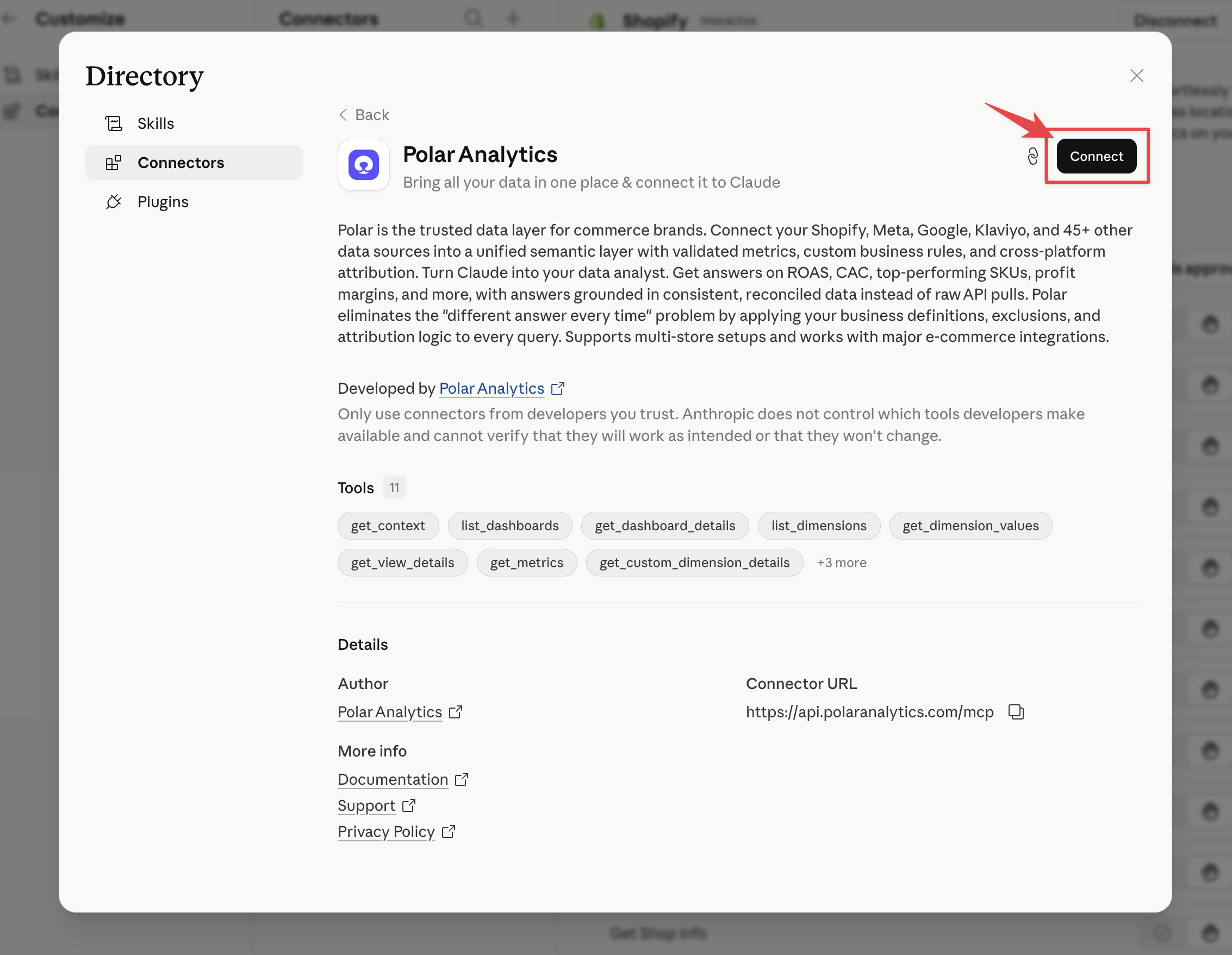
You can also find it from your Claude account under Customize → Connectors. Click Connect, sign in to Polar, and authorize Claude. That's it no URL to copy, no manual configuration.
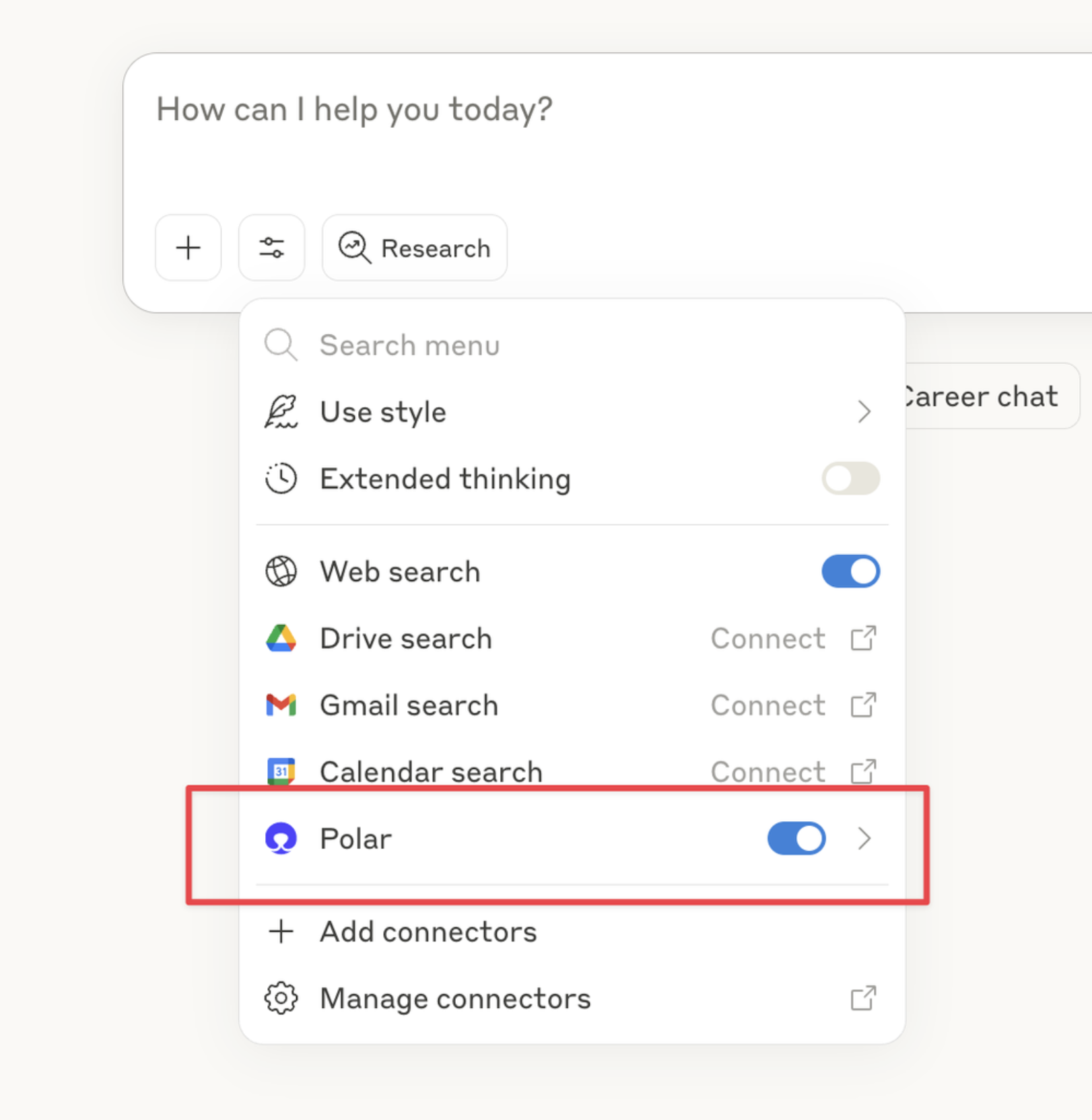
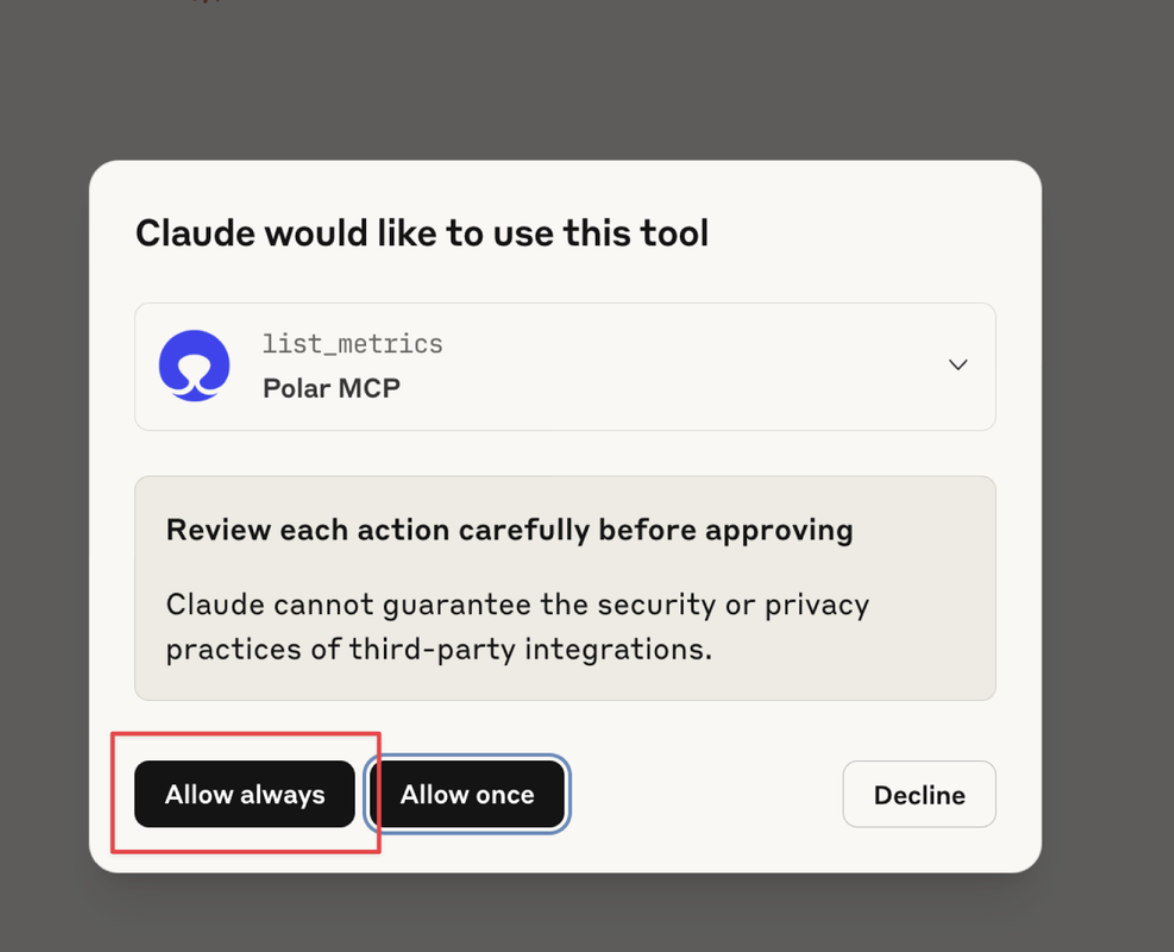
Full walkthrough with screenshots in Use Polar MCP in Claude.
If you're completely new to Polar and haven't connected data sources yet, the MCP setup will prompt you to connect at least one. The initial historical sync can take up to 24 hours you'll get an email when it's ready.
2. Install the Claude app in your Slack workspace.
This is the official Anthropic app in the Slack directory. Your Slack admin may need to approve it depending on your org's app policy. Once installed, connect it to your Claude account.
3. Authorize the MCP in Slack and ask your first question.
Inside Slack, confirm the Polar connector is enabled for the Claude app. Then DM Claude directly, or @-mention it in a channel, and ask:

What were our top 5 products by net sales last month?
Claude will hit the Polar MCP, run a generate_report tool call against the semantic layer, and reply in Slack with the numbers. First time it runs, you'll approve the tool call. After that it's just chat.
One tip worth building into your workflow: when Claude returns a number, glance at the tool call details before you forward it to your CEO. Date ranges and chosen metrics are visible, and confirming them takes two seconds. Every LLM gets date math wrong sometimes. Polar's MCP now returns totals and timezone context inside each report so Claude has clear bounds, but a quick sanity check is a free habit.
Real questions you can ask today
A non-exhaustive menu of questions that work well, grouped by who typically asks them. Every metric below lives in Polar's modeled layer Claude pulls the consolidated number, not a reconstruction.
Acquisition & paid media
- What's our blended ROAS and blended CAC this week vs. last?
- Which Meta campaigns had the highest ROAS in the past 30 days?
- Top 10 Google Ads campaigns by POAS this quarter?
- TikTok spend trend over the last 60 days, by campaign?
- What's our MER for new customers only in Q1?
Growth & retention
- New-customer AOV vs. repeat-customer AOV over the last 90 days?
- What's the 60-day LTV for customers acquired from Meta vs. Google?
- Repeat purchase rate by first-order product in the past 180 days?
- LTV:CAC ratio by channel this quarter?
- Top products driving second orders for customers who first bought in December?
Merchandising & product
- Which SKUs have the best gross margin this month?
- Top 10 products by net sales, excluding returns, last 30 days?
- Which products have the highest discount rate and what's their CM2?
- Inventory snapshot which items are trending to stock out?
Email & SMS
- Klaviyo flow revenue vs. campaign revenue this month?
- Which flows had the highest placed-order rate in Q1?
- Revenue per received email for campaigns, trending?
- Attentive SMS subscribers growth rate last 30 days?
Finance & exec summary
- Net sales by country for last month, using Billing Address?
- CM3 and CM3% by channel for the current quarter?
- Gross margin trend, monthly, last 6 months?
- Can you look at our Weekly Executive dashboard and summarize the top three movements?
That last one matters. Claude can pull any Polar dashboard or report by name through the MCP. If your team already has a weekly exec dashboard built in Polar, you don't need to rebuild it in prompts just reference it.
Where this is headed
The bigger picture: every operator is going to end up with Claude open somewhere. The question is whether their Claude can see their business.
We think Polar is the answer to that question for ecommerce. Your Shopify, Meta, Google, Klaviyo, Amazon, TikTok, Recharge, and every other source gets modeled once in Polar, and then shows up consistently, with the same definitions everywhere Claude operates.
Today, Slack.
Already shipped: Claude Desktop, Claude Web, Claude Code, Claude Cowork, Claude in Chrome, Claude in Excel. Up next: more agentic surfaces as Anthropic keeps shipping.
One connection, every surface.
That's the thesis, and Slack is the first of many proofs of it. Full version in Polar is the Ecommerce Connector for Claude
Table of contents
Frequently asked questions