The 8 Best AI Data Analysts for Ecommerce in 2026

TL;DR
- Best overall for Shopify brands that want answers they can trust across every channel: Polar Analytics. It is the only tool here that pulls, models and acts on your data on a standard plan, without an Enterprise contract or a vendor-built project.
- Best for company-wide BI beyond commerce (finance, product, operations) on a warehouse you already run: Omni.
- Best for brands that need Walmart and long-tail marketplace connectors out of the box: Saras iQ.
- Best for teams already working in Claude or ChatGPT: Claude or ChatGPT + an MCP server.
- Best for a one-off file or spreadsheet: Julius AI.
- Best free option inside the Shopify admin: Shopify Sidekick.
Last updated: November 2026. Written by the Polar Analytics team. Polar is on this list. Every tool, Polar included, is rated from its public website, docs and pricing page with the same rules: see "How we compared these tools".
Ask an ecommerce team what they sold last week and you often get three answers. One Shopify merchant described it on Reddit this fall: "Sessions, conversion rate and add to cart numbers seems to have changed quite a bit, but my actual orders are more or less the same." In another thread, about an order a customer credited to ChatGPT while Shopify logged it as direct traffic, the most upvoted reply was blunter: "Trying to make sense of attribution is a fools errand."
That mess is what an AI data analyst inherits. An AI data analyst is only as good as the data behind it. Two tools can use the same model and give you two different contribution margins, because one reads a semantic layer (one agreed formula per metric) from a warehouse and the other guesses from raw tables.
The best AI data analyst for ecommerce is Polar Analytics for Shopify brands that need one trusted set of numbers across store, ad, marketplace and email data. Omni fits teams with their own warehouse. We rated eight tools on accuracy, ease of use and extensibility: can the tool pull your data, model it the way your business counts, and think on it.
Best AI data analyst by need
| If you are... | Pick |
|---|---|
| A Shopify brand selling across DTC, Amazon and ad channels, with no data engineer | Polar Analytics |
| A $10M+ brand that wants a dedicated Snowflake database, governed metrics and agents | Polar Analytics |
| A company that wants one BI tool for finance, product and operations, on a warehouse it already runs | Omni |
| An enterprise retailer with a BI team | Polar Analytics |
| A founder of a $1M to $10M store who mostly wants to chat | Polar Analytics |
| Already working in Claude or ChatGPT all day | Claude or ChatGPT + an MCP server |
| Analyzing one CSV export | Julius AI |
| A small store with Shopify-only questions | Shopify Sidekick |
What is an AI data analyst for ecommerce?
An AI data analyst for ecommerce is software that answers business questions in plain English from your store, ad, email, marketplace and finance data. You will also see it called AI ecommerce analytics, conversational analytics or an ecommerce AI agent. A good one gives the same number as your P&L, shows which definition it used, and works on its own when nobody is asking.
Under the chat box, every AI data analyst does three jobs:
- Pull the data: connect Shopify, Meta, Google, TikTok, Klaviyo, Amazon and the long tail of sources your brand uses.
- Model the data: turn raw tables into metrics with one definition each, such as net revenue, new customer CAC or contribution margin.
- Think on the data: answer in several steps, remember your business, run checks on a schedule and propose what to do next.
Most tools are good at one or two of these. The weak step decides how far you can trust the answer.
Why the warehouse and semantic layer decide the answer
A language model does not know how your business defines "net revenue" or "new customer". If it reads raw tables or a CSV export, it writes its own formula every time, and the formula can change when you rephrase the question. That is why ChatGPT on a Shopify export often disagrees with your dashboard.
Two layers fix this:
- A warehouse keeps all your sources in one place, joined at the order level, with history. Without it, the AI only sees what one platform's API returns at query time.
- A semantic layer stores one definition per metric: which orders count, how refunds and discounts are handled, which costs go into contribution margin. The AI picks the metric from that layer instead of inventing SQL.
When both are in place, the number in the chat, in Slack and in the dashboard comes from the same definition. When they are missing, every answer needs a second check. Before you buy any AI analyst, ask the vendor: "Where is this metric defined, and who can change the definition?"
How we compared these tools
We did not give decimal scores. A score like 8.4/10 suggests a precision that a vendor-written comparison cannot honestly claim. Instead, we rated each tool Strong, Partial or Weak on three criteria, and we say why in every cell.
| Criterion | What we checked |
|---|---|
| Accuracy | Metrics have one governed definition, and the AI answer traces back to it |
| Ease of use | A business user gets an answer without SQL, a data engineer or a long setup |
| Extensibility: pull | Native ecommerce connectors, plus a way to add a source that is not on the list |
| Extensibility: model | You can create or change a metric, and the AI can help do it |
| Extensibility: think | Multi-step reasoning, memory, scheduled work and proposed actions with approval |
| Plan | Each rating names the plan that includes the capability, so tools are compared on the same terms |
We rated every tool, Polar included, only on what its public website, documentation, changelog and pricing page showed on November 25, 2026. We did not run hands-on tests for this guide. When a capability is not documented, we rate it low rather than guess, for Polar as for everyone else. We have not run a like-for-like accuracy benchmark on every product, so use this table to build a shortlist, then run the five questions at the end of this guide on your own data.
AI data analyst comparison table
| Tool | Accuracy | Ease of use | Extensibility: pull | Extensibility: model | Extensibility: think | Starting price |
|---|---|---|---|---|---|---|
| Polar Analytics | Strong: 400+ prebuilt ecommerce metrics in a semantic layer | Strong: in the app, Slack, Teams, email, Claude and ChatGPT | Strong: 40+ connectors, AI Data Engineer builds new ones | Strong: custom metrics and dimensions on your own rules | Strong (Core plan): Operator with memory, scheduled audits, actions with approval | Priced on annual GMV |
| Omni | Strong once your team models it | Partial: needs a warehouse and a data team | Weak: no native ecommerce connectors | Strong: Modeling Agent helps your team build metrics | Partial: routines to Slack, no actions in other tools documented | Not public |
| ThoughtSpot (Spotter) | Strong once your team models it | Partial: built for BI teams | Weak: no native Shopify or ad connectors | Strong: SpotterModel helps data engineers build models | Partial: multi-step analysis, writes need approval | From $25/user/month, billed annually |
| Saras iQ | Strong: certified ecommerce metrics | Partial: custom layers on Enterprise, set up with a Saras contact | Strong: 200+ connectors | Partial on Essentials, Strong on Enterprise (custom semantic layer) | Partial on Essentials (scheduled reports "coming soon"), Strong on Enterprise (agents for retention and marketing) | iQ Essentials $1,999/month; Enterprise on request |
| Claude or ChatGPT + MCP | Depends on the MCP behind it | Strong: the AI tool your team already uses | Depends on the MCP | Weak: no metric layer of its own | Partial: strong reasoning, scheduling is up to you | Claude Pro $20/month, plus the data source |
| Luca AI | Partial: context layer, no governed metric layer documented | Strong: chat-first for founders | Partial: Shopify, Amazon, Meta, Google, accounting tools | Weak: metric editing not documented | Strong: alerts, scheduled reports, actions with approval | From £450/month |
| Julius AI | Weak: no semantic layer, the AI writes each formula | Strong: upload a file and ask | Partial: Meta Ads, Google Ads, databases, files; no Shopify connector listed | Weak: no metric layer | Partial: scheduled runs, no actions | Free plan, then Plus at $20/month |
| Shopify Sidekick | Partial: Shopify's own definitions, Shopify data only | Strong: free, already in the admin | Weak: Shopify data only | Weak: no editable metric layer | Partial: multi-step tasks and admin actions, no scheduled analysis | Included in Shopify plans |
All ratings come from each vendor's public website, docs and pricing page on November 25, 2026. User review scores come from G2 and the Shopify App Store on the same day. Prices change often: check the vendor's pricing page before you buy.
The 8 best AI data analysts for ecommerce
1. Polar Analytics
Best for: Shopify brands selling across DTC, marketplaces and paid channels that want AI answers and agents on numbers the whole team trusts, without hiring a data team.
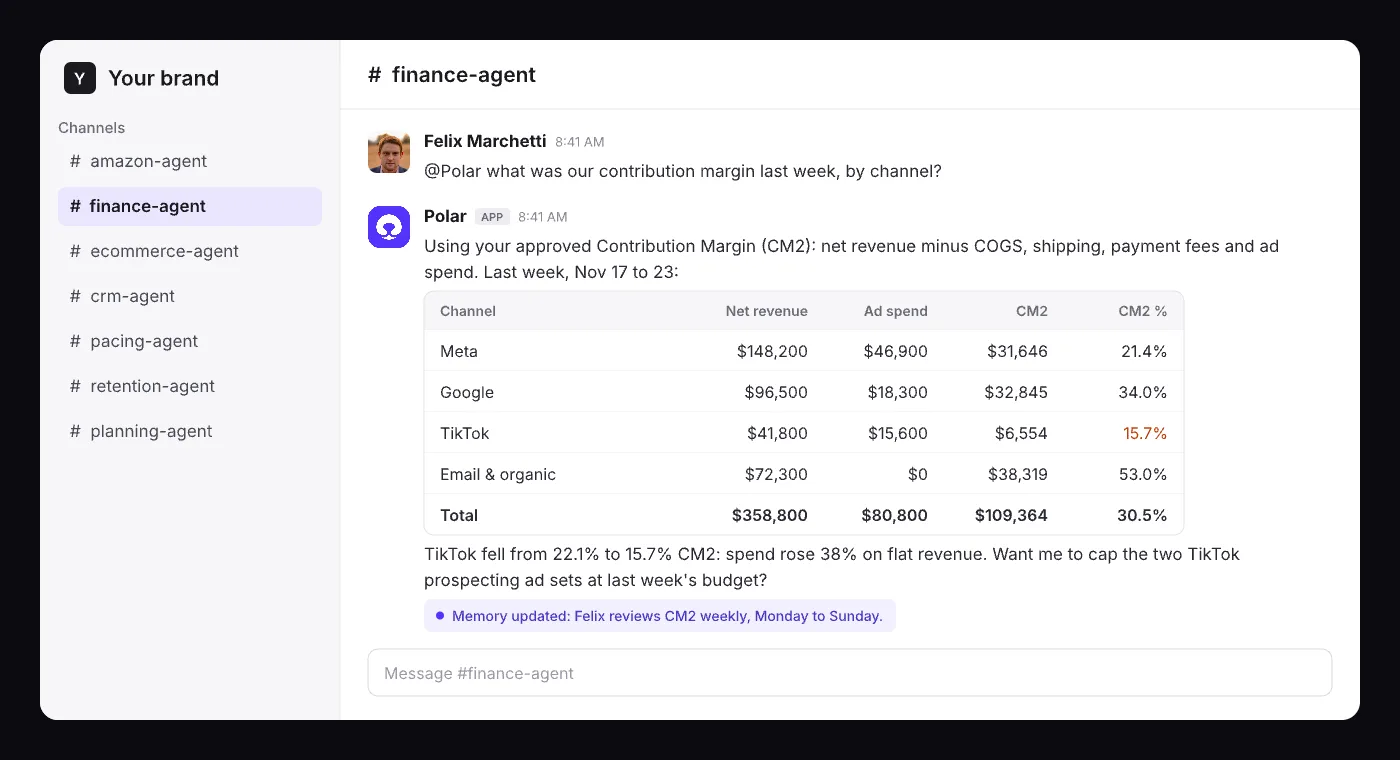
Polar Analytics (Polar) is an AI data platform for commerce brands on Shopify. It brings Shopify, Amazon, Meta, Google, TikTok, Klaviyo and 40+ other sources into a dedicated Snowflake database for each brand. On top sits a semantic layer with 400+ ecommerce metrics, such as blended CAC, contribution margin and LTV, each defined once. Your team adapts them to its own rules with custom metrics and dimensions.
Three agents work on that data:
- AI Data Engineer (pull). Describe a source that is not in the connector list, and it builds the connector.
- AI Data Analyst (answer). Ask a question in plain English and get the number, the chart and the definition behind it.
- Polar Operator (think and act). It reasons in several steps, keeps a memory of your business, runs audits and reports on its own, and proposes actions that run once you approve them, in the app, Slack, Teams or email.
The Polar MCP brings the same governed data into Claude, ChatGPT and any MCP-compatible tool, so an answer in Claude matches the dashboard.
| Pros | Cons |
|---|---|
| Answers trace back to the same metric definitions as your dashboards | No free plan, and pricing rises with GMV |
| Adds sources on request instead of making you wait for a connector roadmap | Operator usage runs on credits (40,000 free to start) |
| Works when nobody is asking: scheduled audits, alerts and digests | Shopify is the only supported core store |
Pick another tool if: you do not sell on Shopify, or your data team wants to hand-build every model in its own BI tool.
Pricing: priced on your annual GMV. The Operator is included in the Core plan, and its usage runs on credits.
User reviews: 4.9/5 on the Shopify App Store (116 reviews) and 4.7/5 on G2 (23 reviews).
In practice: Jones Road Beauty, a nine-figure beauty brand, moved its data to a dedicated Snowflake warehouse with Polar and connected it to Claude through the Polar MCP. Today 13 of its 17 team members query Polar through Claude, running 130+ analyses a month, with one in-house data lead. "We have one data analyst and in the past it used to take two weeks to get a report," said CEO Cody Plofker. Read the Jones Road Beauty case study.
2. Omni
Best for: companies that want one BI tool for finance, product and operations, on a warehouse they already run.
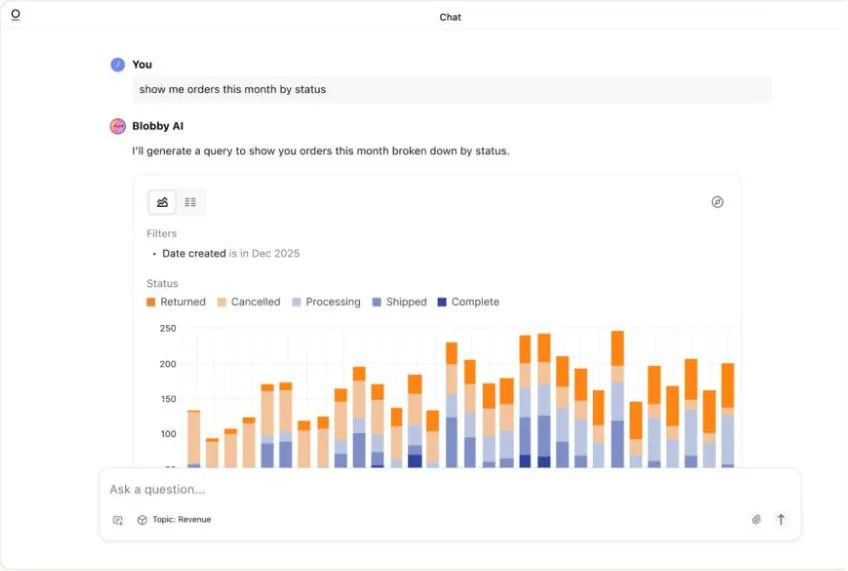
Omni is a BI platform built on a shared semantic model. Its Modeling Agent helps your team build metrics, and the Omni Agent answers questions in chat, in Slack and through an MCP server. In 2026 it added scheduled routines delivered to Slack and reusable Skills.
| Pros | Cons |
|---|---|
| Strong governed model, and AI that helps maintain it | No native Shopify or ad platform connectors: you need a warehouse and pipelines first |
| MCP server for Claude, ChatGPT and Cursor | Ecommerce metrics are yours to define from scratch |
| Fast-moving agent roadmap |
Pick it over Polar if: ecommerce is one data domain among many and your BI covers the whole company. Pick Polar if commerce is the business: Polar ships the pipelines, the Snowflake database and 400+ ecommerce metrics, and your data lead spends time on analysis instead of plumbing.
Pricing: not published on Omni's website.
User reviews: 4.8/5 on G2 (74 reviews).
3. ThoughtSpot (Spotter)
Best for: enterprise retailers where ecommerce is one part of a larger business and a BI team owns the model.
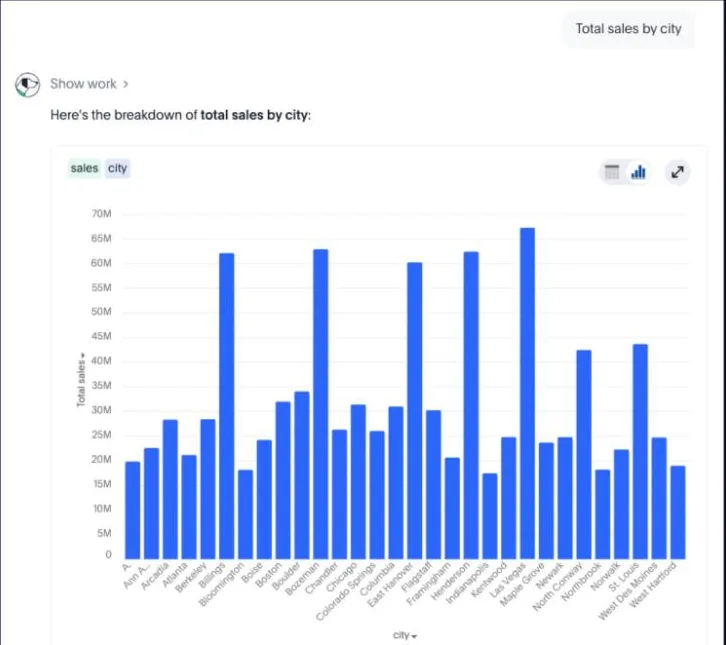
Spotter is ThoughtSpot's AI analyst. It answers questions on a semantic layer your data team builds, with multi-step analysis and memory. Anything that writes to another app waits for user approval.
| Pros | Cons |
|---|---|
| Enterprise governance and security | No native Shopify or ad connectors |
| Agentic MCP server for outside AI tools | Spotter queries are capped on the Pro plan |
Pick it over Polar if: your BI team already models retail data in a cloud warehouse. Pick Polar if you are a commerce brand without a data engineer.
Pricing: Essentials from $25 per user per month, billed annually.
User reviews: 4.4/5 on G2 (363 reviews).
4. Saras iQ
Best for: brands that need Walmart and long-tail marketplace connectors out of the box.
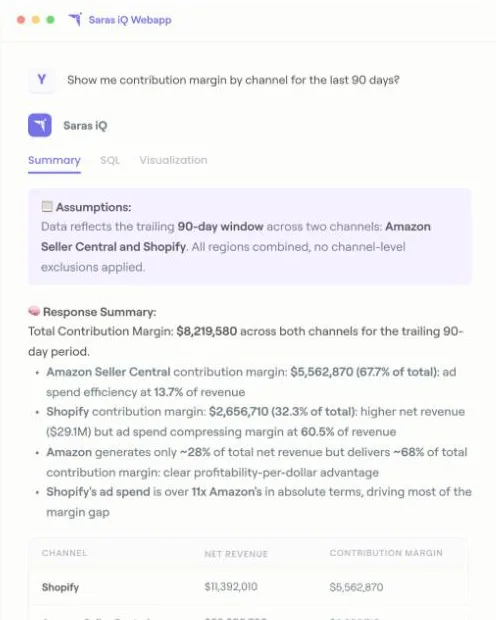
Saras pairs its Daton pipelines (200+ connectors) with certified ecommerce data and an AI layer, iQ, with an MCP for outside tools. A custom semantic layer, a custom context layer and AI agents for retention and marketing come with the Enterprise plan.
| Pros | Cons |
|---|---|
| Wide connector catalog, including marketplaces | Scheduled report agents are listed as "coming soon" on the entry plan |
| Certified data checks | Custom metrics and agents need the Enterprise plan |
Pick it over Polar if: your sales run through many long-tail marketplaces that Polar does not connect yet. Pick Polar if you want custom metrics, new sources and an operator on a standard plan, changed by your own team or the AI Data Engineer.
Pricing: iQ Essentials at $1,999/month; Enterprise on request.
User reviews: Saras iQ has no G2 reviews yet. Saras's Daton pipeline is rated 4.7/5 on G2 (37 reviews).
5. Claude or ChatGPT + an MCP server
Best for: teams that already work in Claude or ChatGPT all day.
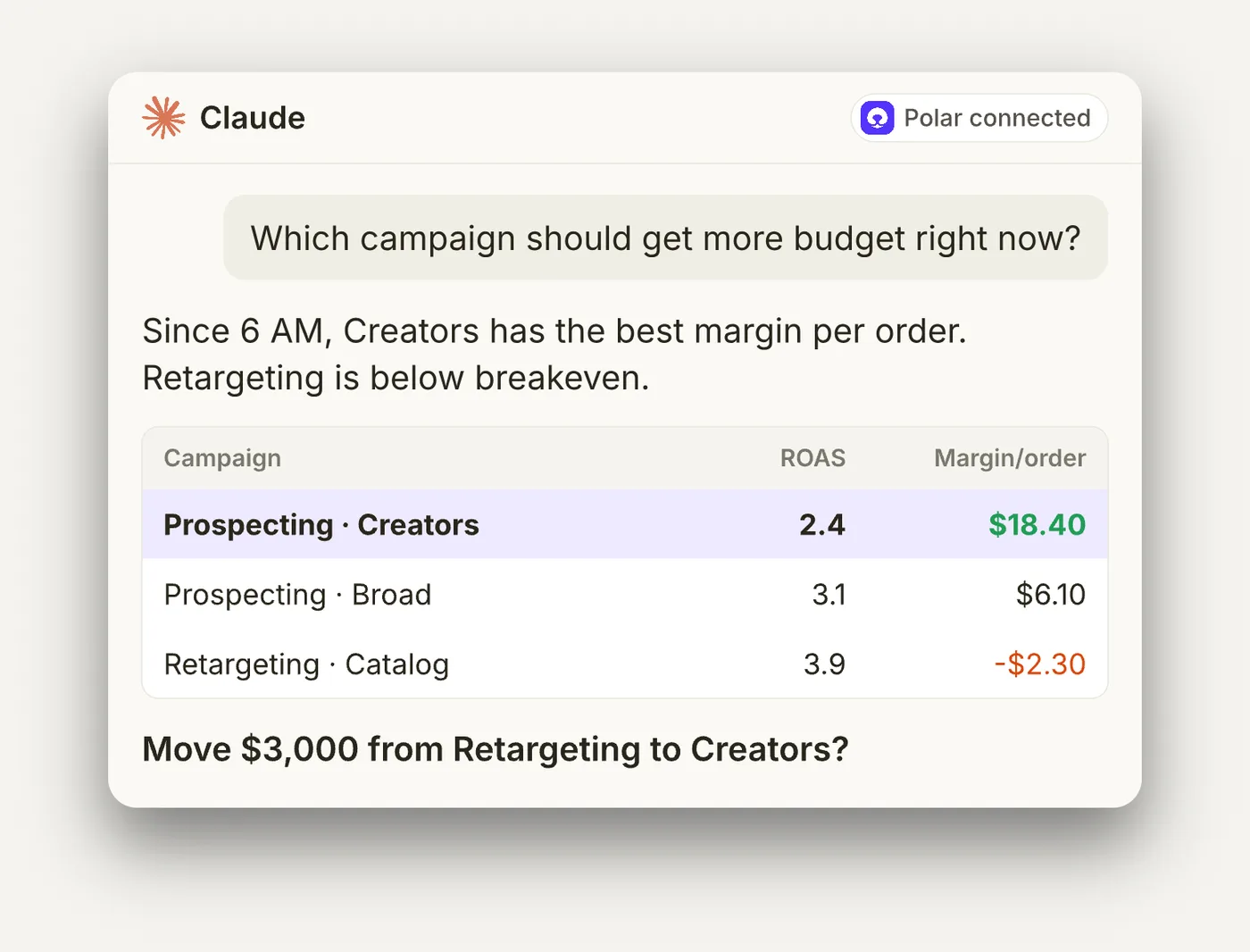
The Model Context Protocol (MCP) lets an AI assistant query another tool. Connect an ecommerce MCP server and Claude or ChatGPT can read live store and ad data instead of a stale export. The answer is only as good as the MCP behind it: if it serves raw tables, the model still writes its own formulas.
| Pros | Cons |
|---|---|
| The AI tool your team already pays for | No metric layer of its own |
| Mix store data with docs, email and other tools in one chat | You build and maintain the prompts, schedules and workflows |
| Custom MCP servers depend on the plan (on ChatGPT, Business, Enterprise and Pro with limits) |
This is not either-or: Polar is an official Claude and ChatGPT connector, so the chat reads the same governed metrics as the Polar app.
Pricing: Claude Pro is $20/month and ChatGPT Plus is $20/month, plus the data source behind the MCP.
6. Luca AI
Best for: founders who want a chat-first analyst with accounting data (Xero, QuickBooks) at a fixed public price.
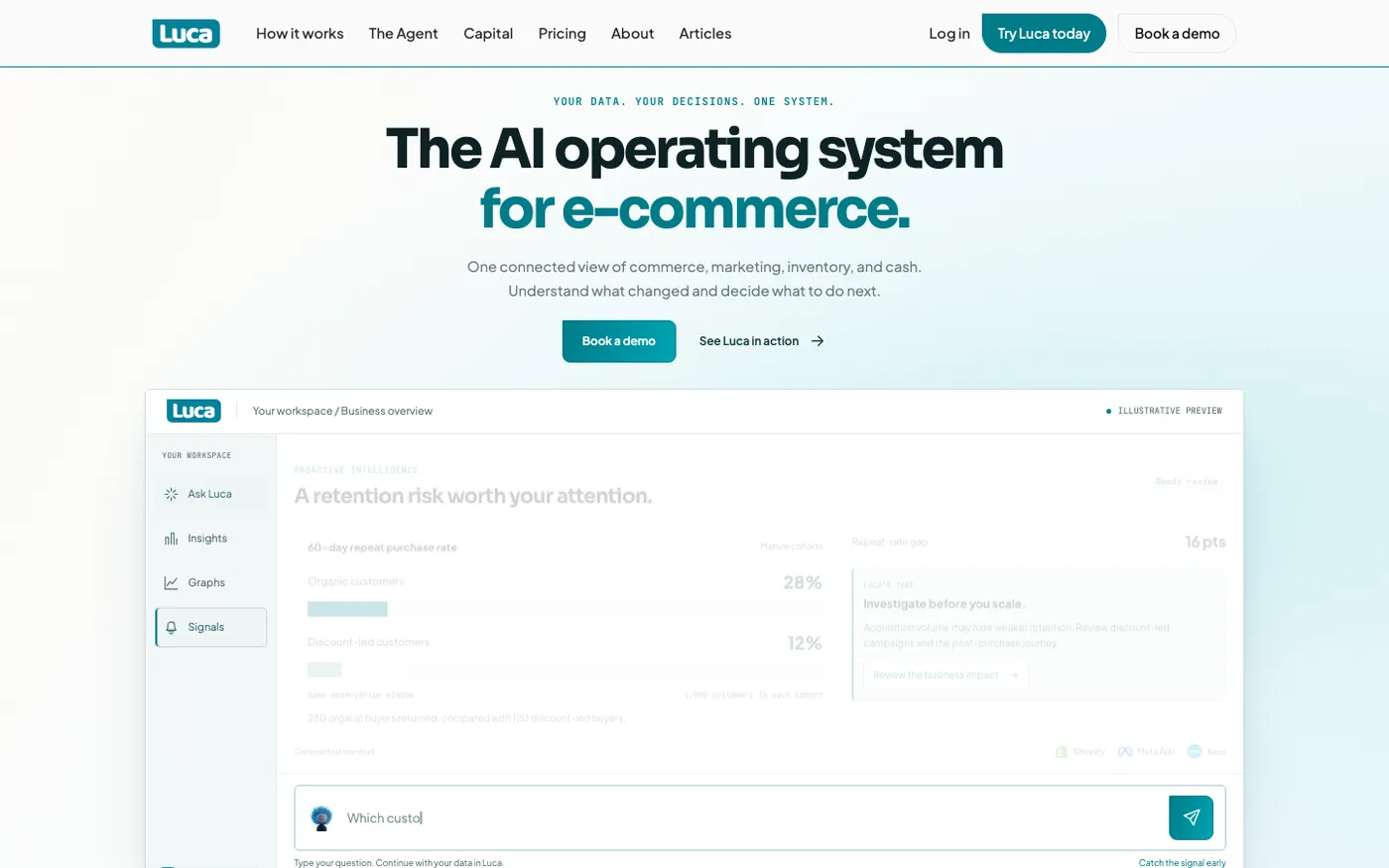
Luca is a chat-first analyst that joins commerce, marketing and finance data. It sends proactive findings, threshold alerts and scheduled reports by web, Slack, email or WhatsApp, and proposes actions that run after review.
| Pros | Cons |
|---|---|
| Built for non-analysts | No governed metric layer documented |
| Finance data (Xero, QuickBooks) next to store data | No MCP documented |
| Public pricing and a free trial |
Pick it over Polar if: you are a founder who mostly asks why numbers moved, at a fixed public price. Pick Polar if several teams need the same numbers in dashboards, Slack and their own AI tools.
Pricing: from £450/month (Founder plan).
7. Julius AI
Best for: one-off analysis of a CSV or spreadsheet.
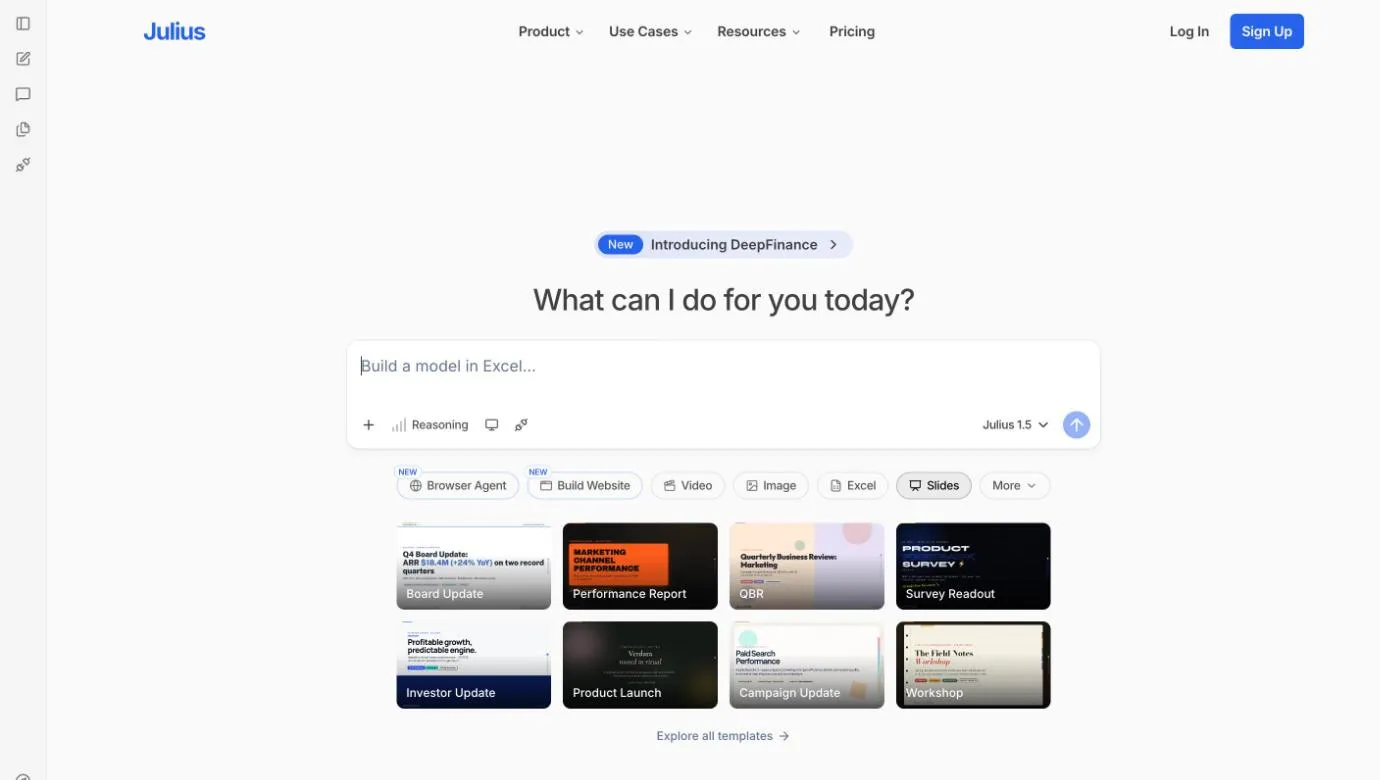
Julius is a general AI workspace for data analysis: upload a file or connect a database and ask questions, with charts in the answer. It connects Meta Ads, Google Ads and databases, but no Shopify connector is listed.
| Pros | Cons |
|---|---|
| Fast for a single question on a file | No semantic layer: the AI decides how to calculate each metric, so results can differ from your reports |
| Scheduled runs (3 on Free, unlimited on Pro) | File exports are stale as soon as you download them |
| Free plan to start |
Pick it over Polar if: you have one file to analyze and no need for live data or recurring reports.
Pricing: free plan, then Plus at $20/month, Pro at $45/month and Business at $450/month.
8. Shopify Sidekick
Best for: small stores that want quick answers and tasks inside the Shopify admin.
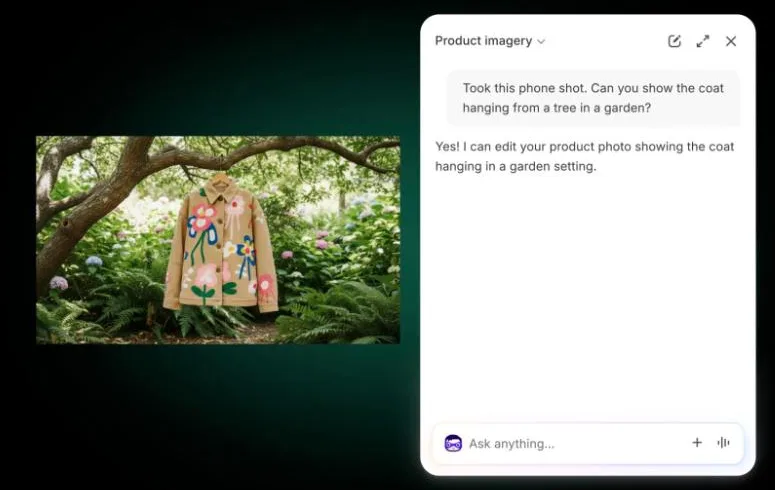
Sidekick is Shopify's built-in AI assistant. It answers questions on Shopify data, runs multi-step tasks in the admin, and suggests what to do next.
| Pros | Cons |
|---|---|
| Free and already in your admin | Sees Shopify data only, not your ad spend, email or costs |
| Takes actions in Shopify (discounts, products, collections) | No contribution margin or blended ROAS without that data |
Pick it over Polar if: your questions are only about Shopify sales and products.
Pricing: included in Shopify plans.
AI data analyst vs. AI operator: from answers to action
An answer is useful. An answer that arrives before you ask, with the fix ready to approve, is what saves a Monday. That is the step from AI data analyst to AI operator.
An operator does three things an analyst does not:
- It runs on its own. Standing audits and digests run every morning or week, without a prompt.
- It remembers. Corrections and preferences are kept, so the next answer starts from your rules, not a blank chat.
- It acts, with approval. It proposes the change in your tools, and nothing runs until a person approves it.
Typical first jobs for a Shopify brand:
- Morning pacing: yesterday's revenue, orders and blended ROAS vs. target, posted in Slack at 8am.
- Leak detection: an ad that keeps spending on a landing page that returns a 404, or a Klaviyo flow that stopped sending.
- Weekly marketing review: spend, revenue and contribution margin by channel, with what changed and why.
Each of these jobs is only as safe as the data under it. An operator that acts on the wrong margin does harm faster than a human could. That is why the Polar Operator works from the same semantic layer as your dashboards, and why we put accuracy first in this guide.
AI data analyst vs. hiring a data analyst
| AI data analyst | Data analyst hire | |
|---|---|---|
| Cost | A software subscription | A full salary plus benefits |
| Time to first answer | Hours to days after connecting data | Weeks to hire, then onboarding |
| Availability | Any hour, plus scheduled work | Working hours, one request at a time |
| Business judgment | Limited to the data and context it has | Weighs context the data does not show |
| Best at | Recurring questions, monitoring, fast answers | New analyses, strategy, explaining results to the team |
The two are not exclusive. At Jones Road Beauty, one data lead serves the whole company because the team asks Claude directly, and he spends his time on the work only a person can do.
5 questions to test any AI data analyst on your own data
A demo always looks good. Ask these five questions during a trial, on your own data, with the same date range, currency and attribution settings in every tool.
| Question | What a good answer includes |
|---|---|
| What was my contribution margin last week, by channel? | Revenue minus COGS, shipping, fees and ad spend, by channel, matching your P&L |
| Why did revenue drop yesterday? | The driver (traffic, conversion rate or AOV), the channel or product behind it, and a comparison to the same day last week |
| What is my blended ROAS today vs. the last 7 days? | Total revenue over total ad spend across all platforms, not each platform's own ROAS |
| Which customer cohort has the best 90-day LTV? | Cohorts by first-order month or first product, with repeat rate and revenue per customer |
| Which products will stock out in the next 30 days? | Inventory, sales velocity and days of stock left per SKU |
If two tools give two answers to the first question, ask each one where the metric is defined. Our guide to the ecommerce semantic layer shows what that definition should contain.
Disclosure: Polar wrote this guide
Polar Analytics wrote this guide and ranks itself first. Here is what we did to keep it useful:
- We compared every tool on the same three criteria and published every rating, with the reason.
- We gave no decimal scores, because we cannot back that precision.
- Polar has a "Pick another tool if" line, and every other tool has a "Pick it over Polar if" line.
- Every tool, Polar included, is rated only from its public website, docs and pricing page.
If something about your product is wrong, email us and we will fix it.
See it on your own data
Ask Polar the five questions above on your store's data. Book a demo.
Table of contents
Frequently asked questions
What is the best AI data analyst for ecommerce?
Polar Analytics is the best AI data analyst for Shopify brands that need answers across store, ad, marketplace and email data. Its AI reads metrics from a governed semantic layer in a dedicated Snowflake database for each brand. Its Operator runs scheduled audits and proposes actions with approval. Omni is the pick for data teams that already run their own warehouse.
What is an AI data analyst?
Software that answers business questions in plain English from your data, explains why a number moved, and can run analyses on a schedule. For ecommerce, it needs your store, ad, email and marketplace data in one place, with one definition per metric.
Can ChatGPT or Claude be my ecommerce data analyst?
Yes, with an MCP server that connects them to live, well-defined store data. On a raw CSV export, ChatGPT data analysis is fast but may calculate metrics differently from your reports.
Why do AI analytics tools give different numbers?
Because each tool defines the metric differently, or lets the model write its own formula. A semantic layer stores one definition per metric, so every answer uses the same one.
Which AI data analyst connects Shopify, Meta and Google together?
Polar connects Shopify, Meta, Google and 40+ other sources in one warehouse, and its AI analyst, Operator and MCP read them together. Saras iQ and Luca also combine store and ad data.
Do I need a data warehouse for an AI data analyst?
You need your data joined and defined somewhere. Tools like Omni and ThoughtSpot expect you to bring your own warehouse and pipelines. Polar includes a dedicated Snowflake database for each brand, so there is no warehouse project to run first.
What is the difference between an AI data analyst and an AI operator?
An analyst answers when you ask. An operator also works when nobody is asking: it runs scheduled audits, remembers your business context and proposes actions in your tools that run once you approve them.